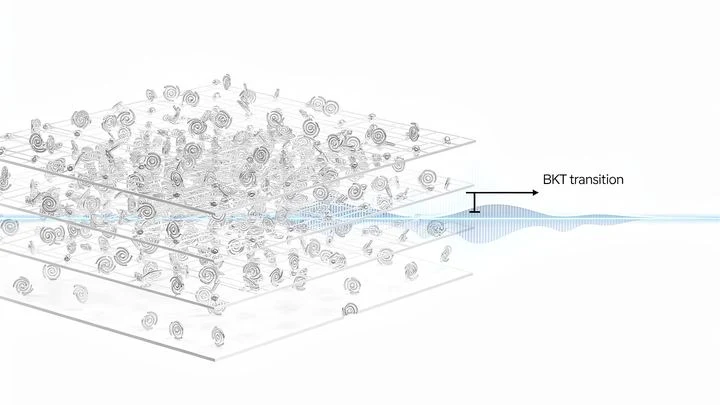
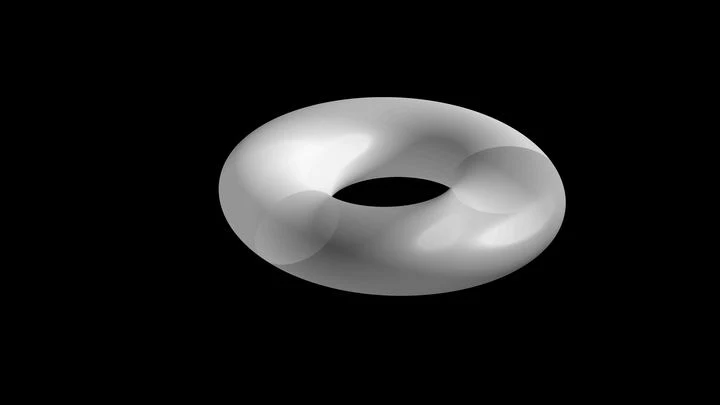
An excitoncondensate is a quantum state of matter formed when electron-hole pairs (excitons) condense into a single coherent quantum state, analogous to a Bose-Einstein condensate. Unlike ordinary condensates of atoms, excitons are composite bosons that can be created and manipulated in semiconductor structures. This state exhibits macroscopic quantum coherence, meaning the entire condensate behaves as a single quantum object, and can support topological excitations such as quantized vortices.
History
The concept was proposed by John Blatt, K. W. Böer, and Werner Brandt in 1962, and independently by L. V. Keldysh and A. N. Kozlov in 1968. Experimental evidence for excitoncondensation was first obtained in coupled quantum wells in the 2000s.
How it works
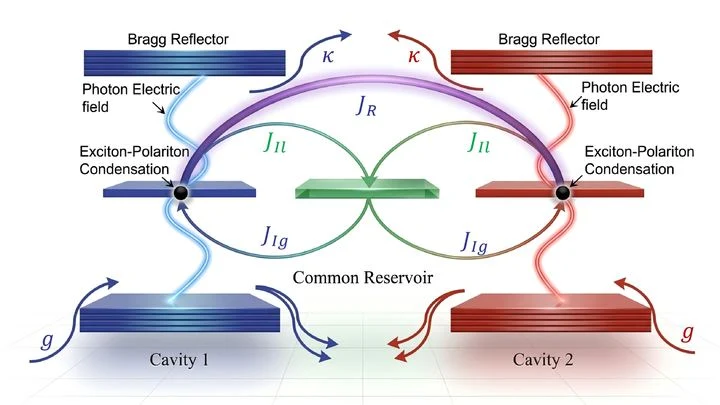
Excitons are created when light excites an electron from the valence band to the conduction band, leaving a positively charged hole. In a semiconductor, these pairs can bind together via Coulomb attraction, forming a bosonicquasiparticle. When cooled to low temperatures and at sufficient density, these excitons can undergo Bose-Einstein condensation, where a macroscopic number of them occupy the same quantum state. The condensate's phase is coherent across macroscopic distances, and its excitations include sound-like modes and vortices.
In practice
Excitoncondensates are studied for potential applications in quantum computing and simulation, as they could serve as a platform for topological quantum bits and coherent light sources.
Fun fact
In an excitoncondensate, the flow of excitons can be dissipationless, similar to superfluidity in liquid helium, but with the added ability to be controlled by electric fields.
Three voices merging into a single chord. In the physics of quantum materials, this image takes on a literal meaning: three layers of graphene, separated by thin spacers, force electrons and holes from different layers to move as a single fluid.
Three voices merging into a single chord. In the physics of quantum materials, this image takes on a literal meaning: three layers of graphene, separated by thin spacers, force electrons and holes from different layers to move as a single fluid.
An empty dance floor where people occasionally appear. Each moves on their own, chaotically, with no connection to the others. But when the right music starts and the hall cools down a bit, the dancers suddenly begin to form long chains and move in unison. That's roughly how electrons behave in a dilute three-dimensional gas.
A copper oxide crystal looks like a dark red pebble. But when a short laser pulse hits it, pairs are born inside: an electron and a 'hole'—a place where an electron is missing. Such a pair is called an exciton and behaves almost like a hydrogen atom: the particles circle each other, bound by electric attraction.
The quantum world is often compared to a musical instrument. Electronic bands in a crystal are like strings, each with its own pitch. Usually, if the strings are tuned simply, without tricky interlacing, then the sound produced by their combined motion remains simple.
In the first moments after the Big Bang, the universe resembled a boiling cauldron. According to one hypothesis, dark matter, the invisible substance that holds galaxies together, could have been born there.
Take two thin sheets of a semiconductor. One is saturated with free electrons, like a packed café where every table is taken. The other, by contrast, is full of empty spots—'holes' eager to be filled. When these sheets are brought close together, a spark of attraction jumps between them: electrons and holes begin to feel each other across the thin gap.
A massive aluminum cylinder weighing a ton hangs in a vacuum. A gravitational wave, a ripple in spacetime, passes through it, and the bar begins to tremble almost imperceptibly. That trembling can be heard as sound: gravitational waves turn into a phonon — a quantum of sound vibrations.
Water in a glass looks continuous, but it's made of molecules. Similarly, physicists have long described the matter inside a neutron star as a uniform soup of protons and neutrons. But real neutron stars are not soup. They are a dense crowd of particles where each neutron feels its neighbors.
The authors of the new work abandoned the uniform picture.
The most abundant construction material on Earth, concrete, hides its deepest secrets at nanometer scales. Its strength and tendency to creep slowly under load are governed by a microscopic gel of calcium silicate hydrate (C-S-H), whose structure is as chaotic as a frozen vortex of atoms.
In 1984, the world of crystallography was turned upside down: sharp diffraction peaks with fivefold symmetry were discovered in an alloy of aluminum and manganese – as if nature had mocked the strict theorems forbidding repeating patterns from having axes of order 5, 8, 10, or 12.
At the center of many galaxies lurks an invisible cloud — a halo of dark matter. If this matter is cold and light enough, it behaves like a superfluid: it flows without friction, and any rotation in it twists into tiny quantum vortices — threads the size of an atomic nucleus.
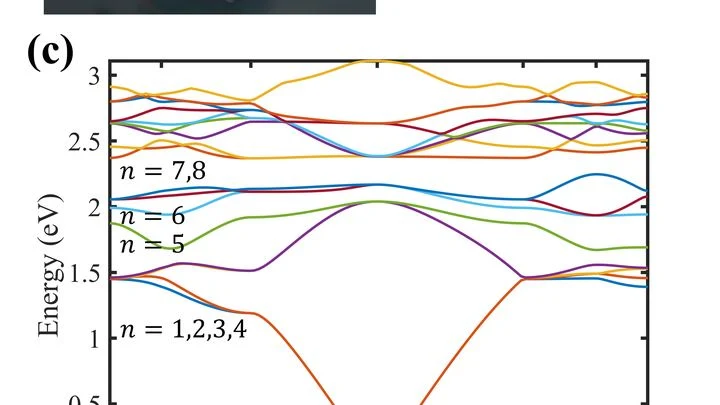
Musicians in an orchestra each play their own part, not hearing the others. In a perfect crystal of tungsten disulfide on graphene, excitons, bound electron-hole pairs, behave the same way: they barely mix due to a hidden symmetry called the valley. The energy levels of such a system resemble notes sorted into separate folders — the chaos is incomplete.
At temperatures billionths of a degree above absolute zero, a Bose–Einstein condensate emerges — a state where thousands of atoms march in a single quantum key.
Light gets trapped in a crystal lattice, but not an ordinary one: it's turned inside out, like a honeycomb where instead of wax there's emptiness, and the edges are made of material. That's how an inverted opal is built: a three-dimensional photonic crystal that blocks light of certain colors.
A pendulum that swings on its own, without any winding — in the quantum world, such 'pendulums' are called time crystals. In them, rhythmic motion arises spontaneously and does not decay. But until now, controlling this rhythm was nearly impossible: any intervention threatened to destroy the fragile order.
A lone potassium atom enters a dense cloud of sodium atoms cooled to near absolute zero. Such a medium is called a Bose–Einstein condensate — all particles merge into a single quantum wave. One might expect the impurity to simply pick up a single neighbor and form a pair. But the experiment showed something else.
In the quantum world, particles can merge into a single liquid that flows without friction. One of its most mysterious forms is the fractional quantum Hall liquid. In it, electrons or atoms move as a single vortex, and their charge splits into fractions, like a pie cut into perfectly equal slices.
A pot of water always boils the same way: hit 100 degrees and bubbles start. Quantum fluids are different. When a cloud of atoms is cooled to near absolute zero, it can turn into a single matter wave — a Bose–Einstein condensate. But the transition itself, it turns out, can happen in three different ways.
Energy transfer in photosynthesis is like a children's slide: it bends under the weight of one, reshaping the path for the next. That's what happens in a leaf: an excited molecule instantly reshapes the 'landscape' of its neighbors.
Physicists reproduce this effect using ions suspended in a vacuum trap.
The universe is not a solid monolith, but a canvas of countless quantum threads. Spacetime doesn't flow like water, but vibrates like a tapestry in the wind. For a long time, physicists only saw the overall pattern, neglecting the tremor of individual threads.
The pendulum of an old clock swings because a spring mechanism gives it a regular nudge. Now imagine a pendulum that decides on its own when to swing, and does so with a steady rhythm, just because the room is warm and there's a slight draft. That's exactly how time crystals behave, born in clumps of light and matter inside a semiconductor chip.
In a thin sandwich of semiconductors, light creates pairs, an electron and a positive hole, that stick together like a ball on a rubber band. Normally, such pairs, called excitons, quickly emit light and vanish. But there are others, dark ones, that live hundreds of times longer because their internal structure forbids them from easily giving off energy.
Two thin sheets with honeycomb patterns were stacked and slightly rotated, creating a new pattern — a moiré, like the shimmer of silk. The electrons in the experiment behaved similarly: they arranged themselves into two layers, with one layer rotated exactly 30 degrees relative to the other.
Picture two choirs in soundproof rooms on a wobbly stage. They sing, but can't hear each other — the air doesn't carry the tune. Yet if the stage trembles, its vibrations link their songs. That's the idea behind a new test for quantum gravity.
A cold cloud of atoms is like a swarm of fireflies drawn to one another. The attraction between atoms tries to pack them into a single dense ball. But quantum jitter, the unavoidable motion of particles, keeps the ball from collapsing. When the attraction is strong, the cloud breaks into separate clumps.
A thrown stone falls with acceleration, and from the fall time you can calculate the force of gravity. Scientists repeat this experiment with a cloud of atoms cooled to near absolute zero. Such a cloud falls in a vacuum chamber, and laser pulses split its waves, like light in an interferometer.
In superfluid helium, a vortex is like a tornado in a bottle, but instead of water, it's a quantum liquid that flows without friction. Such a vortex doesn't dissipate on its own, so the question of where its energy goes has long remained open.
Atoms settled along a chain of traps, like a line of coastal forts. Nearby, a quantum sea: a Bose-Einstein condensate (a substance with zero resistance, where particles move as a single wave).
A quantum dot the size of a virus, squeezed between mirrors, gives birth to two photons in a short flash of light. These photons fly out as a pair, and their polarizations, the directions of wave oscillation, are linked such that knowing one instantly tells you the other.
Magnetic waves in an ultracold gas behave like elastic cords. Two or three such cords can twist into a single knot that breathes: it contracts and expands, but never unravels. For the first time, scientists assembled such knots in the lab and confirmed that their breathing matches calculations exactly.
The gas consisted of two atomic species that do not mix, like oil and water.
In two-dimensional crystals, electrons and holes, quasiparticles corresponding to the absence of an electron and carrying positive charge, attract each other, forming bound pairs called excitons. When cooled strongly, as thermal fluctuations die down, the motions of many excitons can synchronize, like a coordinated dance.
A semiconductor film just one atom thick is like a communal apartment: it houses negatively charged electrons and positively charged 'holes.' When light hits such a film, an electron and a hole can pair up into an exciton — a bound state of an electron and a hole, akin to a hydrogen atom.
The quantum Hall effect has long been suspected of superfluidity — the ability to flow without friction. Imagine a cook following a recipe: for each unit of magnetic flux, he must add exactly a certain number of electrons.
Two-dimensional bismuth on a silicon substrate is a promising material for future electronics. Its edges conduct current without loss, like a highway with no traffic lights. But bismuth itself is delicate: air and moisture quickly degrade its properties.
The 'fish-eye' lens is an unusual piece of glass: its refractive index changes from the center to the edge so that any ray emitted from any point is focused to the point directly opposite. Making such a lens from ordinary glass is nearly impossible, but physicists found a workaround.
A tiny cloud of atoms, cooled to millionths of a degree above absolute zero, floats in a ring-shaped trap. It looks like a glowing necklace, but physicists have made it live on the surface of an invisible bagel.
Using laser beams and microwave pulses, three internal states of the atoms were linked into a cycle.
Ordinary tiles form a repeating pattern. But atoms can do more: under certain conditions, they themselves lay out a complex mosaic where the pattern never repeats, like on antique tile panels.
A quantum dot the size of a few thousand atoms blinks like a faulty light bulb. It flashes brightly, then almost goes dark. Previously, it was thought that in dark moments it emits not only single photons but also extra pairs — a defect for quantum communication.