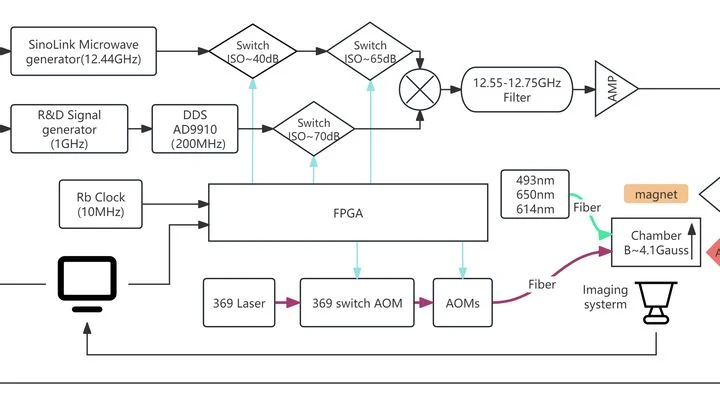
A microwavepulse is a short burst of microwave radiation, typically lasting nanoseconds to microseconds, used to manipulate quantum states in quantum computing and other quantum technologies. It is a key tool for controlling qubits, as microwave frequencies match the energy differences between quantum states in many superconducting circuits.
How it works
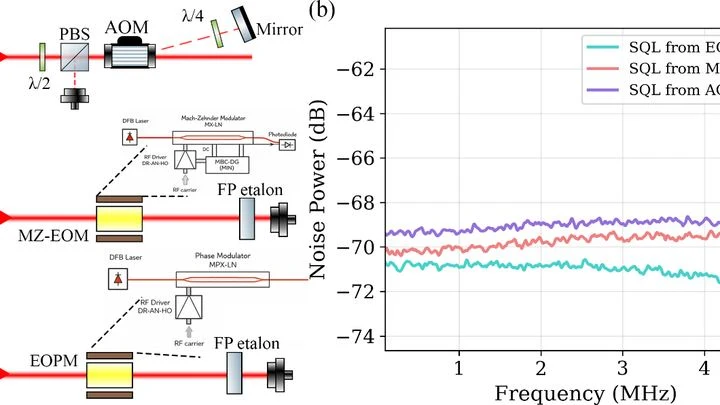
Microwavepulses are generated by arbitrary waveform generators and delivered to qubits via transmission lines or resonators. The pulse's frequency, amplitude, and duration are tuned to drive transitions between quantum states, enabling operations like qubit rotations or entanglement. By shaping the pulse envelope, errors can be minimized, improving gate fidelity.
A ship in a bottle is assembled from the inside, not the outside: masts and sails are pulled through the narrow neck, and once inside the glass they settle into the right pose on their own. Chemists have done something similar with a single cobaltocene molecule, which they pulled into the gap between layers of a two-dimensional crystal.
A superconducting detector usually works like an honest ruler: absorb a photon, get a pulse whose amplitude is strictly proportional to the energy. This mode is convenient, but it has a ceiling: a weak signal easily gets lost in the amplifier noise.
Now imagine a swing.
An ordinary lamp shines steadily, while a lighthouse flashes. Scientists in London have made a tiny diamond work like a lighthouse, but not for light — for radio waves. To do this, they added a bit of nitrogen to the crystal and then shone a green laser on it.
The two states of a strontium atom are like twins running down the same track, but one is slightly higher than the other. Usually, the light used to manipulate atoms pushes one twin harder and the other more weakly. Here, they chose a wavelength of 813 nanometers—'magic'—where both get the same kick.
If you push water in a narrow channel too fast, a steep wave forms and breaks into foam. In the world of ultracold atoms, cooled to near absolute zero, quantum laws prevent such a wave from breaking. Physicists took a cloud of rubidium atoms stretched into a thin thread and sharply compressed it from one end with a movable wall of light.
A short flash of light is like a musical phrase: you can distinguish individual notes if you listen very carefully. But in the quantum world, these 'notes'—temporal modes — are squeezed down to picoseconds, and ordinary optics can barely tell them apart.
A superconducting qubit is like a finicky musical instrument: until you tune it, you won't get a clean note. But even after tuning, the pitch drifts. The culprits are tiny defects in the material that physicists call two-level systems. They're like invisible cracks that appear and disappear, throwing off the processor's rhythm.
An empty resonator isn't truly empty. Even in an absolute vacuum, where not a single photon exists, quantum fluctuations persist. They resemble ripples on water in a dead calm: the surface appears smooth, but molecules keep jittering. Physicists have learned to turn this jitter into real waves.
A polar molecule is like a tiny dumbbell with opposite charges at its ends. Normally, such particles quickly stick together or fly apart when they meet — electric forces are too strong. But the authors of the work found a way to turn this aggressiveness into a controlled game.
A living cell constantly emits faint magnetic signals, as if whispering. Scientists eavesdrop on this whisper with two microscopic 'microphones'—magnetic field sensors.
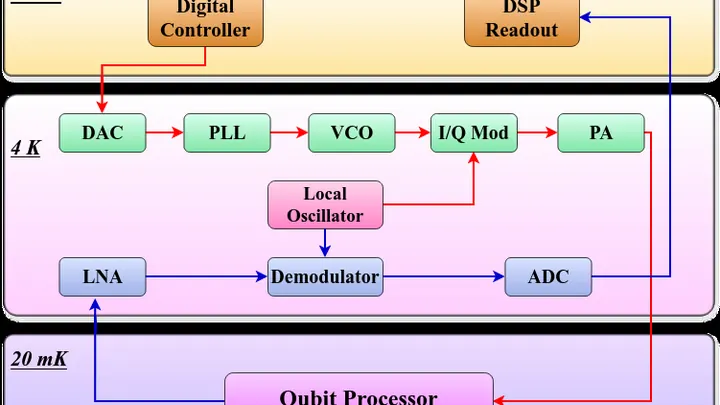
The rows of wires stretching from the warm room into the fridge holding the quantum chip look like a tangled telephone exchange from the last century. Each qubit needed its own analog channel for precise tuning, and the cables carried extra heat and got underfoot.
Now researchers have placed a digital-to-analog converter right in the cold zone, next to the qubits.
A distant lighthouse flashes for an instant brighter than an entire galaxy. This is a fast radio burst — a mysterious signal from deep space. Some repeat, and astronomers have noticed a peculiarity: these bursts show rapid changes in polarization — a property indicating how the radio wave is twisted in space.
Quartz microbalances are thin plates that vibrate at a frequency of five million times per second. When a drop of liquid lands on the plate, the vibration changes: from these changes, you can determine the drop's mass and its elasticity.
An ordinary envelope has a rectangular shape, and the letter inside does not change the envelope's properties. With photons, particles of light, the situation is different: their 'shape' in time can vary, and this shape itself carries information.
At Fermilab's accelerator, a particle beam strikes a target of frozen ammonia. The hydrogen nuclei inside are like tiny tops, and physicists need them all spinning the same way. Then the collisions reveal how the proton's spin is put together.
Light in a particle detector behaves like a voice in the mountains. One shout, and the echo repeats several times, growing fainter with each reflection. So it is in a silicon detector: a real flash from a particle gives rise to false ones that confuse measurements.
A freshly polished niobium surface shines like a mirror. But within minutes, a dull oxide film, invisible to the eye, forms on it. For a superconducting qubit, this film is like sand in an hourglass: it causes the quantum state to decay prematurely.
A regular laser is a light amplifier in which atoms, after receiving energy, collectively emit waves of a single frequency. A maser does the same thing, but for microwaves — the invisible radiation that heats food in a microwave oven and carries signals in phones.
Quantum computers promise to solve problems that are beyond the reach of ordinary computers. But their components, quantum bits, are very sensitive. One type of quantum bit is an oscillating circuit that can exist in two states, like a pendulum swinging left or right. These states store information.
Fireflies flash in a dark forest: you see each flash, but not the flight. A quantum gas microscope can show individual cold atoms, like those fireflies. But until now, it couldn't tell you how fast they're moving.
Now scientists have found a way to fix that.
After the Big Bang, the Universe simmered as a fiery 'soup' of fundamental particles. Expanding and cooling, the soup gradually 'solidified' into protons and neutrons — much like crystallization. Had the solidifying been instantaneous, like a lake cracking in a deep freeze, the fabric of spacetime would have convulsed.
A quantum computer is like an orchestra where each musician plays their part, but if the conductor waves the baton a bit too hard, the delicate instruments go out of tune from excess heat. Controlling qubits at 10 mK (300 times colder than your freezer) is like conducting an orchestra in an ice-cold hall where even a breath can ruin everything.
A typical quantum bit is destroyed by the slightest disturbance — heat, magnetic fields. Physicists made a pair of atoms work together so that disorder wouldn't erase the record. Information was encoded not in each atom individually, but in the difference of their states — like the tension of a rope between two buoys.
Magnetic atoms in a solid are like compass needles: usually, when cooled, they align in one direction: that's how magnetism arises. But in TbInO3, the terbium needles sit on a triangular lattice where it's impossible to please all neighbors at once. One needle wants to point north, another south, and in the end none can settle into a stable position.
A tiny diamond hangs in the air, held by an electric field like a speck of dust in a beam of light. Hidden inside are defects — places where a carbon atom is replaced by nitrogen, with a vacancy nearby. These defects behave like little magnets that can be flipped with laser and microwaves.
If you compress a plate with accordion-like cells, a kink wave runs through it, like a wrinkle in a rug when you push it with your foot. Such waves can switch the material between two stable shapes, and this is the basis of mechanical memory. But if a table leg gets in the way of the wrinkle, it gets stuck. In a new study, researchers showed how to nudge it loose without brute force.
A quantum computer is like an orchestra where each musician, a qubit, must play its note without missing a beat. But every now and then, a passerby, a particle of radiation from space, bursts into the hall and throws the musicians off rhythm. Such glitches are called error bursts, and they disrupt computations.
Quantum computers promise to solve problems beyond the reach of classical machines, but their heart, the qubits, requires ultra-low temperatures near absolute zero. Controlling qubits and reading out their states typically means working from a warm room, running many cables through the refrigerator.
A photon is like a car in a multi-story parking lot, where each floor is its frequency (color). Usually it gets stuck on one level, but scientists added an elevator — a programmable modulator that moves the photon between floors on command.
In the superconducting circuits that make up quantum computers, extra particles, quasiparticles, are born from time to time. They are like random passersby who barge into the processor's work and spoil the calculations.
A quantum computer is like an orchestra where electrons and nuclei play different instruments. Usually, the conductor needs two batons: microwaves for electrons and radio waves for nuclei.
A quantum computer is like an orchestra that has to tune its instruments before every piece. Tuning takes time and requires quiet — in our case, deep cold. For silicon chips with boron atoms, this tuning is usually done with microwaves, slowly and only at temperatures below 2 kelvin (minus 271 degrees Celsius).
Even a laser beam has an invisible tremor — quantum noise. Physicists have learned to 'squeeze' it, like a balloon pinched at the waist: the noise quiets in one direction but amplifies in another. Scientists hid the excess noise where it doesn't interfere with precise light measurements.
Ultrasound in a liquid is like shaking a bottle of soda vigorously: shake it, and bubbles appear. In science, this is called cavitation, and the bubbles don't just float around: they are born, grow, and collapse with tremendous force.
Ordinary light is a stream of photons flying every which way: sometimes more, sometimes fewer, and in that chaos, measurement precision gets lost. Physicists have learned to "tame" this stream by creating squeezed light — where the noise in one characteristic drops below the vacuum level.
Short gamma-ray bursts — instantaneous, but most powerful explosions — are born from the mergers of neutron stars (the superdense remnants of dead stars).
An ordinary laser emits photons one by one, like a faucet dripping water. But what if you need several particles of light born at the same instant? Physicists have made a cloud of cold rubidium atoms emit quadruples of photons — as if the faucet suddenly released four drops at once, each falling into its own test tube.
Short, powerful bursts of radio static from deep space have long puzzled scientists. Their source is believed to be the ultra-dense cores of dead stars, where magnetic fields are unimaginably strong.
Magnetic vortices in superconductors, like whirlpools in water, typically scatter energy and quickly vanish due to internal friction — dissipation. This hampers their use in quantum chips. But in a film of tiny aluminum grains, a vortex gets trapped and resembles a whirlpool in a narrow well: it spins either one way or the other.