How to Tame a Blast Wave express
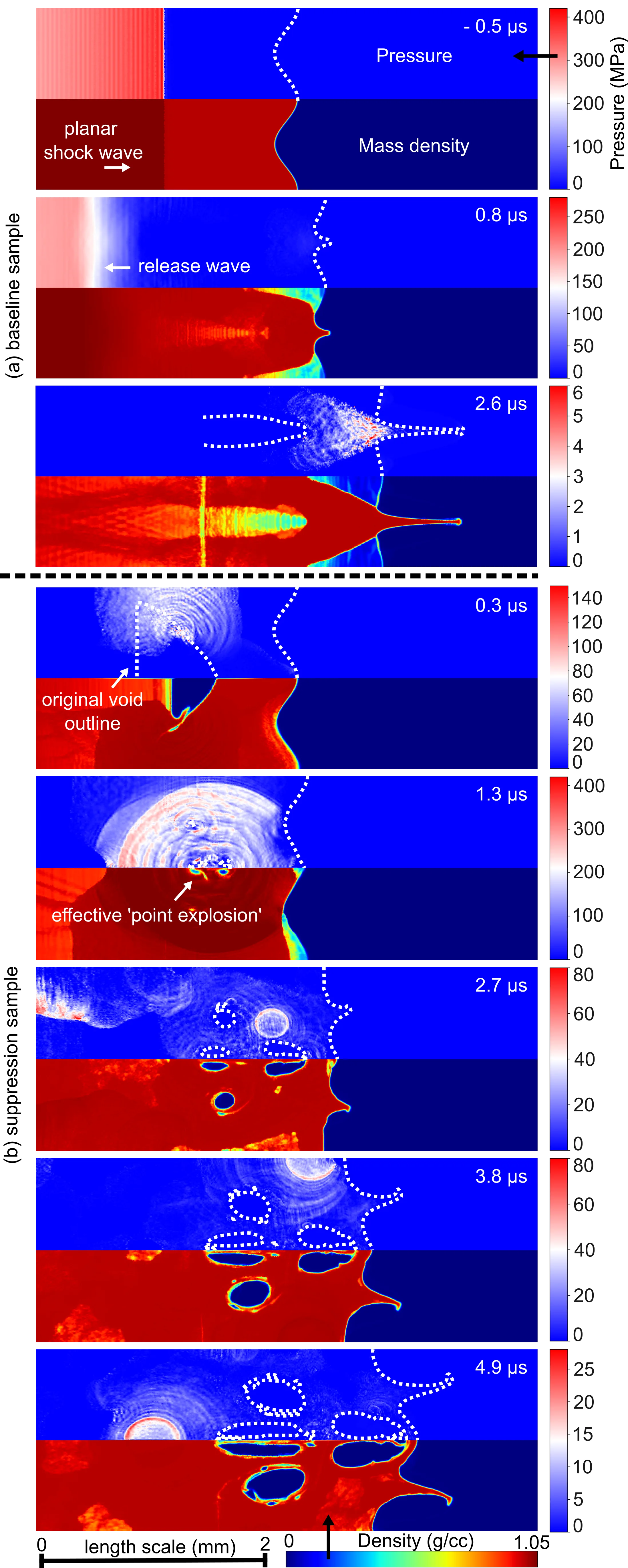
A blast wave slams into a surface, and the surface starts to wrinkle like a carpet when you drag your foot across it. These wrinkles grow, curl into vortices, and stir everything around. In fusion, such mixing is a big problem: the fuel doesn't compress evenly, and the reaction fizzles out.
Physicists have found a way to stop this process without touching the wave itself. They 3D-printed a target with voids beneath the surface. As the shock wave passes through the voids, it splits into several weaker waves that arrive at different times. As a result, the surface barely wrinkles — instability growth is suppressed by more than 70%.
The experiment used X-ray imaging that shows the process in detail. It turned out that the key role is played by the stretched-out pulse, not by weakening the wave or curving the surface. This opens a path to controlling instability in fusion reactors and other high-energy-density systems.
The Richtmyer–Meshkov instability occurs when a shock wave passes through the boundary between two fluids of different densities — for example, air and helium. You can even see it in your kitchen sink: a drop of water falling into oil creates similar vortices.
In science fiction, ships are often protected by force fields that dampen shock waves. Here, the same principle applies, but instead of a field, it's a cleverly engineered material structure.