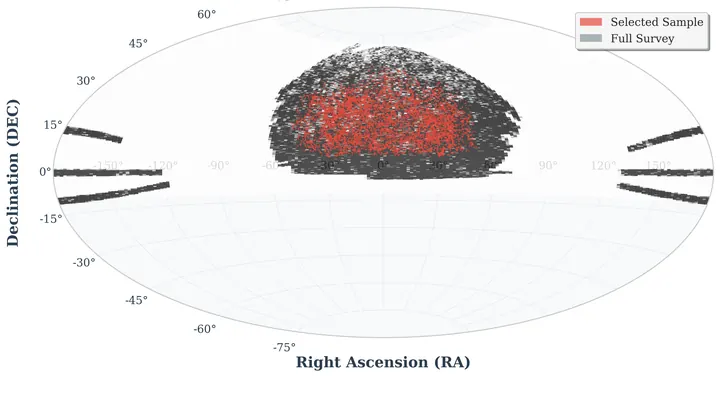
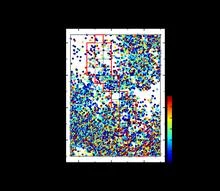
Voids are extensive regions with a reduced density of galaxies, occupying about 80% of the Universe's volume but containing only a few percent of all galaxies. Their diameters range from 20 to 200 megaparsecs (65–650 million light-years). Due to their low density, voids expand faster than the surrounding space. They are not completely empty: inside, there are dwarf galaxies and clouds of cold gas, noticeable as absorption lines in the spectra of distant quasars (Lyman-alpha forest). The edges of voids are delineated by galactic filaments and clusters.
History
The idea of voids in the distribution of galaxies dates back to pioneering works on mapping the Universe in the 1970s (Chincarini, Gregory, Thompson). The term 'void' became established after analysis of the CfA Redshift Survey data in the 1980s, when the Great Wall and adjacent voids were discovered. In 1981, Kirshner and colleagues identified the Boötes void. Theoretical understanding was provided by the works of Sheth and van de Weygaert (2004), establishing statistical properties of voids in hierarchical models. Modern surveys SDSS (2000–) and DESI (2021–) have cataloged tens of thousands of voids.
How it works
Formation and dynamics of a void within the ΛCDM model. From linear theory, the growth of a density perturbation δ(t) ∝ D(t) depends on the cosmological growth factor. A void corresponds to δ < 0. Nonlinear evolution is described by the spherical model (analogous to collapse for overdensities). The equation of motion for a shell of radius R: \ddot{R}/R = -(4πG/3)(ρ_m + 3P_total/c²), where P_total includes the pressure of dark energy P_Λ = -ρ_Λ c². In the era of Λ dominance, the right-hand side becomes positive, which accelerates the void's expansion. Compensation: the excess density on the walls equals the deficit within some radius. Voids also allow testing the model through redshift-space distortions (Alcock-Paczynski test) and through weak lensing.
In practice
Studying voids reveals the mechanisms of large-scale structure formation in the Universe and helps understand how dark energy influences its expansion.
Fun fact
The recently discovered KBC void is so large that its size is difficult to explain within the standard cosmological model — perhaps it points to unknown forces or special properties of dark energy.
The night sky looks like a random scattering of stars. But zoom out to enormous distances, and the chaos disappears. Galaxies gather into long filaments and flat walls, with colossal voids gaping between them — cosmic voids. This structure is called the cosmic web.
A pot of boiling porridge: bubbles burst, steam escapes, and everything gets mixed up. Massive stars in giant gas clouds behave in much the same way. Their radiation and stellar winds blow out enormous cavities, molecular bubbles, scattering material all around.
The JWST spectrograph caught a barely perceptible dip in the spectrum of a distant galaxy — two lines, like shadows cast by cold gas. These are the sodium lines, the very yellow light of streetlamps. Here, at the edge of the visible Universe, they betray the slow exhalation of a galaxy returning matter to space.
The quantum world is often compared to a musical instrument. Each system, whether an atom or a chain of particles, sounds at its own frequencies, which physicists call energy levels. In chaotic systems, like an orchestra without a conductor, these frequencies usually fill the entire available range without gaps.
Lenticular galaxies are the cosmic quiet types: they have a disk but no bright spiral arms. For a long time, their origin remained a mystery. A team of scientists ran the Hydrangea computer simulation and traced the fate of each galaxy from its youth to the present day.
On the mass–size diagram, these galaxies line up in a V shape.
Spacetime sometimes resembles a sheet of paper in which you can punch a hole and connect the edges with a short tube: you get a wormhole. In the simplest mathematical models of such wormholes, massless scalar fields appear — something like an invisible fog filling everything around.
The Universe is structured like a sponge: there are dense regions packed with galaxies and gas, and giant pores — cosmic voids. These voids occupy most of space, but their contents have remained a mystery because matter there barely reveals itself.
Now astronomers have 'felt' the voids using fast radio bursts — super-powerful pulses from distant galaxies.
An invisible film, a quantum field, is stretched over a rubber bagel. While the bagel is small, the film stays taut and doesn't sag anywhere: the vacuum remains empty. But once you stretch the bagel to a certain size, a dent spontaneously appears in the film — the field starts to be felt at every point.
This dent is not random.
Toss a handful of glitter into a river, and some flakes will drift straight while others spin in tiny eddies. Galaxies in the universe do something similar: they don't just recede due to cosmic expansion: they also swirl in giant currents, like wood chips caught in invisible whirlpools.
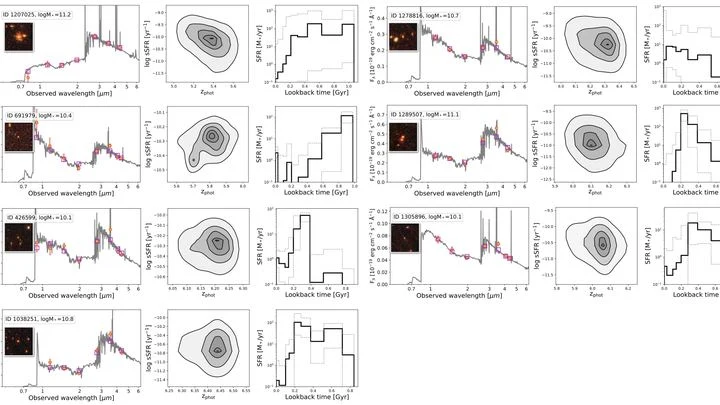
In the first few hundred million years after the Big Bang, the cosmos was like a noisy teen club: galaxies flared up, collided, and churned out stars by the hundreds.
In the constellation Cetus, 65 million light-years from Earth, three dwarf galaxies nestle: DF2, DF4, and DF9. All have been declared “galaxies without dark matter” — the mysterious invisible substance that usually holds stars together.
On the outskirts of the Virgo Cluster, where galaxies crowd together but haven't yet clumped into a dense mass, lies VCC 693. Outwardly, it's an unremarkable dwarf: a small cloud of stars and gas. But astronomers suspected that behind its calm appearance lurks a turbulent past.
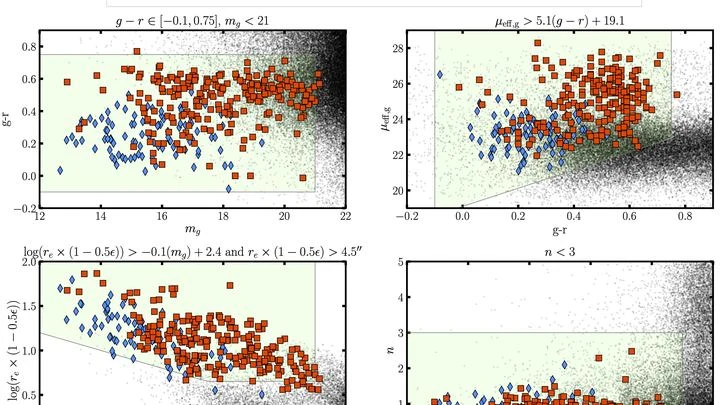
In 2015, astronomers were examining the Coma galaxy cluster and noticed something odd: huge, almost invisible "fluff balls." These galaxies are as large as our Milky Way but shine hundreds of times fainter.
A population census, but instead of houses (galaxies, and instead of residents) stars. Astronomers set out to count the smallest and faintest "homesteads" in our cosmic neighborhood: dwarf galaxies. They are thousands of times fainter than the Milky Way, and spotting them in images is as hard as picking out a firefly in front of a spotlight.
In the nearly empty regions of space, galaxies spin in unison, like dancers in the same troupe. This dance creates a difference in light from opposite sides: on one side stretching, on the other compression. This optical shift has become a probe of the first moments after the Big Bang.
In the nearly empty regions of space, galaxies spin in unison, like dancers in the same troupe. This dance creates a difference in light from opposite sides: on one side stretching, on the other compression. This optical shift has become a probe of the first moments after the Big Bang.
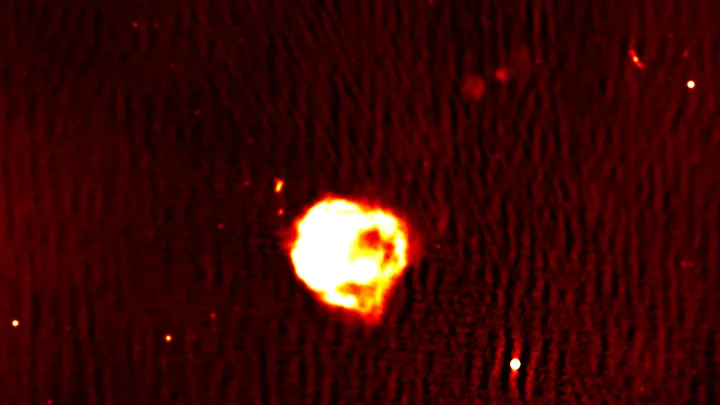
A river of stars (not a cluster, but a distinctly elongated, glowing ribbon) crosses the outskirts of a distant galaxy. Such a stream was spotted in data from the first survey by the Vera Rubin Observatory. It stretches along the minor axis of the galaxy LEDA 751050, like a scarf streaming from the galactic disk.
The stream is enormous: 130 by 15 kiloparsecs.
Someone has thrown an invisible stone into the stellar pond of the Milky Way. The ripples spread not through water but through the motion of stars: in a region 200 by 50 parsecs across, their average vertical velocity is 7 km/s lower than that of their neighbors. The deviation is statistically significant at the 6σ level, so chance cannot explain it.
The hall is silent, but the conductor has already raised the baton. The orchestra is quiet, yet the score is changing. So it is in an optical resonator: there is no light, but the quantum vacuum—that emptiness filled with short-lived field fluctuations—is already conducting the…