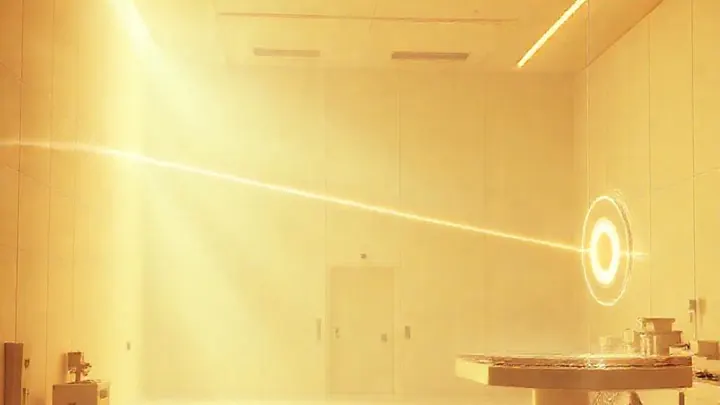
A fusion reactor is a device designed to generate energy by fusing atomic nuclei, typically isotopes of hydrogen like deuterium and tritium, at extremely high temperatures. Unlike nuclear fission, which splits heavy atoms, fusion mimics the process that powers the Sun and other stars, offering the potential for a nearly limitless and clean energy source. The challenge lies in confining the superheated plasma — a gas of charged particles at millions of degrees — long enough for fusion reactions to produce more energy than is consumed.
History
The concept of controlled fusion was first explored in the 1950s, with early devices like the tokamak developed by Soviet physicists, including Andrei Sakharov and Igor Tamm. The international ITER project, currently under construction in France, represents the culmination of decades of research.
How it works
The most common approach is magnetic confinement, where powerful magnetic fields hold the plasma in a toroidal (donut-shaped) chamber, preventing it from touching the walls. The fuel is heated to temperatures exceeding 100 million degrees Celsius, at which point the nuclei have enough kinetic energy to overcome their electrostatic repulsion and fuse. When deuterium and tritium fuse, they produce a helium nucleus, a neutron, and a significant amount of kinetic energy. The neutron, being uncharged, escapes the magnetic field and is captured by the reactor wall, where its energy is converted into heat to drive turbines. Recent research focuses on managing plasma turbulence and instabilities, as well as using the energetic alpha particles produced in the reaction to help sustain the plasma temperature, a process known as self-heating.
In practice
Fusion reactors are primarily pursued for commercial electricity generation, but the technology also has potential applications in nuclear medicine, where fusion-produced isotopes can be used for imaging and therapy.
Fun fact
A single gram of fusion fuel can produce as much energy as burning about 8 tons of coal.
When a laser beam hits a gas, it tears electrons from atoms and accelerates them to nearly the speed of light. As these electrons fly through the plasma, they emit X-rays, like a glowing trail from a fast particle. In the new work, physicists made a single laser pulse create not one but two such trails in succession.
Inside a solar flare, magnetic field lines snap like stretched rubber bands and reconnect — releasing in minutes enough energy to power humanity for millions of years. In the lab, this process, magnetic reconnection, could long be triggered but not stopped. Now physicists have a switch.
Atomic batteries powered by plutonium decay have been running pacemakers and space probes for over sixty years. But the raw material is scarce: worldwide, only a few kilograms of plutonium-238 are produced each year, barely enough for the most critical missions.
Microwave plasma in a vortex is like a kitchen mixer that simultaneously heats and stirs the gas. In the reactor, the gas is swirled, and microwaves heat it to thousands of degrees, tearing carbon dioxide molecules apart. Scientists created a computer model of such a reactor to understand how pressure affects the process.
To probe deeper into the workings of the universe, physicists accelerate electrons and smash them together. An ordinary electron is like a spinning top that wobbles randomly. For delicate experiments, you need particles whose spins all point in the same direction: this is called polarization.
In the distant Cigar Galaxy, there is an unusual beacon. It doesn't shine in the usual sense: its rays are born in a scorching cloud around a black hole that is devouring matter from a companion star. Such objects are called ultraluminous X-ray sources. Their X-ray brilliance is so intense that it outshines entire galaxies.
This cloud, the corona, is like a boiling cauldron.
A stellarator fusion reactor resembles an intricately twisted magnetic cocoon. Its job is to confine superheated plasma so that hydrogen nuclei fuse and release energy. But the cocoon's three-dimensional shape creates gaps: some particles escape, especially the fastest ones, which carry most of the heat.
The race for fusion energy is like trying to bottle a lightning bolt. For decades, physicists have struggled to recreate on Earth the processes that power the Sun. The main challenge is getting light nuclei to fuse despite their mutual repulsion, while extracting more energy than was spent heating and confining the plasma.
The 21-kilometer ring near Protvino was once planned to accelerate protons. Today, the same tunnel could host a very different machine — a muon collider. The muon is a heavy cousin of the electron, and that's its strength. On a curve, an electron radiates like a searchlight, losing precious energy. A muon radiates a billion times less.
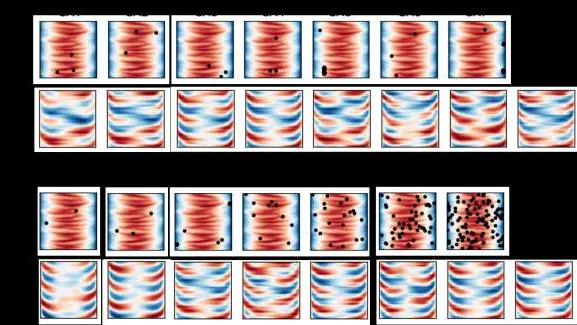
Inside a fusion reactor, plasma rages — a gas heated to millions of degrees. There are no direct windows, and cameras and sensors quickly fail. Engineers see only fragments of information: a few sensors at scattered points. It's like trying to grasp a symphony from the sound of three microphones in a vast hall.
A collision of two neutron stars is a cosmic forge where the heaviest elements of the periodic table are hammered out in seconds. In 2017, detectors picked up gravitational waves from such a merger, and telescopes saw a flash — a kilonova.
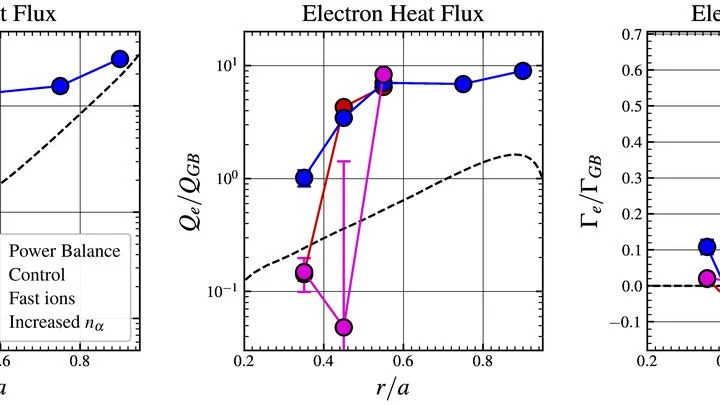
Water boils in a pot: bubbles churn, heat quickly escapes into the air. In the center of the ARC fusion reactor, plasma behaves similarly — except instead of bubbles, there are turbulent eddies, and instead of air, there's a magnetic field that must hold the heat.
Atomic nuclei are wrapped in fluffy electron coats — in such attire, they can't get close enough to embrace. But swap the light coat for a heavy one: a muon, a particle from the standard model, shrinks the cloud by nearly 200 times.
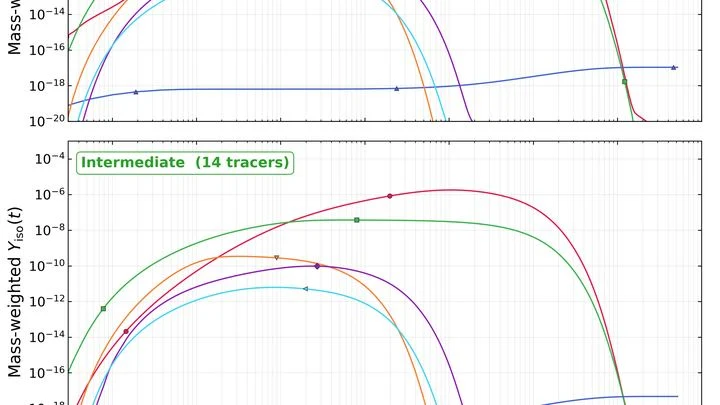
The atomic nucleus is a natural spring of colossal power. When the protons and neutrons inside it rearrange, it enters a special long-lived state — a nuclear isomer. It stores energy like a spring compressed to its limit.
Imagine a powerful hair dryer that blows not warm air but white-hot plasma, such devices are called plasma wind tunnels. They are used to test on Earth how a spacecraft will enter the atmosphere.
Before assembling a huge puzzle, you need to stamp out the pieces — otherwise the picture won't come together. In fusion-based quantum computers, the role of such pieces is played by tiny clumps of light — photonic resource states. They are collided and measured to gradually grow the computational fabric.
A swing only gets going if you push it in rhythm. Miss the beat, and your effort is wasted. Light interacts with an atomic nucleus in much the same way: a photon is usually absorbed only when its energy exactly matches the gap between nuclear levels. But what if the photon's energy doesn't fit? The authors of a new study have found a workaround.
Fusion, the merging of a proton with a boron-11 nucleus, promises a near-perfect energy source: no dangerous neutron flux, just a stream of charged particles that can be directly converted into electric current. But there's a fundamental problem: the Coulomb barrier.
A doughnut-shaped magnetic trap holds plasma made of boron and hydrogen. Inside, the temperature rises above one hundred million degrees — hotter than the center of the Sun. At such heat, nuclei collide and fuse, releasing energy.
A piece of metal heated at one end produces a weak electric current: this has been known for nearly two hundred years. But what if, instead of a simple metal, you take a layered "sandwich": a superconductor, a thin insulator, and a flat layer of electrons?
An ordinary nuclear reactor is like a boiler where fuel burns evenly throughout the volume. Here the picture is different: a fission wave, a narrow zone where atoms split and release heat, slowly creeps along a cylindrical rod of uranium carbide. Ahead of the wave, the fuel is untouched; behind, it is already spent. So fire runs along a candle wick, leaving wax behind.
Hot plasma in a tokamak is like a temperamental beast: you need to hold it in, but not let it overheat. In the ASDEX Upgrade reactor, researchers found a regime where plasma eddies solve this problem on their own. Stochastic modeling showed that oscillations at the plasma edge fling out blobs, like bubbles from a boiling pot.
Every time deuterium and tritium fuse in a fusion reactor, a fast neutron flies out. It can turn one substance into another — for example, create valuable isotopes for medicine.
Today such neutrons cost a fortune, because there are few experimental facilities and they rarely operate.
Deep inside a massive star, two carbon nuclei collide and merge into a single magnesium nucleus. This process determines how quickly the star burns its fuel and which chemical elements it manages to create. But calculating such a fusion on paper has proven incredibly difficult: nuclei are not billiard balls but quantum systems that can rearrange themselves in many ways.
Inside a future fusion reactor, a magnet weighing as much as a small car will float. It holds the superheated plasma like an invisible hand holding a cloud. Previously, such a magnet was considered unsuitable for deuterium-tritium fuel: neutron fluxes would quickly destroy it.
A laser strikes a target, and a cloud of plasma, accelerated to hundreds of kilometers per second, shoots into the chamber. The chamber isn't empty: it's filled with a tenuous gas that plays the role of the cosmic medium. The plasma slams into this gas like a speedboat hitting still water, shoving it aside.
Inside every cell, chemical reactions are constantly underway, like a tiny kitchen where protein chefs whip up essential compounds. But seeing exactly how a chef prepares a dish is tricky when you're surrounded by a crowd of other molecules.
Light from an ordinary lamp is chaos: photons scatter in all directions with no order. But if you make many atoms emit light simultaneously and in sync, you get a short, powerful flash, like applause that turns individual claps into a single burst. Such coordinated emission is called superradiance.
Igniting a miniature sun is a long-held dream of humanity. Typically, scientists try to confine scorching plasma (a gas of charged particles) at temperatures of hundreds of millions of degrees. But plasma tends to escape magnetic traps, and confinement comes at enormous cost.
For two atomic nuclei to fuse, they must overcome their fierce electric repulsion — like trying to bring two angry bulls together. Normally, only monstrous energy does the trick, as in stellar cores, where Hans Bethe explained fusion back in the 1930s.
Deep inside stars, light nuclei fuse, giving birth to helium and streams of neutrons. On Earth, we recreate this process by combining deuterium and tritium — special isotopes of hydrogen.
Atoms, like a swarm of fireflies, shine in unison. When they flash together, the light multiplies — a hundred atoms shine ten thousand times brighter than one. Physicists have turned this trick into a heat engine. A typical motor needs both a hot and a cold source, but here the atoms operate with just a cold one.