A shock absorber is a mechanical device designed to dampen vibrations and absorb energy from impacts, thereby isolating sensitive equipment from external disturbances. In physics research, shock absorbers are crucial for maintaining the stability of precision instruments, such as those used in gravitational wave detectors, atomic clocks, and quantum computing setups. They work by converting kinetic energy into heat, reducing the amplitude of oscillations.
History
The concept of damping vibrations dates back to the early 20th century, with the first practical shock absorbers developed for automotive use. The physics of vibration isolation was formalized in the mid-20th century, leading to sophisticated designs for scientific instruments.
How it works
Shock absorbers typically use a piston moving through a viscous fluid, which creates resistance and dissipates energy as heat. In advanced applications, they may incorporate active control systems or metamaterials that can adaptively cancel vibrations. The goal is to minimize the transmission of vibrations from the environment to the sensitive equipment, ensuring that measurements are not corrupted by external noise.
In practice
Shock absorbers are used in a wide range of technologies, from vehicle suspension systems to the vibration isolation platforms that support laser interferometers in gravitational wave observatories like LIGO.
Fun fact
In quantum experiments, shock absorbers are so effective that they can reduce vibrations to levels below the quantum noise floor, allowing researchers to observe quantum effects that would otherwise be masked.
A tiny defect in a diamond crystal is like a sensitive microphone picking up the faintest magnetic fields. That's how sensors based on nitrogen-vacancy centers work (where a nitrogen atom and a neighboring vacancy form a quantum system). To hear the whispers of individual molecules, the sensor is placed right at the surface.
Hot tea cools down, and ice cream melts — heat always flows from warm to cold, and this law seemed unbreakable. But in the quantum world, even familiar rules can be rewritten. Physicists placed a tiny mechanical resonator (a vibrating bridge the size of a microbe) in an optical cavity between two mirrors.
A levitating dust grain in an optical trap is an ideal pendulum for measuring gravity. It hangs in vacuum, never touching the walls, and its motion depends only on external forces. The new work proposes an improved sensor: a mechanical 'squeezed' qubit based on a nonlinear oscillator.
Gravitational wave detectors are microphones listening to the trembling of space. But their own noise drowns out weak signals. To hear more, physicists add special "squeezed" light to the instrument: it reduces quantum noise, like noise cancellation in headphones.
A gas bubble in water sings loudly — this is Minnaert resonance: the heavy liquid prevents the bubble from compressing quickly, forcing it to vibrate. In air, there's no such effect: air is too light. But if you dress the bubble in a soft silicone shell, like rubber, it plays the role of the water mass. You get an 'elasto-bubble'.
A quantum magnetometer based on hydrogen nuclei works like noise-canceling headphones. It alternately "listens" to the field in two different ways: the noise is the same for both, but the desired signal is different. By subtracting one from the other, the device extracts the signal, reducing interference by more than 1000 times.
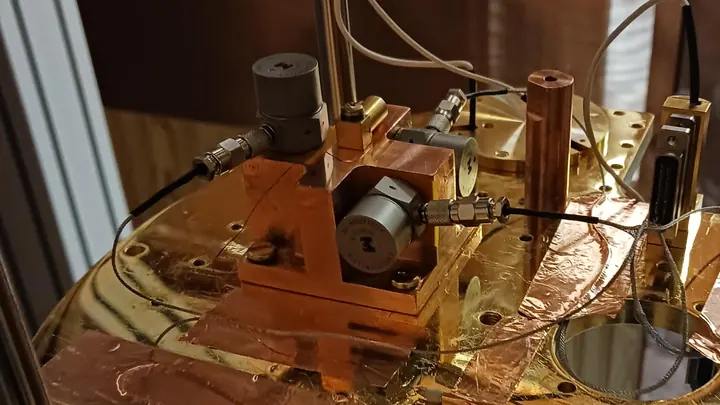
Inside a refrigerator that cools matter to near absolute zero beats a mechanical heart — the pulse tube. It pumps gas and extracts heat, but along with the cold it brings tremors. Each beat of this heart shakes the instruments sitting next to the sample and ruins delicate measurements.
A tiny seesaw weighing 1.5 nanograms oscillates not from the wind, but from the heat of its surroundings. Physicists nearly stopped it by cooling it to 0.006 degrees above absolute zero.
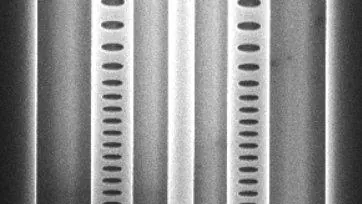
In the world of microchips, where streams of photons, quanta of light, carry information, a fundamental problem arises: light passing through matter inevitably heats it. This heating spawns thermal fluctuations — chaotic, unpredictable jostling of atoms that disrupts precise device operation.