Interference is the superposition of waves, where they either reinforce or cancel each other out. Like ripples on water from two thrown stones: in some places waves meet crest to crest and grow, in others they cancel, and the water is almost still.
History
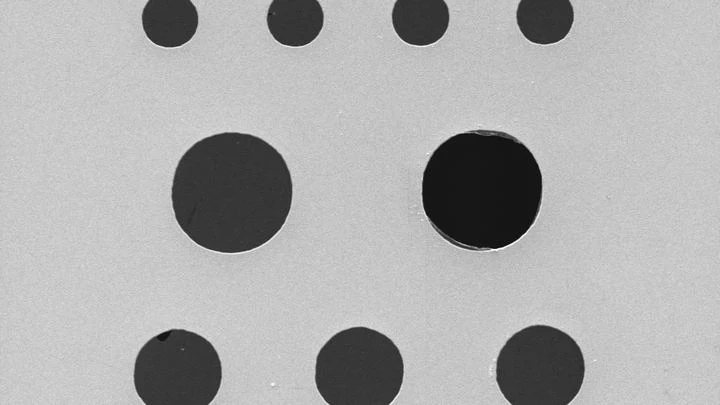
The wave nature of light was discussed by Robert Hooke and Christian Huygens in the 17th century, but the decisive interference experiment was performed by Thomas Young in 1801. He passed light through two closely spaced holes and obtained alternating bright and dark fringes. Augustin Fresnel developed a mathematical theory of diffraction and interference, leading to acceptance of the wave theory of light. In 1924, Louis de Broglie proposed the hypothesis of wave properties of matter, and soon electron interference was experimentally confirmed. Erwin Schrödinger formulated the wave equation, where interference of wave functions explains the quantum behavior of particles.
How it works
Interference occurs when two or more coherentwaves superimpose in space. The resulting field E = E_1 + E_2 + ..., and the intensity is proportional to the square of the amplitude: I ∝ |E|^2. When adding monochromatic waves of the same frequency with a constant phase difference Δφ, we get I = I_1 + I_2 + 2√(I_1 I_2) cos Δφ. Condition for constructive interference: Δφ = 2πm (maximum); destructive: Δφ = (2m+1)π (minimum). In quantum mechanics, the wave function ψ = ψ_1 + ψ_2 gives probability |ψ|^2 = |ψ_1|^2 + |ψ_2|^2 + 2 Re(ψ_1* ψ_2). The superposition principle guarantees linearity of evolution, and interference manifests even when particles are sent one by one.
Fun fact
Noise-canceling headphones work on interference: they create "anti-noise" that cancels out the sound around you.
A spotlight with an adjustable beam width sweeps along the shore. Its light is the long ocean waves that are born in the surf zone and spread in both directions: toward the beach and out to the open sea. Previously, this spotlight was considered a point source, but the actual breaking zone, where short waves break, has a finite width, and it changes as the wave front advances and retreats.
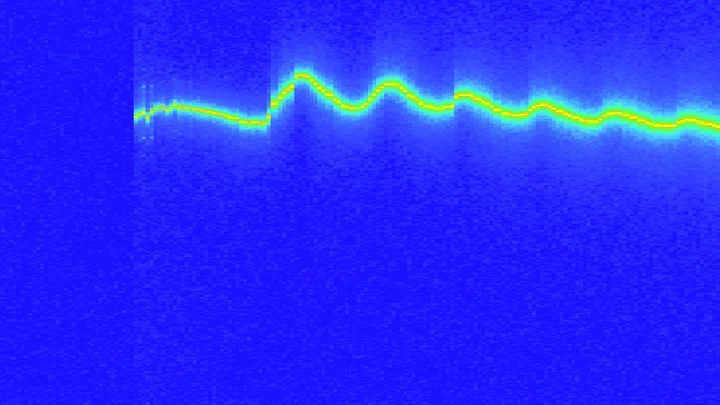
Two strings are stretched side by side: one thick and dull, the other thin and bright. Pluck the thick one, and you get a muddy sound with no clear pitch. The thin one responds with a pure tone. But link them together, and an unexpected effect appears: a sharp dip in the spectrum, as if someone muted a single note.
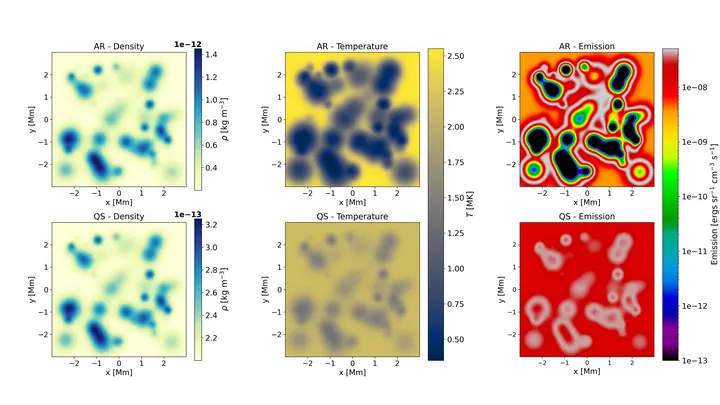
The solar corona is the Sun's outer atmosphere, heated to millions of degrees. How it gets so hot is still unclear. One candidate is torsional waves: they twist magnetic field lines like a rubber band. Such waves were recently spotted with the new Daniel K. Inouye Solar Telescope.
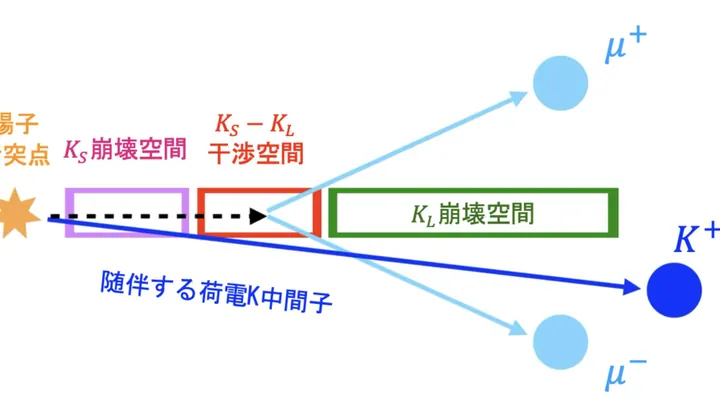
Two pebbles drop into water at a distance. The waves from them run toward each other and at certain spots they cancel out — the water becomes smooth, even though each stone alone would create ripples. Much the same happens with a pair of photons (light particles) born in a single crystal and flying off in different directions.
A stone drops into a pond, and ripples spread across the water. In the same way, massive bodies generate gravitational waves, except it's space itself that ripples. So far, these waves have been caught by giant detectors that barely flinch as a wave passes through. But what happens on the microscopic scale, inside a tiny piece of matter?
Graphene, a sheet of carbon one atom thick, behaves like a calm water surface, until superconductivity appears. Then, unusual waves ripple across it, like the circles from a thrown stone: pairs of electrons move without friction.
Plasma is not just hot gas; it's an entire orchestra of charged particles, each group playing its own part. Heavy ions (atoms that have lost electrons) set the slow rhythm, while light electrons dart around ten thousand times faster.
In the first moments after the Big Bang, the Universe underwent a rapid expansion, inflation, blowing up quantum fluctuations to scales visible today in the cosmic microwave background.
In 1915, Albert Einstein and Wander Johannes de Haas demonstrated that when an iron rod is magnetized, it twists slightly — the angular momentum of electrons is transferred to the crystal lattice.
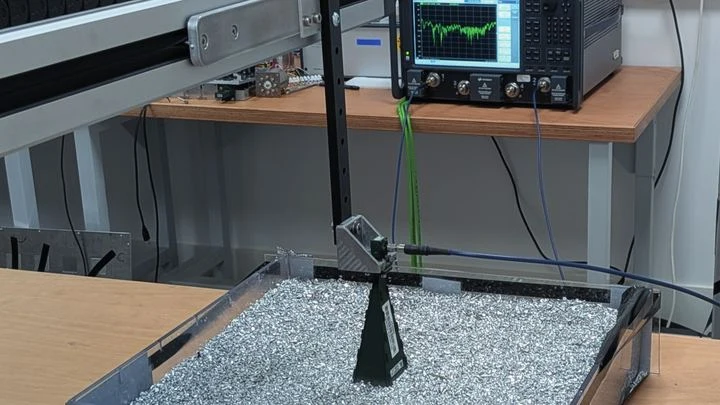
Radio signals in a room act just like sound in a concert hall: bouncing off walls and objects, they create a unique pattern — a silent melody for every location. Your phone, like a keen ear, catches this melody amid noise and distortion. It remembers which chord matches the corner of the couch, and which one fits the doorway.
A beam of light enters frosted glass and fades — nothing unusual. But physicists have long known how to make light pass through without losing a single photon. This trick is called electromagnetically induced transparency: two light waves cancel each other at the right point, and absorption disappears. Now a similar feat has been pulled off with atoms.
Graphene, a two-dimensional carbon crystal, has long tantalized physicists with the hope of high-temperature superconductivity. Its electrons obey the relativistic equation of Paul Dirac, racing at tremendous speed, barely noticing each other.
In the first moments after the Big Bang, the Universe was not a silent void but a seething cauldron of plasma, threaded with sound waves. As the temperature dropped, the cosmos underwent phase transitions — spontaneous reorganizations that gave birth to bubbles of a new phase.
Moments before totality, swift shadow bands glide across the ground, like ripples from pebbles tossed into water. For centuries, this phenomenon baffled scientists. It turns out the key is that light is a wave.
The Sun isn't a pinpoint lamp but a vast disk. When the Moon nearly covers it, a thin glowing crescent remains.
Physicists have achieved three-dimensional Anderson localization of electromagnetic waves — a phenomenon where waves become permanently entangled in a random labyrinth of metal particles and cease to propagate.
Drop two pebbles into a pond at the same time — the ripples will spread evenly and in sync. The same happens in a quantum interferometer: a particle is split into two waves that travel along different paths and then meet. Ideally, their crests align.
A stone drops into a pond, and ripples spread across the water. If a protruding branch blocks the ripples' path, part of the wave reflects, and part bends around the obstacle. Gravitational waves, ripples in spacetime itself, behave similarly when passing by galaxy clusters or black holes.
A pebble tossed into a pond sends ripples spreading in all directions. Now imagine the pond itself suddenly turning into jelly — instantly, faster than the wave can complete a single crest. Some ripples would keep spreading but change their spacing, while others would unexpectedly turn around and run back toward the point of impact, as if time were flowing backward for them.
Sunlight hits a silicon wafer, and a current flows in the circuit. That's the familiar work of a solar cell: light knocks out electrons, and a p–n junction (the boundary between two layers with different conductivities) forces them to move in one direction. But in some crystals, current arises differently — without any junctions, purely from the material's internal structure.
Throw a stone into a pond, and ripples spread across the water. Throw two stones nearby, and the ripples intersect, creating a pattern of reinforced and canceled waves. That's interference.
Two nearly identical pendulums are set in motion at the same time. One decays quickly, the other swings for a long time. At some point, their motions overlap, and in the combined picture, a subtle shift appears that would be invisible if you looked at each pendulum separately.
A stone falls into a pond, and ripples spread across the water. But if the stone is very small and the water is not quite ordinary, the ripples pass right through it, as if it weren't there.
Gravitational wave detectors work like sensitive microphones, picking up the trembling of space from distant cosmic catastrophes. When two black holes merge into one, the newborn object rings like a bell, and that ringing is a unique 'voice' of gravity.
A stone drops into a pond — ripples spread out and vanish. But in a narrow channel, a wave sometimes gathers into a hump and rolls on, unchanging in shape, kilometer after kilometer. Such stubborn solitary waves are called solitons. And if the crest is not smooth but pointed, like a spring compressed to its limit: that's a peakon.
A pebble drops into a pond, and neat circles spread across the water. But the pond's bottom is strewn with invisible glass shards: each one slightly delays the wave, scatters it here, or alters its pace. That's roughly how gravitational waves, the trembling of space itself, pass through distant galaxies and dark clumps of matter.
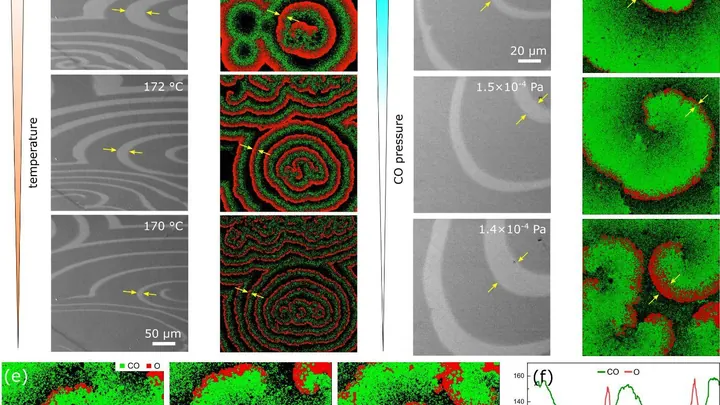
A platinum plate sits in a chamber with rarefied gas, and waves run across it. Not water waves, but chemical ones: patches where the surface is covered with oxygen give way to patches where carbon monoxide sits. Previously, these waves were seen as dark and light areas in images, but it was impossible to tell exactly which patch corresponded to what.
A swimmer cutting through water at the speed of the waves running on it finds themselves in a strange position: the waves they themselves generate can neither overtake them nor fall behind. They pile up at the swimmer's bow and freeze. A similar phenomenon occurs when a light source moves inside a medium at a speed matching the speed of energy transfer of the waves.
A tiny diamond bridge vibrates so strongly that it starts to 'sing' at many frequencies at once. Previously, such vibrations would dampen themselves: the harder the resonator swung, the harder it was to add energy. Physicists found a loophole in this rule.
They used light to drive the diamond. Light pushes on the bridge, making it tremble.
Normally, electric current is the same in both directions, like water in a straight pipe. But at the boundary between a normal metal and a superconductor, this rule breaks down. Two waves on water, going around a wide obstacle from different sides, can arrive with different delays and meet ‘out of step’.
Cilia are tiny hairs on cell surfaces. They beat like oars, moving fluid. In the lungs, they push dust and microbes out. But their lengths vary: in humans, they are thousandths of a millimeter; in comb jellies, several millimeters. How do such different cilia work together?
Scientists built a machine that jerks fluid sharply, as if a cilium had struck. They filmed it with a high-speed camera.
Two tiny emitters, each about the size of an atom, can together do what neither can do alone. We're talking about light scattering — when light hits particles and bounces off in all directions. Usually, a pair of particles scatters light only slightly more than a single one.
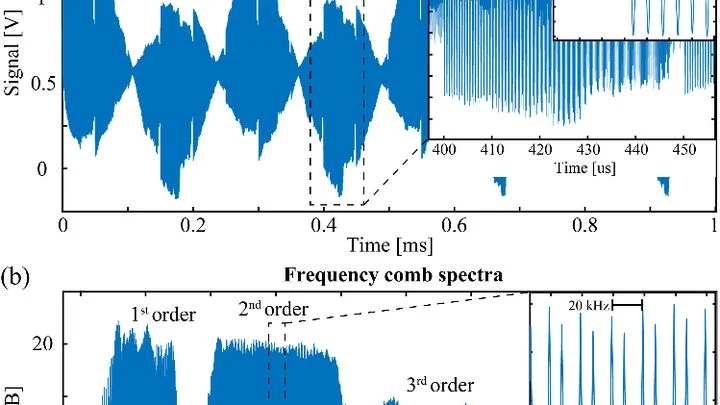
Ordinary white light is a jumble of all colors at once, like the noise of a crowd where everyone speaks at their own frequency. But scientists need light where frequencies are aligned with ruler-like precision, like piano keys, where each note sounds distinct and exact.
In a small copper box, resembling a matchbox, magnetic waves reside. They arise in a tiny crystal of yttrium iron garnet when radio waves are passed through it. Two waves with different characters (one fast, the other slow) usually ignore each other. But when their frequencies match, a dance begins: the waves either merge into one strong wave or cancel each other into complete silence.
If you compress a plate with accordion-like cells, a kink wave runs through it, like a wrinkle in a rug when you push it with your foot. Such waves can switch the material between two stable shapes, and this is the basis of mechanical memory. But if a table leg gets in the way of the wrinkle, it gets stuck. In a new study, researchers showed how to nudge it loose without brute force.
An ordinary superconductor loses resistance when cooled, and current flows through it without loss. But in ultrathin films, things are different: the material fluctuates between normal and superconducting states, and in this transition zone, strange resistance waves emerge. Resistance rises and falls as if someone were turning a volume knob.
Toss a handful of pebbles into a pond, and the spreading ripples intersect, creating splashes and calms. That’s roughly how gravitational waves, predicted by Einstein, behave. Except it’s not water that’s oscillating, but spacetime itself.
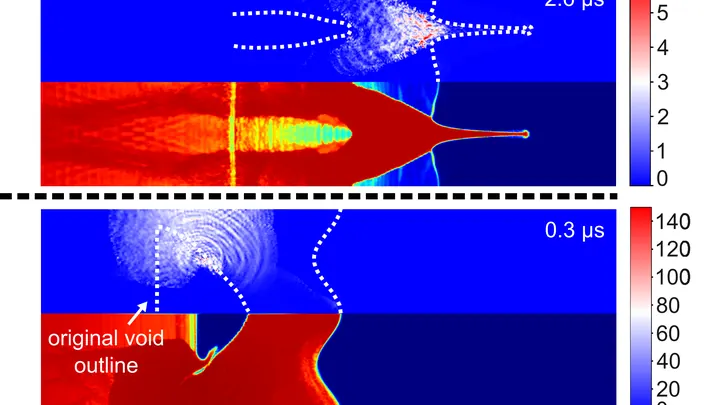
A blast wave slams into a surface, and the surface starts to wrinkle like a carpet when you drag your foot across it. These wrinkles grow, curl into vortices, and stir everything around. In fusion, such mixing is a big problem: the fuel doesn't compress evenly, and the reaction fizzles out.
Physicists have found a way to stop this process without touching the wave itself.
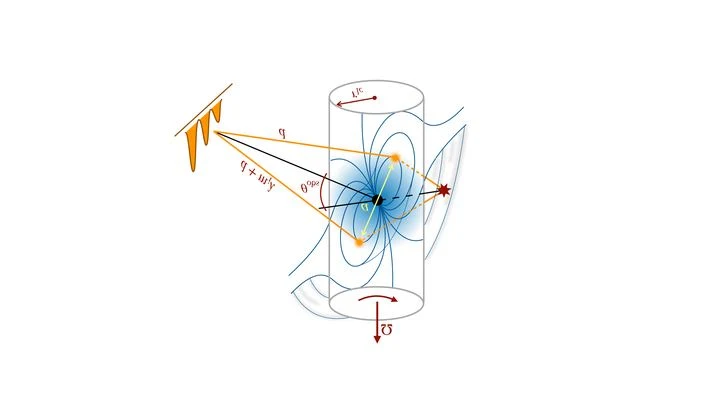
A radio telescope picks up a signal from the Crab Nebula, and instead of a smooth line, the screen shows bright and dark bands, like on a zebra's hide. This is the emission from the pulsar, a rapidly spinning neutron star left over from a supernova explosion.
If you toss a stone into a pond, ripples spread across the water. Tiny magnetic crystals also host waves — except it's not water that oscillates but the direction of magnetization. These are called spin waves. They travel through the crystal like ripples on a surface and can carry information.
In an ultracold cloud, potassium atoms behave like waves that can add up and amplify each other — much like sound waves in a musical instrument create a loud chord. Physicists have learned to control this process by tuning the strength of atomic interactions with a magnetic field.