3D printing, also known as additive manufacturing, is a process that creates physical objects from a digital blueprint by depositing material layer upon layer. Unlike traditional subtractive methods that carve away from a solid block, 3D printing builds up the final shape with precision, enabling complex geometries that would be impossible or prohibitively expensive to machine. The technology has evolved from rapid prototyping to a production tool across industries, from aerospace components to custom medical implants.
History
The first working 3D printer was developed by Chuck Hull in 1984, who patented stereolithography—a process using UV light to cure photopolymer resin layer by layer. The term '3D printing' gained popularity in the 1990s as fused deposition modeling (FDM) became commercially available.
How it works
A digital 3D model is sliced into thin cross-sectional layers by software. The printer then translates each slice into physical form—typically by extruding molten plastic, curing liquid resin with light, or fusing powder with a laser—and repeats the process layer by layer until the object is complete. Recent advances include volumetric printing, where an entire object is solidified at once using holographic light projection, and continuous printing methods that eliminate the layer-by-layer pause.
In practice
Used in manufacturing for rapid prototyping, custom prosthetics, dental aligners, aerospace lightweight components, and even food printing. In research, it enables the fabrication of microfluidic devices and metamaterials with tailored properties.
Fun fact
Some 3D printers can now print an entire object in a single flash of light using volumetric techniques, reducing print time from hours to seconds.
A sheet of paper left on a wet table warps and lifts its edges. No one controls that motion, but it follows the same laws as plant growth: some areas of the sheet shrink more than others, and the flat form becomes three-dimensional. Engineers have long dreamed of taming this process so that a flat blank folds itself into a desired sculpture. In the new work, that trick succeeded with accuracy down to one percent.
To capture every detail of a statue's shape, you could break it into millions of tiny cubes and describe each one — slow, heavy, and your computer's memory would groan at the seams. That's how 3D medical scans are usually handled: a CT or MRI is a huge array of such cubes (voxels), and to create or improve an image, the machine has to plow through all of them.
Creating a material with desired properties is an art that long relied on intuition and luck. Nature gives no hints: dozens of elements in the periodic table, and the number of their combinations tends to infinity. Previously, materials scientists resembled alchemists, trying everything in a row, or relied on statistical models that lost power beyond the known.
Training an accurate aerodynamic model is like culinary art: first, a chef masters hundreds of recipes to grasp the general principles, then easily perfects a specific dish. Engineers created AeroTransformer and fed it 30,000 different wing shapes — a whole galaxy of culinary ideas galaxy.
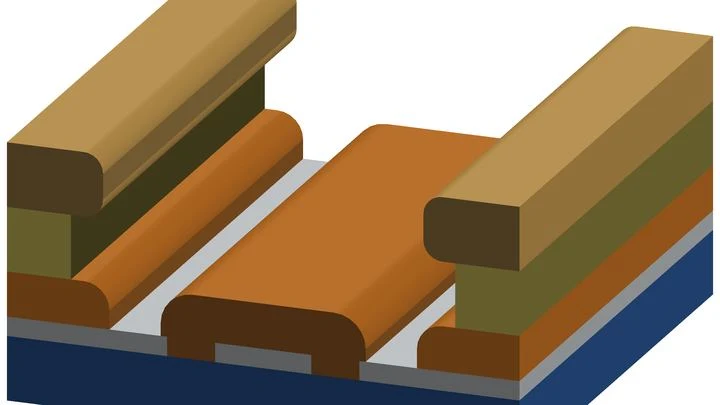
Conventional photolithography, used to make chips, hits a fundamental limit: light cannot draw features smaller than its wavelength. Here, they took a different route. First, they made sparse vertical ridges of oxide, then deposited layers of aluminum oxide, each one atom thick, onto them.
Light from distant stars travels for millions of years, but X-rays can't be caught with ordinary glass: they pass right through it like a bullet through paper. That's why X-ray telescopes need special lenses: stacks of tiny prisms that gently deflect the rays and focus them to a single point.
A piece of aluminum alloy is heated, and it quietly tells you about its strength. You just need to listen to that story in how the metal absorbs heat.
The usual way to find out how strong an alloy is — pull it until it breaks. That takes time and destroys the sample.
A laser beam strikes a gold-and-silver film for just a few nanoseconds — in that time, light travels less than a meter. At the point of impact, the metal boils, splatters, and freezes into a random pattern of tiny particles. Each pattern is as unique as cracks in ice or tree branches.
An octopus tentacle bends, grabs, and stretches — all without a single bone. The secret is that inside it, sections that contract alternate with sections that remain passive. Scientists have long tried to replicate this trick in artificial materials, but until now they couldn't precisely dictate how a material would change shape.
Now researchers have proposed 3D-printing elastic threads from two materials at once.
A metal part grown on a 3D printer looks indistinguishable from a forged one. But when load is applied, a very different story unfolds inside. A synchrotron X-ray beam is like a microscope that sees through steel and reveals what's happening right at the crack tip.
In ordinary forged steel, a crack blunts before it can propagate further.
An ordinary rubber pad dampens vibration the way a thick blanket muffles sound: the thicker and heavier, the better. Engineers have long dreamed of a material that is light yet "eats" oscillations as well as a massive damper.
A typical 3D printer squeezes out plastic like a pastry chef piping cream from a bag. Here, instead of plastic, it's light. A laser beam draws in liquid resin, making it solidify at precise points. This creates parts too small to see without a microscope.
Until now, such printers were slow: the beam crawled across the surface like a pen on paper.
In microchips, wires usually lie flat on the surface, like rails on the ground. But sometimes one wire needs to leap over another without touching it. For that, engineers build air bridges — thin metal arches suspended above the chip.
Previously, such a bridge was assembled in several stages: deposit a layer, expose it, etch it, repeat. Each stage is a chance to mess something up.
A flashlight beam in fog draws a cone, but it can't carve a figure out of a cloud. A hologram, though, is like a stencil for light: it knows in advance where to gather into bright points and where to remain shadow. Now such a stencil makes liquid resin solidify throughout the entire volume at once, without layer-by-layer printing.
A printer that prints not with ink but with metal and ceramic is now a reality. Scientists took an ordinary drop of water containing dissolved metal salts and made it deposit copper, zinc oxide, or nickel hydroxide onto a surface — all with precision down to millionths of a meter.
The secret lies in electricity.
As light passes through a patterned plate, it folds inside a transparent liquid into a three-dimensional pattern. Where the light is brighter, the resin hardens. After 7.5 seconds, a finished part is lifted out of the liquid — complete with cavities, channels, and tiny protrusions.
A regular 3D printer prints point by point or layer by layer.