Laser instead of a finger: measuring the elasticity of turbid liquids express
Cream, gel, blood, or construction mortar: they all both flow and spring back. To understand how such a material will behave, engineers and doctors usually squeeze or rock it with a special instrument. That is slow and damages the sample.
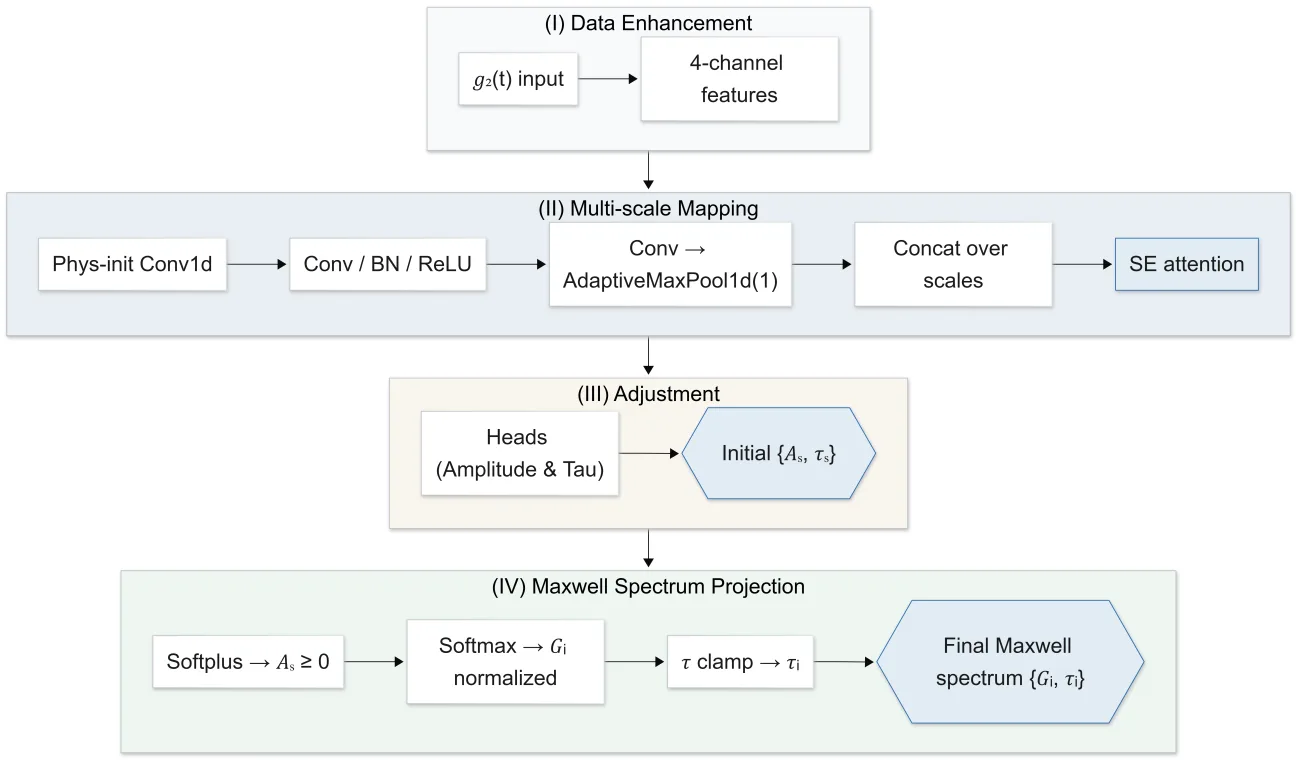
A group of researchers proposed a different path. A laser beam illuminates the turbid liquid, and a camera captures the "ripple"—random light and dark spots that arise when light scatters inside. From these spots, one can infer how microscopic particles move within the liquid. Then a neural network takes over: it translates the speckle pattern into a set of numbers describing the medium's elasticity and viscosity — much like how the jiggling of jelly on a plate hints at how much gelatin it contains.
The method was tested on various liquids with different degrees of turbidity. The error was less than one percent, and the results matched those of a traditional instrument. Now it is possible to quickly check the quality of cosmetics, medicines, or food products right on the production line, without waiting for laboratory tests.
The laser beam has once again become a universal measuring tool: this time for soft and turbid media.
Original abstract
as written by the authors arXiv:2603.01262
Critical breakthroughs in the area of biomedicine and materials science increasingly depend on rapid, non-contact methods for viscoelastic characterization. Laser Speckle Rheology (LSR) is positioned to meet this demand, effectively circumventing the speed and invasiveness bottlenecks inherent to traditional mechanical rheometer. However, its application in turbid fluids is severely constrained by multiple scattering, where standard physical inversions rely heavily on precise, sample-specific optical transport parameters that are difficult to measure in situ. To overcome this barrier, we propose a physics-guided deep learning framework that infers a Maxwell relaxation spectrum from the intensity autocorrelation g2(t) and speckle-intensity histogram statistics. The resulting spectrum is then propagated through a Maxwell forward model to predict G'and G'' under physics-consistency constraints. Quantitatively, the framework achieves RMSElog as low as 0.009 against reference and generalizes to previously unseen scattering conditions, preserving physically plausible frequency dependence and G'- G'' phase behavior. It reduces reliance on optical transport parameters that are hard to determine in situ and returns an interpretable generalized Maxwell relaxation spectrum, improving the practicality of LSR in turbid media.
The speckled pattern from a laser on a rough surface is called a "speckle pattern." It arises because light waves reflecting from irregularities add up and cancel each other at random points.