How a Neural Network Sharpens Focus in Particle Showers express
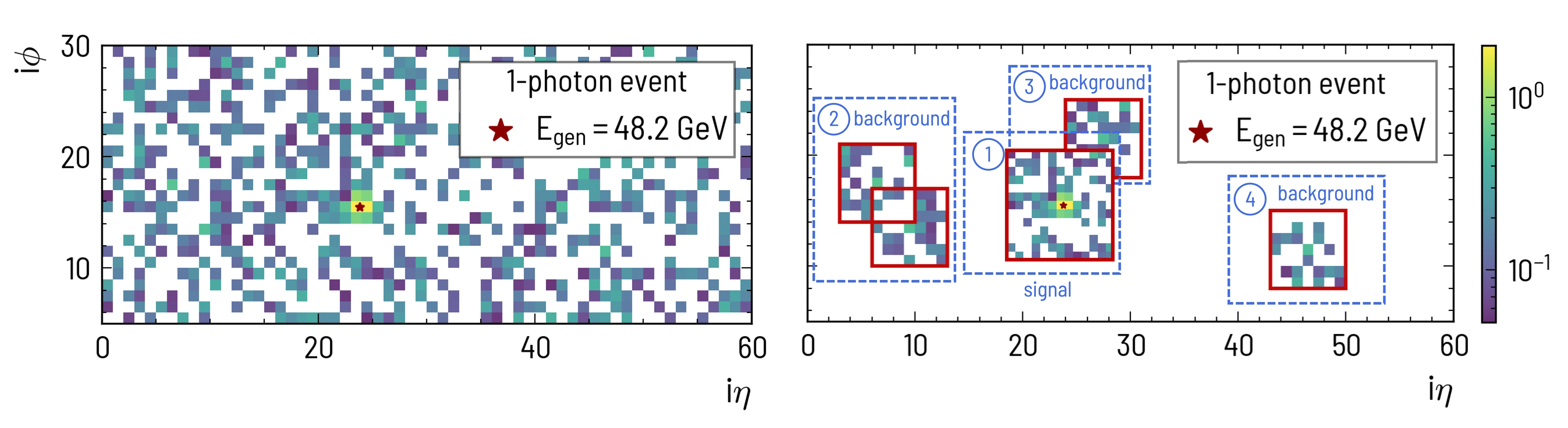
In the Large Hadron Collider's detectors, millions of particles are born every second. Their energy flashes in the calorimeter look like raindrops on a window pane: individual drops are visible, but when there are many and they merge, it's hard to make out each one. Physicists need to know exactly how much energy each particle carried and where it landed.
The new approach hands this task to a neural network. Instead of analyzing each flash one by one, the algorithm looks at the whole picture at once, like a conductor who hears the entire orchestra, not individual musicians. It learns from computer simulations where the correct answers are known in advance, gradually finding patterns that allow it to separate signals even when they almost completely overlap.
The results are encouraging. In a simplified detector model, the new method separates overlapping flashes more accurately, doesn't err on single particles, and less often mistakes one particle for two. And when simulating the decay of a neutral pion into two photons, the standard algorithm often lost the signal, while the neural network maintained a clear picture and correctly reconstructed the mass of the original particle.
In a more realistic model, similar to an electromagnetic calorimeter, the best result came from a single-step architecture called ClusTEX. It not only measures energy more accurately but also stays reliable when some sensors fail, like a pianist who keeps playing even if a few keys stick. Such resilience is crucial for a detector's long-term operation under radiation and wear.
Original abstract
as written by the authors arXiv:2603.18172
Accurate clustering of electromagnetic energy deposits is essential for reconstructing photons and electrons in modern hadron collider experiments, where boosted topologies and pileup cause overlapping showers and ambiguous energy assignment. We present deep learning-based clustering approaches that reconstruct particle energy and position directly from calorimeter readout. The study includes a two-step strategy in which candidate seed windows are identified and then jointly processed via distance-weighted message passing or attention mechanism and a single-step graph transformer, ClusTEX, which performs candidate selection and reconstruction in one inference stage. ClusTEX uses a novel positional encoding scheme that separates local coordinates within the graph from global detector coordinates, enabling efficient, geometry-aware inference. Models are trained on GEANT4 simulations of a simplified (toy) and an ECAL-inspired topology with an explicit $$\eta-\phi$$ dependence. Performance is evaluated using efficiency, energy and position resolutions and splitting rate - reconstruction of two objects for a single photon. In the toy calorimeter, attention-based interactions improve the reconstruction of overlapping showers relative to both the standard algorithm and distance-driven message passing, while maintaining performance on isolated photons and reducing splitting without multi-pass inference. For boosted $$\pi^0\to\gamma\gamma$$, the attention-based model retains di-photon mass reconstruction capability, where the standard algorithm becomes inefficient. In the ECAL-inspired topology, ClusTEX provides the best overall performance, yielding improved energy resolution and reduced splitting compared to two-step approaches and the standard algorithm. It also remains robust under localized detector failures, showing improved stability and partial recovery of energy in non-responsive channels.
In physics, a calorimeter is not a weight-loss device but an instrument that measures particle energy by making particles get stuck in dense material and release heat or light.
In Liu Cixin's sci-fi novel "The Three-Body Problem," aliens use unfolded protons to spy on accelerators — while here, Earth scientists battle noise from the detectors themselves.