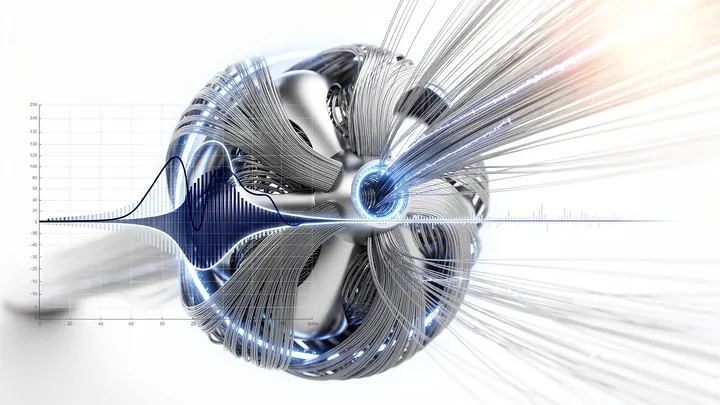
Energy reconstruction is a technique used in cosmic ray physics to estimate the energy of the primary particle—the original cosmic ray that enters Earth's atmosphere—from the properties of the extensive air shower it produces. This is crucial because cosmic rays cannot be directly detected at their source; only their secondary particles reach ground-based detectors. Accurate energy reconstruction is essential for understanding the cosmic ray spectrum, composition, and origins.
History
The technique was developed in the 1950s and 1960s with the advent of large air shower arrays, such as the Volcano Ranch experiment in New Mexico. The fluorescence technique was pioneered in the 1970s by the Fly's Eye experiment in Utah.
How it works
When a high-energy cosmic ray hits the atmosphere, it triggers a cascade of secondary particles—an air shower. The energy of the primary particle is correlated with the shower's size, particularly the number of particles at the shower maximum and the total energy deposited in the atmosphere. Detectors like fluorescence telescopes measure the longitudinal development of the shower, while surface arrays sample the particle density at ground level. By fitting the observed shower profile to simulations, researchers estimate the primary energy.
In practice
Energy reconstruction is used by observatories like the Pierre Auger Observatory and the Telescope Array to measure the ultra-high-energy cosmic ray spectrum, which shows a suppression at the highest energies—the GZK cutoff.
Fun fact
The highest-energy cosmic ray ever detected, the 'Oh-My-God' particle, was reconstructed to have an energy of about 3 × 10^20 electronvolts—roughly the kinetic energy of a baseball thrown at 100 kilometers per hour, but packed into a single subatomic particle.
A storm in the upper atmosphere lasts a few millionths of a second. A cosmic ray, a proton or a helium nucleus, strikes air molecules, sending a swarm of particles downward. Most of them stay together, but occasionally one particle gains so much energy that it surges ahead.
A cartographer receives a sheet with distances between hundreds of unnamed islands. No island is labeled, but the distances repeat, forming triangles and quadrilaterals. From these repetitions, the cartographer reconstructs the map of the archipelago, not knowing which island is which. This is roughly how the new work in molecular spectroscopy works.
The universe abhors monotony. A century ago, Edwin Hubble and Georges Lemaître gave us an elegant picture: an expanding cosmos, smooth as the surface of an inflated balloon.
Cosmic rays are particles from deep space, accelerated to colossal energies. Smashing into the atmosphere, they trigger particle showers with radio waves. These waves are fingerprints, revealing the energy and direction of the intruder.
In the Large Hadron Collider's detectors, millions of particles are born every second. Their energy flashes in the calorimeter look like raindrops on a window pane: individual drops are visible, but when there are many and they merge, it's hard to make out each one. Physicists need to know exactly how much energy each particle carried and where it landed.
Cosmic rays are charged particles that constantly bombard Earth from deep space. When one of these particles enters the atmosphere, it collides with air nuclei and spawns a whole cascade of secondary particles: electrons, muons, photons.
Neutrinos are ghost particles: predicted by the Standard Model, they barely interact with matter. Catching them is like trying to hear a whisper in the roar of a waterfall.
A few hundred million years after the Big Bang, the universe resembled an endless dark ocean, shrouded in a thick fog of neutral (non-ionized) hydrogen. Then something dispersed the gloom: ultraviolet radiation knocked electrons out of atoms, making the gas as transparent as pure water.
Every second, dozens of particles from space fly through each of us. Most are light protons, but there are also heavier atomic nuclei: carbon, oxygen, iron. They are born in stellar explosions and travel to Earth for millions of years. Their energy can be staggering: a single particle can carry as much as a tennis ball on a serve.
At night over the Siberian taiga, a faint blue light sometimes flickers. It's not the aurora borealis but a cosmic-ray shower: a single particle from deep space slams into the atmosphere and shatters into millions of secondary particles. They race toward the ground in a broad front, like a ripple from a stone dropped into water, and make the air glow.
The cosmic electron spectrum is like fingerprints at a crime scene. Particles arriving from the depths of the Galaxy carry in their energies the traces of those that produced them. For a long time, the picture was blurred: instruments with wide energy bins, like out-of-focus photographs, did not reveal details.