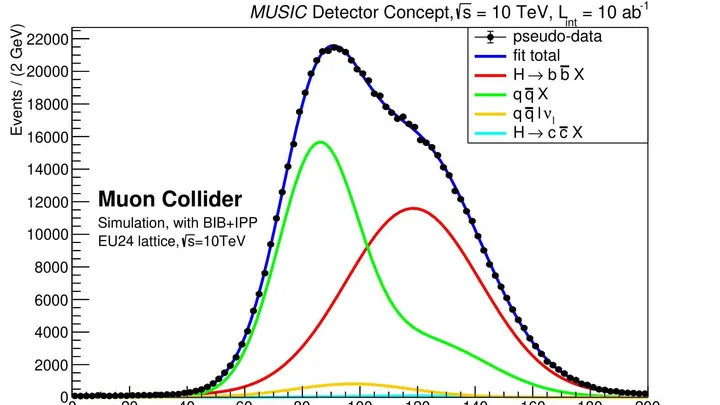
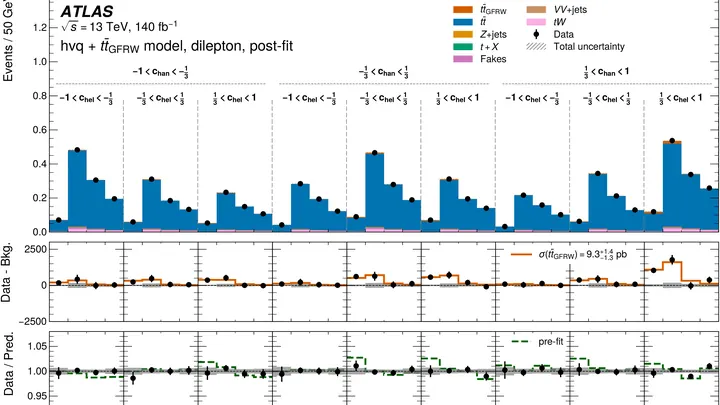
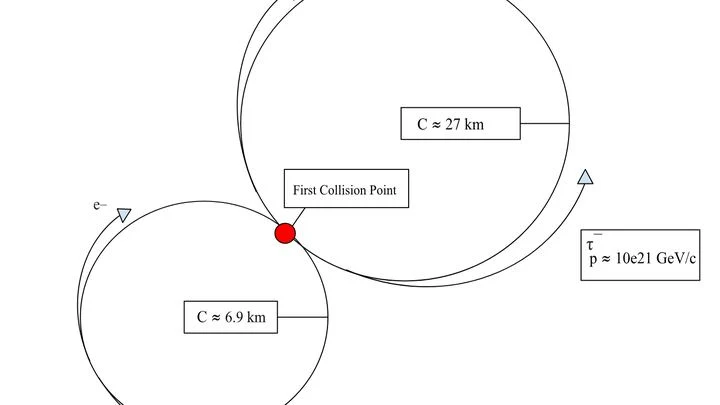
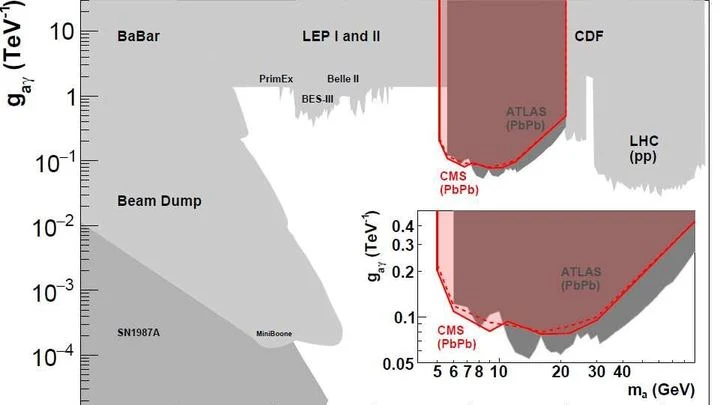
The Large HadronCollider is a 27-kilometer ring, buried underground at depths of up to 175 meters. In it, two counter-rotating beams of protons are accelerated to an energy of 6.8 TeV each (speed — 0.99999999 of the speed of light) and collide head-on with a total energy of 13.6 TeV. The beams are kept in orbit by 1232 superconducting magnets, cooled by liquid helium to 1.9 K (colder than outer space). At the collision points, gigantic detectors — ATLAS, CMS, LHCb, and ALICE — record the hundreds of particles born in each collision.
History
The LHC project emerged in the early 1980s as a successor to the Large Electron-PositronCollider (LEP). After approval in 1994, construction proceeded from 1998 to 2008. On September 10, 2008, a beam was successfully circulated, but 9 days later an electrical fault caused a helium explosion and took a sector out of commission. A restart after repairs and upgrades occurred in November 2009, and the first 7 TeV collisions took place in March 2010. Thousands of CERN engineers and scientists played a key role in creating the accelerator, and the ATLAS and CMS collaborations were instrumental in discovering the Higgs boson.
How it works
Protons are accelerated by high-frequency resonators (400 MHz), and the trajectory is maintained by superconducting magnets. When counter-rotating bunches collide at the intersection points, thousands of particles are born, which are registered by multi-layered detectors: tracking systems (silicon pixels), calorimeters (electromagnetic made of PbWO₄ crystals, hadronic — iron/scintillator), muon chambers. Magnetic fields in the detectors (solenoids or toroidal magnets) enable momentum measurement. A huge challenge is extracting rare events from the background at high luminosity — this is accomplished using online trigger systems and offline analysis on computer farms worldwide (GRID).
In practice
The LHC discovered the Higgs boson — the last missing piece of the Standard Model. The superconducting magnets and vacuum technologies developed for it are now used in proton cancer therapy and for sterilizing medical equipment.
Fun fact
In one second, protons in the LHC circle the ring 11,245 times, and the total energy of each beam is comparable to that of a high-speed train.
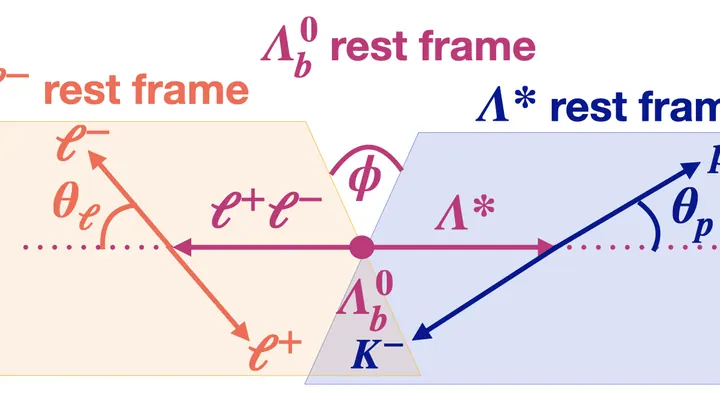
At the Large Hadron Collider, protons are smashed together, and among the debris, a heavyweight particle, the lambda baryon, sometimes appears. It lives for a tiny fraction of a second before decaying into other particles.
Three billiard balls scatter across the table after a strike: their trajectories depend only on the initial push. But in the world of atomic nuclei, things are more complex: particles sense each other on the fly, even if they are not bound together. For a long time, physicists could only measure pairwise interactions, while what happens when three meet remained behind the scenes.
Three billiard balls scatter across the table after a strike: their trajectories depend only on the initial push. But in the world of atomic nuclei, things are more complex: particles sense each other on the fly, even if they are not bound together. For a long time, physicists could only measure pairwise interactions, while what happens when three meet remained behind the scenes.
A proton or an atomic nucleus slams into Earth's atmosphere at tremendous speed, and a cascade of billions of particles is born. This extensive air shower races toward the surface, while sensitive telescopes catch its faint glow. From the shape of the glow, physicists determine how deep the shower penetrated the atmosphere and what it was made of.
In proton collisions at the Large Hadron Collider, sometimes not one but two Higgs bosons are produced. The rate of such events is a direct imprint of how the Higgs field interacts with itself. In the Standard Model, this coupling is rigidly fixed, but extended theories allow deviations.
The cosmic racer SS 433 tears through the Galaxy, ejecting two narrow jets of superheated gas at a quarter of the speed of light. This is a microquasar — a binary system where a black hole siphons matter from a normal star, and some of it escapes as jets.
The cosmic racer SS 433 tears through the Galaxy, ejecting two narrow jets of superheated gas at a quarter of the speed of light. This is a microquasar — a binary system where a black hole siphons matter from a normal star, and some of it escapes as jets.
The Higgs boson is like a tuning fork that rings at a strictly defined note. But physicists have learned to hear it even when the note is off — in the so-called 'off-shell' region. It was there, in the data from the CMS detector, that answers were hiding about what the Higgs mechanism is really made of.
The proton is not a monolithic ball. It is a seething cloud of quarks and gluons that constantly appear and vanish. Parton distribution functions help describe this picture: they show the probability of encountering a quark or gluon with a certain energy inside the proton.
The 21-kilometer ring near Protvino was once planned to accelerate protons. Today, the same tunnel could host a very different machine — a muon collider. The muon is a heavy cousin of the electron, and that's its strength. On a curve, an electron radiates like a searchlight, losing precious energy. A muon radiates a billion times less.
Deep inside the ATLAS detector, like in a giant thermos, liquid argon sloshes — a transparent liquid at minus 184 degrees Celsius. When a particle flies through it, a weak electrical signal is born, like a quiet splash.
Deep inside a neutron star, matter is squeezed so tightly that familiar protons and neutrons give way to new players. Hyperons are born there — particles that harbor a strange quark.
For a long time, astronomers searched for the 'factories' of the most energetic cosmic rays — particles that carry the macrocosm compressed to the size of an atomic nucleus. Colossal star-forming regions like Cygnus OB2, where winds from young giants collide, were prime suspects.
At accelerators, by smashing heavy nuclei, physicists briefly create a quark-gluon plasma — a state of matter where quarks and gluons are not confined inside particles but are free. For a long time, it was imagined as a gas, but experiments showed it's an almost perfect liquid.
The story began almost a century ago, when Edwin Hubble showed that galaxies are receding, and Fritz Zwicky and Vera Rubin later realized: to explain their motions, invisible mass is needed — dark matter.
Atomic nuclei are not always like billiard balls. Some are elongated, like cigars, others are flattened. But xenon-129 resembles a potato — a bumpy triaxial ellipsoid.
On a scorching afternoon, a stifling haze hangs over the city, and not a single cloud is on the horizon. Usually, in such weather, all you can do is wait for nature to take pity and send some cool relief. But what if shade and rain could be switched on schedule, like a light in a room?
Deep inside the detector at the Large Hadron Collider, protons collide, and for a fleeting moment something heavy is born. It instantly shatters into two Higgs bosons — particles that, like nesting dolls, each hide two pairs of b-quarks.
A stone falls into a pond, and ripples spread across the water. Likewise, light from distant galaxies spreads in all directions — calmly and steadily. But at the center of some galaxies, it's not a stone but a veritable cannon: it fires particles with monstrous force. Astronomers call such objects HSP BL Lac.
A noisy train station at rush hour. Thousands of people hurry past, voices merging into a dull roar. Somewhere in the crowd, two people try to shake hands with a special, barely visible gesture. Spotting such a handshake is nearly impossible.
A drop of cream in a glass of milk. Shake it, and the fat doesn't spread evenly: it clumps into denser blobs that move differently from the rest of the liquid. Quarks inside mesons, tiny particles that live for mere fractions of a second, behave in much the same way.
A meson consists of a quark and an antiquark, and they are rarely equals.
Two blindingly bright beams smash head-on. At the point of impact, a particle is born for an instant — the very one responsible for the mass of everything in the universe. That's the Higgs boson. Usually, it's produced by accelerating protons or electrons, but here the projectiles are particles of light themselves — photons.
At the Large Hadron Collider, protons collide billions of times per second, and only once in a trillion collisions does a pair of Standard Model Higgs bosons (the particles responsible for the mass of everything) emerge. In the CMS experiment, physicists hunted for exactly such events.
A coin landing on its edge is about as rare as a heavy B meson decaying into a light pion and an electron-positron pair. Over a decade of collider operation, only a handful of such events have accumulated, but physicists have finally managed to spot them.
The decay probability is about 2.4×10⁻⁸.
In the LHCb detector, where protons collide, one unusual track was found among billions of decays. The particle, named $$D_{s1}$$(2933)^+, appears for a moment and immediately decays into other particles. Its lifetime is so short that it cannot be observed directly — only through its decay products can its existence be reconstructed.
A handful of coins accelerates to one-fifth the speed of light. That's what Coracle interstellar probes will be like — tiny spacecraft weighing just a few grams, each with an ultrathin sail film. A powerful laser beam pushes them forward: light presses on the sail like wind fills a yacht's sails, except instead of air, it's a stream of photons.
The Higgs boson is like a conductor that gives mass to all other particles. Without it, electrons would be massless and atoms would fall apart. But how does the conductor interact with itself? That is the key question a future muon collider aims to answer.
In the CMS detector at the Large Hadron Collider, protons accelerated to nearly the speed of light collided. Among billions of such collisions, physicists searched for a rare signature: the production of a single heavy particle that immediately decays into a W boson and a b quark.
Oil droplets in boiling broth usually scatter apart, but if you bump them together very slowly, they may stick for a moment. Something similar happens with top quarks — the heaviest known building blocks of matter.
In a giant particle accelerator, particles smash into each other, and sometimes after the collision only two photons, particles of light, remain. Physicists can predict how often this happens, but their calculations have long disagreed with what detectors see. Each refinement of the theory changed the answer, and there was no consensus.
When two particles fly at almost the same speed in the same direction, their signals in the detector merge, like two voices in unison. Telling a duet from a soloist is an art in itself.
From 2016 to 2018, at the Large Hadron Collider at CERN, protons collided at energies of 13 teraelectronvolts, as if two peas were accelerated to speeds where their impact spawns a whole swarm of new particles.
In collisions of heavy nuclei at colliders, quark-gluon plasma is born — a state of matter where quarks and gluons are as free as water in steam. Heavy quarks, such as b-quarks, entering this plasma lose energy, and their bound states, bottomonia, are destroyed.
At the Large Hadron Collider, protons collide, and from the flash dozens of particles are born. Among them may be traces of rare processes — for example, the decay of a Standard Model Higgs boson into two W bosons. But these particles fly apart so quickly that their tracks merge into a single wide jet.
Cosmic rays are particles that arrive from deep space. When such a particle hits the atmosphere, it triggers a whole shower of new particles, like a billiard ball breaking a rack, sending balls scattering in all directions. To predict what such a shower will look like, we need to know how the primary particle interacts with the nuclei of air atoms.
Colliding two lead nuclei at the Large Hadron Collider is like throwing two hefty bags of marbles at each other. Usually, the marbles scatter in all directions, but sometimes one bag passes so close that the marbles don't collide: they just exchange glances.
A ring road around the Sun, where the traffic is not cars but clumps of matter. The diameter of this road is measured in light-years: it encircles our planetary system at its outer edge, in the Oort Cloud, where the star's weak gravity still holds sway.
In proton collisions at the Large Hadron Collider, physicists have for the first time caught a particle with two charm quarks. It is called Ξcc+ (pronounced "ksi-ksi-plus") and resembles a bead with not one but two heavy nuclei.
Two particles flying apart in opposite directions behave as a single whole: measuring one instantly determines the state of the other. Such quantum entanglement has long been known for light particles, but now it has been observed for the first time in heavy Z bosons — the carriers of the weak force.
In the kitchen, two flashlight beams pass through each other without noticing. Light barely interacts with light. But if you accelerate particles to enormous energies, two photons can collide and give birth to something new.