XGBoost (eXtreme Gradient Boosting) is a machine learning algorithm that builds predictive models by combining many simple decision trees in an iterative fashion. It is a form of gradient boosting, where each new tree corrects the errors of the previous ones, gradually improving accuracy. XGBoost is widely used for structured data problems, such as classification, regression, and ranking, and is known for its speed and performance in competitions and real-world applications.
History
XGBoost was introduced by Tianqi Chen in 2014 as a research project at the University of Washington. It quickly became a dominant tool in machine learning competitions, especially on platforms like Kaggle.
How it works
The algorithm starts with an initial prediction and then fits a decision tree to the residuals (errors) of that prediction. Each subsequent tree is trained on the remaining errors, and the predictions are combined by adding the trees together, weighted by a learning rate. XGBoost includes regularization to prevent overfitting and uses a cleverly optimized implementation that handles sparse data and parallel processing efficiently.
In practice
Used in diverse fields including medical diagnosis (predicting disease progression from imaging or lab data), finance (credit scoring and fraud detection), and physics (classifying particle events or predicting material properties).
Fun fact
XGBoost has been used to win numerous machine learning competitions, and its name is short for 'Extreme Gradient Boosting', reflecting its focus on pushing the limits of performance and scalability.
A thousand candidates are sitting in the interview room, but only two hundred will be hired. It used to seem that to accurately estimate age from DNA, you had to interview every one of the thousand sites where a chemical mark alters gene activity. Now it's clear: you can hear out just a fifth of them, and the final decision barely changes.
Diamond is not just a gemstone. Hidden inside its crystal lattice are defects that sense magnetic fields better than many instruments. One such defect, the NV center, acts as a tiny compass, but its needle wavers from heat and noise. For the compass to point accurately, calibration is needed.
Imagine a simultaneous interpreter in a room where two people are speaking: they must keep up with both meaning and intonation, but if the speech is too fast, only a paraphrase remains. That's roughly how scientists feel as the stream of gravitational waves from black hole and neutron star mergers grows, while precise signal calculations lag behind.
The brain doesn't just react to the world: it's constantly guessing what will happen next. This principle is called predictive coding: neurons compare expectations with reality and update their internal picture when an error occurs. But how such a complex system could be wired into the living tissue of the cortex remained unclear.
A web where lions eat zebras and hyenas finish the leftovers is not just a list of dinners. It's a survival map for an entire region. When the climate shifts, animals move, and the map tears. To understand where it will tear and where it will hold, you need to find its unchanging 'skeleton'—the connections that repeat across different places.
A neuron receives thousands of signals on its branching processes — the dendrites. Some signals push the cell toward firing (excitation), others hold it back (inhibition). For a long time, it was thought that the neuron simply adds up all the 'fors' and 'againsts.' But in real dendrites, inhibition works differently: it can not subtract but divide the excitatory signal.
The temperature at the center of a galaxy cluster reaches a hundred million degrees. These largest gravitationally bound systems are natural laboratories where nature hides 85% of its mass in invisible dark matter.
15 175 107 stars. Each one got an age. But no number is free of uncertainty: a star's age isn't a nail hammered into the timeline: it's a probability cloud, a fog hiding the true value. For galactic evolution, such a timestamp is priceless: without it, the map of the Milky Way remains flat.
A hundred thousand stars in the dense core of a globular cluster move like steel balls in a giant pinball machine. Each 'bump' — a gravitational encounter between a binary system and a single star — triggers a cascade of unpredictable events.
In the depths of the Universe, when a massive star collapses into a black hole or a magnetar is born, a gamma-ray burst flares up — for an instant, it outshines all the stars in the observable Universe.
Power systems with solar panels and wind turbines are like a chess game: cloud cover and load changes are the opponent's moves, impossible to foresee. To maintain balance, operators used to run through dozens of scenarios (uncertainty) — that took too much time and computing power.
X-ray magnetic circular dichroism is a precise tool that has long allowed the separation of spin and orbital magnetic moments. However, the classical approach resembles judging an orchestra by its volume: it relies on sum rules, reducing the entire fine structure of the spectrum to a couple of integrals.
A large neural network like Whisper masters hundreds of languages and resembles the standard model of the universe: everything is balanced. But training on a rare language disrupts this equilibrium — it turns into a black hole, pulling in all training resources. The network starts forgetting the other languages.
DFTB is a high-speed train in the world of quantum chemistry: hundreds of times faster than classical DFT, yet still on electronic rails. But its engine — iterative self-consistency of charges — sometimes resembles an orchestra where each instrument starts from an arbitrary note.
Recommendation systems that decide which post you’ll see next run on deep neural networks made up of thousands of operations — intricate computation Graphs (blueprints of operations on data). These systems are living, ever-evolving Dynamical Systems: the slightest architecture change cascades through the entire graph.
In the courtroom, a string is presented as input. Twelve jurors (computation paths) examine it symbol by symbol. Each can render a 'guilty' (accept) or 'not guilty' verdict. For a conventional nondeterministic automaton (NFA), one 'yes' vote suffices.
60 mice, 1,980 samples, 234 lung cancer patients. Behind each number lie thousands of genes. Their activity is measured to understand the disease. But the data aren’t uniform: for one patient, you assess a protein level (a continuous number), make a diagnosis (yes/no), and determine the tumor subtype (a category).
Galaxy clusters are the greatest gravitational ensembles in the Universe. In X-ray glow from hot plasma, the story of cosmic expansion, hidden dark matter, and enigmatic dark energy is encoded.
Engineers create an alloy for solar concentrators by adding hard particles — like raisins in dough, to help it hold its shape under extreme heat. Too big a raisin and the material cracks. Previously, scientists manually counted these particles on microscope images.
Imagine an interpreter sitting in a meeting room, translating every word. But then they notice their translation could improve if they learned from their mistakes. They start noting which phrases caused confusion and adjust them. Within an hour, their translation is more accurate and the meeting runs smoother.
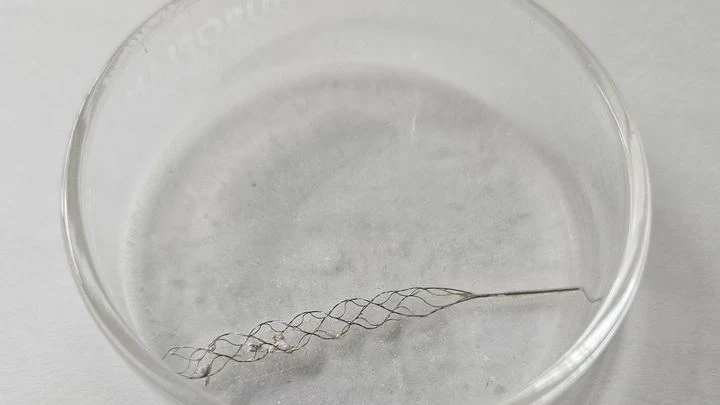
A plumber clears a clog in a narrow, winding pipe — by feel, without seeing inside. That's roughly how a surgeon feels during mechanical thrombectomy, the operation to remove a blood clot from a brain vessel. Time is short, and every move can either save a life or damage the vessel wall.
A rice field by the sea may look green, but the stalks are stunted and the grains are shriveled. Salt has silently poisoned the soil. In Satkhira district in southern Bangladesh, every farmer knows this scene. Salty water comes in with the tides, seeps into the ground, and the land stops yielding. To fight the problem, you first need to know where the salt is hiding beneath the roots.
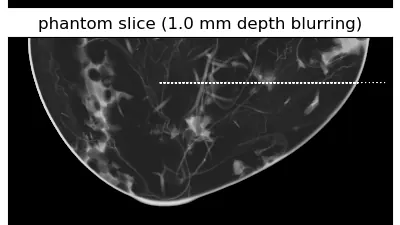
The X-ray machine moves around the breast in an arc, taking several images from different angles. From these flat frames, the computer assembles a 3D picture, like putting together a mosaic from pieces. But if the mosaic pieces are crumpled or smudged, the picture turns out blurry. In tomography, the role of "crumples" is played by noise and imperfections in the imaging.
Show the same photo of a cat to two different neural networks, and they often reach a similar conclusion: "cat." But ask them for more detail, and their answers may diverge. One model focuses on the whiskers, another on the coat color, a third on the pose. So even within the "visual" world of neural networks, there's no complete unity.
Training an accurate aerodynamic model is like culinary art: first, a chef masters hundreds of recipes to grasp the general principles, then easily perfects a specific dish. Engineers created AeroTransformer and fed it 30,000 different wing shapes — a whole galaxy of culinary ideas galaxy.
A protein is like a chain of amino-acid beads that folds into a precise shape, and that shape dictates how the protein works in a cell. Protein designers swap beads to achieve the desired form, but the number of possibilities is enormous.
A uranium nucleus is like a tight wallet snapped shut on two halves. To make it burst and release energy (that is, to make the nucleus split) you have to climb over an energy barrier. The height of this threshold determines whether a substance is stable or ready to fall apart at any moment.
An orchestra where each musician plays their own part but hears only the neighbor. One wrong note, and a wave of errors rolls through the hall. That's how Ising machines work — special devices for solving problems where you need to find the best option among many.
Smartwatches measure your pulse with light: an LED shines through the skin, and a sensor picks up the reflected signal. By analyzing the fluctuations in this signal, you can estimate blood pressure, but accurate calculation requires a powerful neural network — usually running in the cloud, so data leaves the device.
Particle detectors such as resistive plate chambers (RPCs) work like sensitive traps: when a charged particle flies through, it generates an electrical signal. But sometimes the chamber fires a false hit, as if an invisible hand pressed a doorbell. These spurious signals muddy the picture and make it harder to pinpoint the particle's path.
Training a neural network is like sledding down a hill: you need the right speed to avoid getting stuck or flying off the track. In the popular momentum method (like inertia), a constant value of 0.9 is typically used.
When a planet passes in front of a star, the light pierces its atmosphere and absorbs the flavor of gases. Each gas leaves its color fingerprint in the light — a bitter or sweet stroke. Scientists try to read this recipe: what substances and in what proportions are mixed in the air of an alien world.
When a massive star dies and collapses into a supernova, a neutron star is born — a city-sized sphere with the Sun's mass. Its matter is so compressed that a teaspoon weighs more than Mount Everest. Physicists are trying to learn the "recipe" of this matter — the equation of state that explains how matter behaves under extreme pressure.
The atmosphere is a chaotic system, and a detailed global forecast requires monstrous computing power. StretchCast sidesteps this by working like the human eye: it creates 'sharp vision' over a selected region with an ultra-fine grid, while seeing the rest of the world blurry, but sharp enough to capture global connections.
In a cold cloud of atoms chilled to near absolute zero, energies can behave like threads that weave into braids. These braids are not just a pretty image: their pattern is tied to topology, the branch of mathematics that studies properties preserved under continuous deformations.
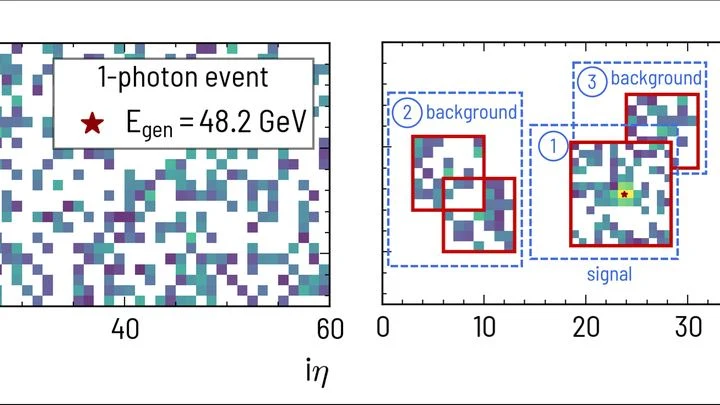
In the Large Hadron Collider's detectors, millions of particles are born every second. Their energy flashes in the calorimeter look like raindrops on a window pane: individual drops are visible, but when there are many and they merge, it's hard to make out each one. Physicists need to know exactly how much energy each particle carried and where it landed.
A programmer writes code, runs it, sees an error, and fixes it. Now this process can be handed over to the program itself. Machine learning can already improve algorithms, but it usually requires lots of data and ready-made examples.
Growing an ultra-pure germanium crystal is a bit like baking a finicky soufflé: a slight overheating or an extra speck of impurity, and the whole ingot is only good for remelting. Such crystals are the heart of detectors that catch the rarest events, from dark matter to double beta decay.
Proteins in a cell communicate like people in a bustling city: some pass signals, others put on the brakes, and still others just hang around. A graph neural network sees the map of these connections, who's linked to whom, but to it, they're just lines.