Aluminum Nitride Piezoelectric Transducer express
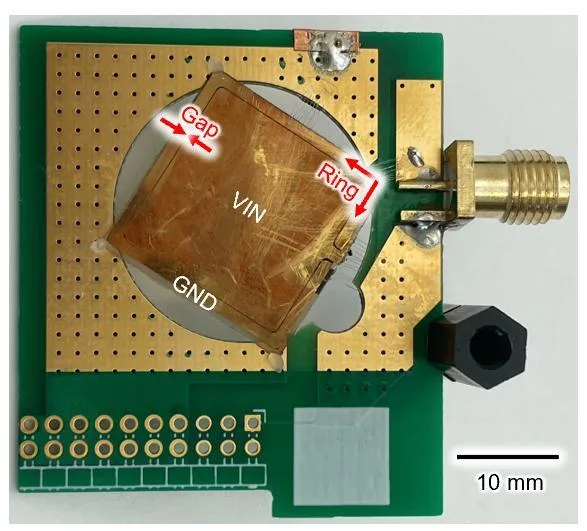
The electric current in a wall outlet is like water in a high-pressure pipe. To power a delicate chip, the pressure needs to be reduced, and this is usually done by bulky coils with iron cores. The engineers behind this work propose replacing them with a tiny plate of aluminum nitride — a crystal that vibrates at a frequency of 13.52 million times per second, converting electricity into mechanical vibrations and back.
The plate resonates like a bell after being struck: the longer it rings, the lower the losses. The researchers measured a quality factor of 1677—meaning the vibrations decay very slowly, and energy is hardly wasted. But such a bell has false overtones — spurious vibrations that corrupt the signal's purity. To eliminate them, a grounded ring was added around the plate, like a drum mute, and the spectrum became clean.
Currently, such transducers are already used in phones and chargers, but they cannot deliver high power: they overheat. The new material promises to solve this problem: it withstands high temperatures and dissipates heat like a metal. In the future, this could enable chargers the size of a coin that power a laptop or even an electric vehicle without getting hot.
Original abstract
as written by the authors arXiv:2603.19409
In this work, we demonstrate the first single-crystal aluminum nitride (AlN) wafer-based thickness-extensional (TE) mode bulk acoustic resonator for piezoelectric power conversion. The device exhibits a high series resonance 3-dB quality factor ($$Q$$) of 1677 and an electromechanical coupling coefficient ($$k^2$$) of 6.1%, highlighting the strong potential of AlN resonators for efficient power conversion. To suppress in-band spurious modes, a grounded ring structure is proposed and experimentally validated. The measured frequency-domain impedance response shows a spurious suppression of the spectrum above the resonance at 13.52 MHz. A comparative analysis with prior PZT, LN, and LT-based resonators indicates that AlN achieves a competitive figure of merit and $$f \cdot Q$$ product, while its material thermal conductivity is orders of magnitude higher than that of the incumbent piezoelectric power-converter resonators. The power-handling capability is expected to be superior in AlN single-crystal wafers and will be demonstrated in ongoing experiments. These results suggest that AlN offers a promising platform for compact, robust piezoelectric power converters and next-generation power electronic systems.
The frequency of 13.52 MHz is about 600 times higher than the highest note on a piano. Such rapid vibrations allow energy to be transferred very compactly.
In Arthur C. Clarke's novel 'Childhood's End,' aliens use compact energy sources that don't heat up — reminiscent of the dream of powerful piezoelectric transducers.