Thermal conductivity is the property of a material to conduct heat, determining how efficiently thermal energy transfers through substances like thin films or superconductors.
49 related articles · 5 formulas · 2 who worked here
Thermal conductivity (k) is the proportionality coefficient in Fourier's law: heat flux density q⃗ = –k ∇T, where ∇T is the temperature gradient. It characterizes the ability of a substance to transfer the kinetic energy of microscopic particles without macroscopic movement of the substance. In metals, heat transfer is mainly by conduction electrons; in dielectrics, it is by phonons (quanta of crystal lattice vibrations). Silver has the highest thermal conductivity among pure metals (k ≈ 430 W/(m·K)).
History
The law of thermal conduction was formulated by Joseph Fourier in 1822 in his 'Analytical Theory of Heat'. For over a century, thermal conductivity remained a phenomenological constant. The kinetic theory of gases (James Clerk Maxwell, Ludwig Boltzmann) made it possible to relate it to molecular motion. In the 20th century, the development of quantum solid-state theory (Peter Debye, Rudolf Peierls) led to the phonon picture and the prediction of lattice thermal resistance. At the end of the century, materials with extreme thermal conductivity (diamond, graphene, nanotubes) were discovered.
How it works
In solids, heat transfer occurs via two main carriers: conduction electrons and phonons. Phonons — collective lattice vibrations — behave like a gas of quasiparticles and obey Bose–Einstein statistics. The distribution of phonons over frequencies and wave vectors is described by dispersion relations depending on crystal symmetry. Thermal resistance arises because the phonon mean free path is finite, limited by anharmonicity of interatomic potentials (three-phonon processes), isotopic disorder, defects, and grain sizes. At high temperatures, scattering on other phonons (so-called Umklapp processes) dominates. In nanostructures, the mean free path can be limited by geometric dimensions, leading to reduced thermal conductivity (phonon ballistic regime).
In practice
Copper pipes in a radiator quickly release heat into the room, while a wool sweater retains body heat due to low thermal conductivity of air in fluffy fibers.
Fun fact
Diamond has a thermal conductivity five times higher than copper, although diamond is an electrical insulator. The reason is a rigid crystal lattice and light carbon atoms, along which phonons travel quickly.
A tiny black hole flies through a hydrogen cloud and stretches atoms like taffy. That is what a superconductor looks like when it traps a persistent current: a material in which electricity flows without losses turns into a miniature permanent magnet.
Swimming season opens when the water feels tolerable. But everyone has their own threshold: one person shivers at twenty degrees, another swims comfortably at fifteen. Scientists decided to figure out where this difference comes from.
They compared a swimmer's body to a house trying to keep heat in while a cold wind blows outside.
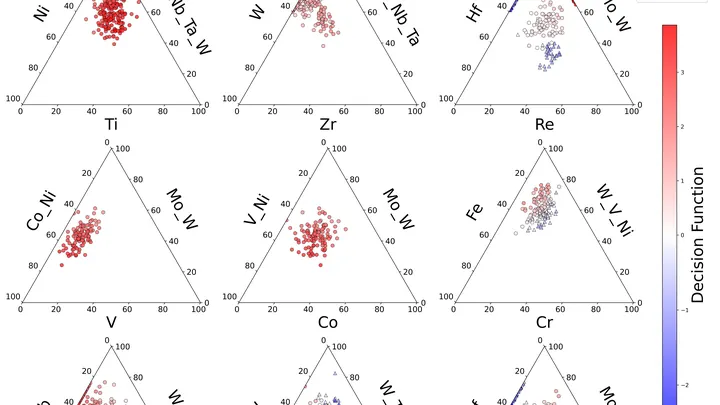
A metal made of five different atoms is like a soup with bits of carrot, peas, potato, onion, and meat floating in it. Each bit is its own element: chromium, vanadium, titanium, niobium, and tantalum. Such an alloy is called high-entropy: there is no single order, and the atoms are mixed almost randomly.
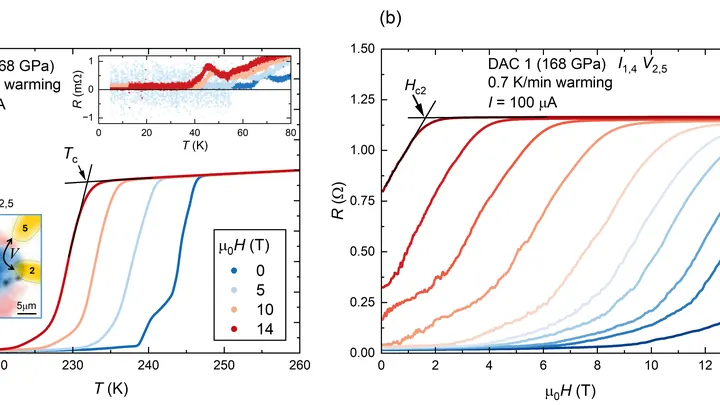
Inside a diamond anvil cell, squeezing a sample with a force millions of times greater than atmospheric pressure, a thin film of lanthanum meets hydrogen. The hydrogen comes from ammonia borane — a powder that, when heated, releases its hydrogen like a sponge releasing water.
A regular battery releases heat smoothly: what you store is what you get. The power is fixed once and for all, like a faucet that pours water in a single stream. But sometimes you don't need a steady flow; you need a short, powerful burst: to instantly heat a part, trigger a reaction, or dump excess heat.
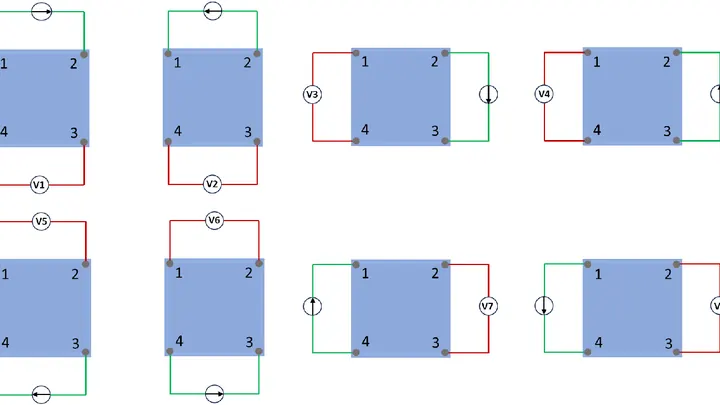
A superconductor is a material in which electricity flows without loss, like water through a perfectly smooth pipe. But if you squeeze it slightly, like a spring, its properties change. Scientists have long wanted to measure how much heat such a compressed material absorbs, but instruments couldn't fit into the cramped setup. Now they've devised a way around this obstacle.
A camera watches a person's face and hands, and from barely perceptible changes in skin temperature it understands: they are struggling right now. Body heat is like invisible ink that shows up under stress. Blood rushes to some areas and drains from others, creating a unique pattern for each person. The challenge is to find the spots and seconds in that thermal signature that betray anxiety.
An ordinary wire heats up when current flows through it — some energy is wasted. A superconductor lacks this flaw: electricity flows through it without loss, like water through a perfectly smooth pipe. The trouble is that most superconductors require either very low temperatures or colossal pressures, like those found in the depths of planets.
Inside an MRI magnet, current flows through a closed superconducting loop, like water circling in a bucket after you give it a spin, it just keeps going on its own. To change that current, you heat the loop with a small heater: it stops being superconducting, becomes an ordinary resistor, and then an external source can 'top up' or 'draw off' current.
Hot water after a shower, warm air from ventilation, the heated walls of an engine — all this is heat below 100°C. Usually, it dissipates without doing any useful work. Now it can be captured and turned into electricity.
Inside the new device is a wire made of a nickel-titanium alloy. This material remembers its shape: when heated, it contracts; when cooled, it returns to its original shape.
A microchip the size of a fingernail gives off as much heat as a small light bulb. Getting rid of that heat is like trying to cool a cup of hot tea with a teaspoon: the insulating material around transistors is usually a poor heat conductor.
A microchip the size of a fingernail gives off as much heat as a small light bulb. Getting rid of that heat is like trying to cool a cup of hot tea with a teaspoon: the insulating material around transistors is usually a poor heat conductor.
Drop a pebble into a pond, and ripples spread across the water. In much the same way, any body, even the tiniest, perturbs the gravitational field around it. In empty, cold space, these perturbations, like ripples on a calm surface, make two nearby objects always repel each other.
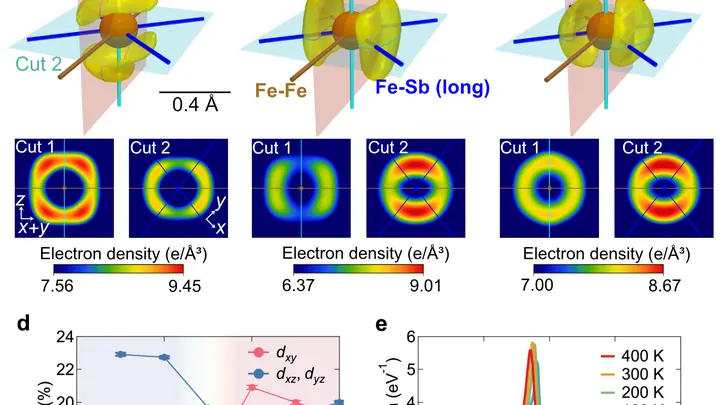
A house with cork walls suddenly gets covered in copper sheets, but only when frost sets in. That's roughly how FeSb₂ behaves when made into a film just a few atomic layers thick. Under normal conditions, it's a narrow-gap insulator: electrons sit tightly in place like spectators in an overcrowded hall.
A tiny sandwich of oxides, grown layer by layer, becomes perfectly conducting at about minus 200 degrees Celsius. This is not a magic trick but a new chapter in the search for high-temperature superconductors.
In a crystal, heat travels on waves. Atoms vibrate, and these vibrations, called phonons, carry energy from the hot edge to the cold one. For a long time, it was believed that if phonons hit resonance (their frequencies exactly match) and can exchange energy, heat would flow like an avalanche. It turns out that's not the case.
A film sliver thinner than a human hair was placed between diamond anvils and squeezed. The pressure climbed — a hundred thousand atmospheres, half a million, a million… Yet the material kept conducting electricity without resistance.
A film sliver thinner than a human hair was placed between diamond anvils and squeezed. The pressure climbed — a hundred thousand atmospheres, half a million, a million… Yet the material kept conducting electricity without resistance.
A superconductor is like a perfect wire — current flows through it with zero loss. The catch is that you have to cool it way down. Physicists have long hunted for materials that superconduct at more practical temperatures. One approach: don't wait for nature to oblige — build your own material, layer by layer, like a Lego set.
A ceramic plate as thin as a soap film, and through it flows current with zero resistance. That's the superconductivity achieved in nickelates, relatives of the famous cuprate superconductors. Previously, this required enormous pressure, comparable to that at the ocean floor.
Many materials behave like finicky ice: at one pressure they melt, at another they turn harder. Superconductors in the cuprate family are no exception. Their ability to carry current without loss depends on how tightly the crystal lattice is squeezed. In a new study, physicists traced this dependence for the compound Bi-2223.
The river splits in two. One branch is wide and fast, with water flowing smoothly, but as temperature rises, the flow slows: eddies and waves appear. The second branch is narrow, with rapids, where water leaps from rock to rock. This flow, on the contrary, becomes more lively with warming.
In superconductors, electrons pair up and flow without resistance. Usually, these pairs are distributed uniformly, like water in a calm lake. But sometimes ripples appear in the material — pairs bunch up and thin out with a certain period. This state is called superconductivity with pair-density waves.
Graphene, a sheet of carbon one atom thick, behaves like a calm water surface, until superconductivity appears. Then, unusual waves ripple across it, like the circles from a thrown stone: pairs of electrons move without friction.
In a glass of water, oil gathers into droplets: that's equilibrium separation dictated by chemistry. But there are systems where order arises not from rest but from a constant flow of energy.
A piece of metal is cooled to minus two hundred degrees, and electric current begins to flow through it without the slightest friction, like water in a pipe flowing without touching the walls. This behavior is called superconductivity.
Crystals glued to the outside and inside of a metal wall act as an invisible channel. One, receiving current, starts to tremble, and these vibrations, like ripples on water, spread out in all directions through the metal. The inner crystal catches this tremor and generates electricity again.
In a soup pot, you only need two thermometers to gauge the temperature everywhere — if you know heat travels in circles from the bottom. Science works the same way: from a handful of measurements, you want to reconstruct the full heat picture.
The system captures the gist of heat flow, compressing it into a handful of governing numbers.
A molecule works like a marketplace: electron shoppers enter through two gates (contacts) and head for stalls with the most attractive goods — the chemically active spots. Previously, current was thought to spread evenly, but it turns out up to 90% of all flow rushes through these 'hot spots'. Reactive centers become superconducting highways inside the molecule.
Inside the destroyed Fukushima reactors lie hundreds of tons of melted fuel — a mixture of uranium, zirconium, iron, and fission products. This debris is called fuel debris. It must be extracted, transported, and securely packaged for decades. But how will this volatile mixture behave under heat, compression, or accidental impact?
When physicists drive electrons through an ultrapure gallium arsenide channel at helium temperatures, they expect to see a well-behaved, almost ideal fluid.
Heat is all around us: from a car's exhaust pipe to the casing of a running laptop. Thermoelectric materials could turn that waste heat into electricity.
Tungsten is a true heavyweight among metals. It withstands monstrous heat and isn't afraid of radiation, which is why it's prized in fusion reactors. But there's a catch: at room temperature, it behaves like a piece of glass: it cracks on impact instead of bending.
In a hot mug, water sometimes freezes faster than in a warm one. This paradox is over half a century old and is called the Mpemba effect. It is usually attributed to fluid motion or evaporation. Now physicists have shown that a similar trick is possible without water, just through radiation of heat.
In the crystal CsV3Sb5-xSnx, which becomes a superconductor at low temperatures, current does not flow as a uniform stream but along narrow, winding paths. A scanning microscope with a sensitive magnetic field sensor helped reveal these paths: it picks up the faintest currents, much like a sonar probes the seafloor.
Usually, superconductivity is a story about cold. The lower the temperature, the easier it is for electrons to pair up and flow without resistance. But in a new study, physicists grew thin films of nickelates doped with europium and saw the opposite picture.
A thin film of yttrium barium copper oxide warms under a stream of infrared light, and suddenly stops dissipating energy. That's superconductivity: electrons pair up and move as a single quantum swarm. But in underdoped samples, the harmony breaks long before the pairs fall apart. The pairs are there, but the collective rhythm isn't.
A thermometer that turns a heat flow into an electrical signal: that's the anomalous Nernst effect: in a magnetic material, heat generates a transverse voltage. Until now, engineers could only tweak this signal slightly by changing the proportions of two metals.