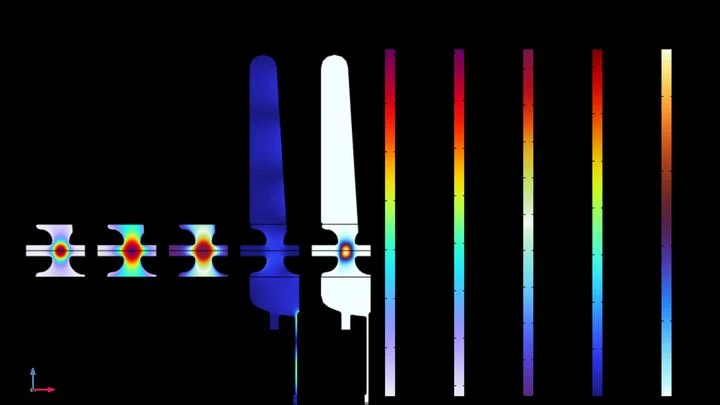
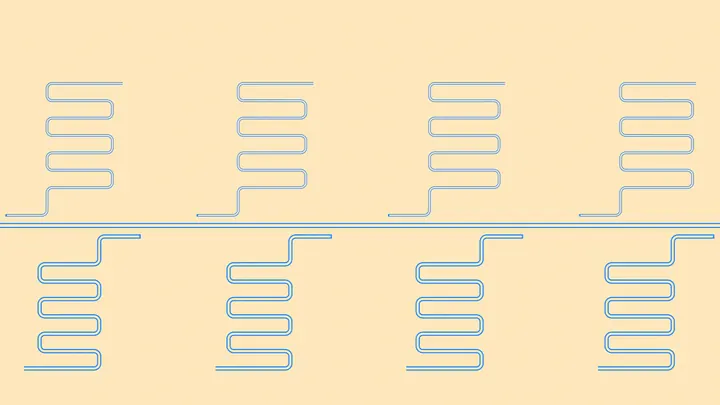
The quality factor, often denoted as Q, is a dimensionless parameter that describes how underdamped an oscillator or resonator is. It is defined as the ratio of the energy stored in the resonator to the energy lost per cycle, multiplied by 2π. A high Q factor indicates that the resonator loses energy slowly, meaning it has a sharp resonancepeak and a narrow bandwidth. In physics and engineering, Q is crucial for characterizing the performance of systems ranging from mechanical pendulums to optical cavities and superconducting microwave resonators.
History
The concept of quality factor was introduced by the electrical engineer K. S. Johnson in the 1920s while working on radiofrequency coils at Bell Labs. It was later adopted widely in physics and engineering.
How it works
The quality factor is mathematically expressed as Q = 2π × (energy stored) / (energy lost per cycle). For a damped harmonic oscillator, Q is inversely proportional to the damping coefficient. In practice, a resonator with high Q will ring for many cycles after being excited, and its frequency response will be sharply peaked at the resonant frequency. Losses can arise from various mechanisms, such as internal friction in materials, electrical resistance, radiation, or coupling to the environment.
In practice
High-Q resonators are essential in technologies such as quartz crystal oscillators for precise timekeeping, superconducting cavities for particle accelerators, and optical microcavities for laser and sensor applications.
Fun fact
The quality factor of a superconducting microwave resonator can exceed one billion, meaning it can store energy for millions of cycles before losing it, which is crucial for quantum computing applications.
A translator who used to catch only fragments of sentences now hears the entire conversation. Similarly, physicists studying strong interactions have long been unable to calculate how two particles respond to a flash of light when they do not form a stable nucleus.
A regular battery releases heat smoothly: what you store is what you get. The power is fixed once and for all, like a faucet that pours water in a single stream. But sometimes you don't need a steady flow; you need a short, powerful burst: to instantly heat a part, trigger a reaction, or dump excess heat.
Imagine a smart antenna panel, a phased array, that steers radio waves traveling at the speed of light. It works like an orchestra: hundreds of tiny emitters, like musical instruments, shift their phase (the moment they 'join' the overall sound) on command via a variable voltage.
When two dark matter particles approach each other, they can attract more strongly than expected. This phenomenon is called Sommerfeld enhancement — it works like an invisible spring that compresses before impact. For a long time, it was believed that the spring compresses more strongly the slower the particles approach each other.
Two pendulums hang from the same crossbar. A push, and they start swinging, gradually falling into and out of sync. In a topological qubit, Majorana particles, special excitations that can store quantum information, play the role of these pendulums.
Gravitational-wave observatories are like a keen ear listening for distant rumbles of cosmic catastrophes. To catch the faint whisper of merging black holes, detectors of gravitational waves use specially prepared light — known as squeezed vacuum.
Imagine a perfectly tuned orchestra, where every instrument is adjusted with flawless precision, trying to play in a noisy hall. That noise is quantum gravity — the microscopic ripples of spacetime. It constantly threatens to throw the musicians off.
A tuning fork grows quieter not because someone stops holding it, but because the very hand that strikes it creates an invisible haze around it that damps the vibrations. A superconducting resonator behaves much the same way — a tiny track along which a microwave signal runs with almost no loss.
An ultra-sensitive microphone tries to catch the whisper of a distant galaxy. But the microphone itself trembles from heat: its atoms jitter like popcorn in a pan. Physicists call this jitter thermal noise, and it often drowns out weak signals.
A guitar string rings longer if you don't touch it too much. A resonator, a device that vibrates at a single frequency like a tuning fork, behaves in much the same way. A team of engineers made such a "tuning fork" from aluminum nitride, smaller than a grain of sand, and made it oscillate 16 billion times per second.
A single electron in a magnetic field is like a tiny top that spins and weakly "squeaks" at its own frequency. Hearing that squeak directly is nearly impossible: it gets lost in the noise. Scientists have devised a resonator: a superconducting microwave strip that works like a tuning fork tuned to the same note.
Sound in a solid is waves of compression and rarefaction rippling through atoms, like ripples across a spring mattress. If you place obstacles with just the right spacing, waves at certain frequencies can't pass: they bounce back. Such a periodic structure is called a phononic crystal, and it works for sound the way a multilayer mirror works for light.
An ordinary kitchen thermometer shows the temperature at which mercury stops resisting electricity. For superconductors used in quantum computers, the critical temperature is like a quality passport: the higher, the better.
Inside large particle accelerators, there are hollow metal chambers where beams are accelerated. Over time, grime settles on their walls, like in an old pan. This grime prevents the accelerator from running at full power.
To restore the accelerator's strength, plasma, a glowing gas of argon or neon with a bit of oxygen, is sent into the chamber.
Inside some materials, electric current flows with zero resistance. These are superconductors, and they only work when it's very cold. Copper oxides are special: they stay superconducting at somewhat higher temperatures, but why has been a puzzle for forty years.
A quantum computer is like an orchestra, where each qubit is a musician and the control signals are the conductor. If the conductor waves the baton imprecisely, the musicians fall out of sync. In a real device, signals pass through power amplifiers, like loudspeakers that add noise and distortion.
Building ultrasensitive sensors for light measurements and spectroscopy starts with tiny chambers where light ricochets like an echo in a canyon. Previously, engineers chased the quality factor — the duration of this echo: the longer it rings, the more noticeable the slightest changes.