A semiconductor is a material that can conductelectricity not always, but only when heated or illuminated. Imagine a drawbridge that is usually raised, but when a signal flag is raised (energy is given), it lowers and allows cars to pass. In a semiconductor, electrons sit in 'locked' places, but with a little heat or light, they gain enough strength to break free and turn the material into a conductor.
History
Semiconductor properties were first observed by Michael Faraday in 1833 in silver sulfide. In 1874, Karl Braun discovered the rectifying effect at a metal-semiconductor contact. The decisive breakthrough came in 1947 with the invention of the transistor at Bell Labs (Bardeen, Brattain, Shockley). Shuji Nakamura in 1993 made a breakthrough by creating a bright blue LED based on gallium nitride, opening the way to white LED lighting. For this achievement he was awarded the Nobel Prize.
How it works
The conductivity of a semiconductor is determined by the concentration and mobility of free charge carriers. In an intrinsic semiconductor at T>0, electrons transition from the valence band to the conduction band, leaving holes. The carrier concentration obeys the law of mass action: n_i^2 = N_c N_v exp(-E_g/kT). When doped, donors create levels near the conduction band, facilitating thermal ionization. The principle of operation of the p-n junction, the basis of diodes and transistors, relies on diffusion and drift of carriers in an electric field. An important role is played by Coulomb's law, which determines potential barriers, and the Schrödinger equation, which describes the wave functions of electrons in a periodic potential.
Fun fact
Your smartphone and computer work thanks to billions of tiny semiconductor switches—transistors. If they were made of ordinary conductors, the phone would heat up like an iron and discharge in seconds!
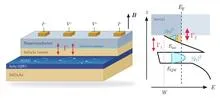
A thin layer of indium arsenide lies hidden under a superconducting film, like a voice beneath the noise of a crowd. In such a hybrid, current takes the path of least resistance and flows almost entirely through the metal, leaving the semiconductor inaudible to standard probes.
In a quiet room with no magnets anywhere, two electrons in a silicon trap still feel a faint trembling. It comes from the nuclei of silicon and germanium atoms, which spin randomly like the needles of broken compasses. This trembling was once considered noise, but now it has become a measuring instrument itself.
A plastic film as thin as a hair, and inside it — platinum dots smaller than a millionth of a millimeter. These dots sit at the boundary between two transistor layers and catch electric charge like a sponge catches water. As charge accumulates, the transistor changes its resistance, and remembers that state.
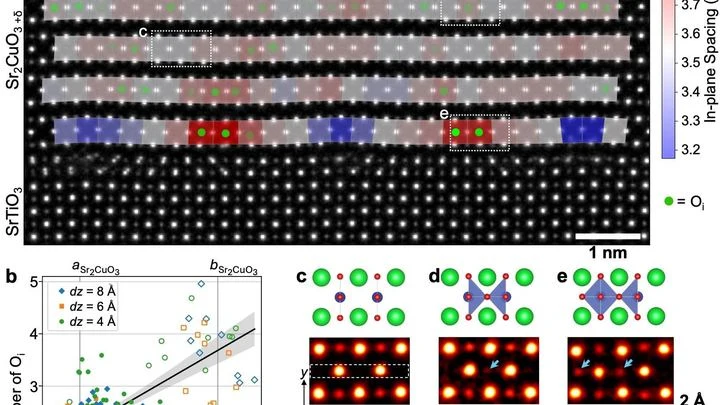
A superconductor is a material that conducts electricity without loss, like water flowing through a perfectly smooth pipe. In copper-based superconductors, tiny oxygen additions act like a volume knob: a bit more and the material starts superconducting; a bit less and it stops. But the oxygen atoms themselves are so small that seeing them directly was impossible.
An ordinary wire heats up when current flows through it — some energy is wasted. A superconductor lacks this flaw: electricity flows through it without loss, like water through a perfectly smooth pipe. The trouble is that most superconductors require either very low temperatures or colossal pressures, like those found in the depths of planets.
A bridge where pedestrians and cyclists flow together without getting in each other's way. That's roughly how hybrid systems of superconductors and semiconductors work: the former carry current without loss, the latter control that current.
An empty dance floor where people occasionally appear. Each moves on their own, chaotically, with no connection to the others. But when the right music starts and the hall cools down a bit, the dancers suddenly begin to form long chains and move in unison. That's roughly how electrons behave in a dilute three-dimensional gas.
A light switch clicks, and the light comes on. But imagine a switch that, with the same press, can either turn on the lamp or leave the room dark. It also remembers what it did last time, and sometimes it seems to flip a coin to decide whether to light up.
This kind of behavior was found in a crystal of black phosphorus — a semiconductor just a few atomic layers thick.
A microchip the size of a fingernail gives off as much heat as a small light bulb. Getting rid of that heat is like trying to cool a cup of hot tea with a teaspoon: the insulating material around transistors is usually a poor heat conductor.
The orchestra plays, but the conductor hears only a general hum. Each instrument plays its own part, but you can't tell where the flute is and where the double bass is. You need a spectrum analyzer — a device that breaks down sound by frequency.
A piece of metal is cooled to minus two hundred degrees, and electric current begins to flow through it without the slightest friction, like water in a pipe flowing without touching the walls. This behavior is called superconductivity.
Some crystals behave like a switch: nudge the temperature or pressure, and they turn from a conductor into an insulator. This is called a metal–insulator transition (a change in the ability to conduct electricity).
A superconductor is a material where electrons pair up and move without resistance. In conventional superconductors (s-wave), these pairs are identical in all directions, like a perfect sphere. But there are others, d-wave, where pairing resembles a four-leaf clover: stronger in some directions, weaker in others, and vanishing entirely at special points — the nodes.
Usually, superconductivity is a story about cold. The lower the temperature, the easier it is for electrons to pair up and flow without resistance. But in a new study, physicists grew thin films of nickelates doped with europium and saw the opposite picture.
A well-coordinated orchestra of electrons in a superconductor is easily thrown off rhythm. Thermal jolts destroy the fragile order, and resistance returns. For decades, scientists have sought ways to strengthen this ensemble — mostly by changing the material's composition or compressing it to unimaginable pressures.
A switch that knows which way to let current flow. That's how a Josephson diode works — a superconducting bridge where current goes willingly in one direction but meets resistance in the other. In the new study, such a bridge was made from graphene — a sheet of carbon just one atom thick.
A potter uses a sharp stylus to trace a pattern on a still-damp clay tile. One wrong move, and the line blurs, the tile cracks. Physicists work with films of the high-temperature superconductor YBCO (a compound of yttrium, barium, copper, and oxygen) in much the same way.
In murky mud, between two electrodes, long chains of bacteria line up: each one as thin as a microscopic cable. Every such filament conducts current over a full centimeter, a true marathon for a microbe.
Imagine a carousel with two types of seats: some spin clockwise, others counterclockwise. If you push all of them at once, the carousel jerks but stays in place. That's how a Weyl semimetal crystal works: electrons are born in pairs—'left' and 'right'—and their contributions to current cancel each other, like two identical motors running in opposite directions.
An ordinary diode in electronics works like a one-way street: current flows in only one direction. In superconductors, where electricity flows without resistance, such behavior has long been elusive — current is usually symmetric.
The authors of the new work found a way to create a perfect superconducting diode using light.
Two thin layers of a semiconductor were twisted relative to each other by 2.29 degrees, like two sheets of transparent paper with printed grids. Where the lines nearly align, a large pattern of dark and bright spots emerges. Electrons in this pattern behave very differently from those in a regular crystal.
A bridge made of two rows of planks bends under the feet of pedestrians, and each step gets a boost from the elastic motion of the deck. A similar principle underlies superconductivity: electrons glide without resistance because the atomic lattice itself adapts to them. In nickel-based materials, this picture has long been elusive.
Electric current in a wire is like a crowd of people hurrying down a corridor. Usually, each person bumps into walls and loses speed almost instantly: that's electrical resistance.
Two paper-thin sheets of a semiconductor are stacked and slightly rotated — by about three to four degrees. The atomic lattices don't match, creating a large-scale pattern — a moiré, like the ripples from two washboards shifted by a small angle. In this pattern, electrons move quite differently than in a regular crystal.
Light leaves a trace even when there is almost none of it. A single photon, a tiny bundle of energy, strikes a silicon wafer and knocks out a handful of electrons. The trouble is that the handful is too small to notice. You need an amplifier.
Usually, the signal is amplified by applying a voltage to metal contacts on the detector's surface.
Diamond is the hardest natural material and usually does not conduct electricity. But if you add a few foreign atoms to its crystal lattice, it can become a semiconductor, like silicon in computer chips.
A fabric that stretches lengthwise but not crosswise. That's roughly how a semi-Dirac material works: electrons can move freely in one direction but barely budge in the other. Because of this unusual anisotropy, special tracks, one-dimensional channels, emerge at the edges of the two-dimensional crystal. Electrons race along them only along the perimeter, like water in a trough.
A single-atom-thick sheet of tungsten telluride is like thin foil: electrons can't pass through because there's a band gap between their possible states, like a moat you can't jump across. Add two more layers, and the moat disappears; the material becomes a metal, and current flows. Add more layers, and the properties change again, as if someone is flipping modes with a single button.
Among magnets, there are quiet masters of disguise. An ordinary magnet attracts paperclips and has two poles — north and south. But there are materials that are internally arranged like a magnetic chessboard: their atoms are aligned in a strict order, yet externally the material behaves neutrally, as if no magnet exists at all. Such substances are called altermagnets.
When you flip a switch, the light doesn't come on immediately — electrons in the wires need time to 'get going' and move together. In ordinary metals and semiconductors, current builds up gradually, like water in a hose when you first open the tap.
In a thin semiconductor channel, electrons behave not like lone runners but like a crowd at rush hour. They constantly bump into each other, and these collisions determine how easily heat and electric current pass through the material.
A superconductor is a material that, when strongly cooled, loses its electrical resistance: current flows through it without losses. Scientists took a layered crystal of PdTe2, similar to a stack of sheets of paper, and cooled it to temperatures below 1.8 kelvin (that's about -271°C).
A superconductor is a material through which current flows without loss, like water through a perfectly smooth pipe. But to make the pipe perfect, you have to cool it to very low temperatures. Physicists have long been looking for ways to make such a pipe at warmer temperatures, and one clue is the quantum critical point.
An ordinary transistor in a phone is made in a vacuum chamber, where atoms are deposited layer by layer. Expensive and slow. But indium oxide can be printed like ink — from a drop of liquid metal that, in air, coats itself with a thin oxide film.
The authors took indium, melted it, and rolled it over a substrate at 250 degrees.
A thin wire of the new material conducts electricity without loss when cooled to three degrees above absolute zero. It's like water flowing through a pipe without any friction against the walls. The material is called PtPb3Bi, and its hallmark is an internal structure resembling a bundle of threads: electrons run freely along a thread but struggle to jump between threads.
A crystal grows in a hot solution like a lollipop on a stick in sugar syrup. Only instead of sugar, it's germanium oxide, and instead of a stick, there's a tiny seed. By changing the solution composition, you can make the crystal grow faster, alter the shape of its faces, or even turn it into a mass of many small crystallites.
In a molecule resembling chlorophyll and built from carbon, a metal atom at the center acts as a toggle. Shifting it by fractions of a nanometer can make the molecule glow, quench, or boost its brightness a hundredfold.
A crystal of germanium with tin is like a mosaic where each tile is an atom. If you lay the tiles randomly, the mosaic has one color, but if you arrange them in a pattern, it has another. Physicists measured how the atomic pattern changes a semiconductor's most important property: its band gap, that is, the energy needed to get an electron moving and creating current.
A superconductor is a material that conducts electricity without loss, but only at very low temperatures. On such a material, researchers placed a film of magnetic material one atom thick.
A sheet of graphene one atom thick is like a flexible metal mesh through which electrons zip almost unimpeded. Stack two such sheets with a slight twist, and the material's properties change dramatically: it can become an insulator that blocks current.