phenomenon

overtones

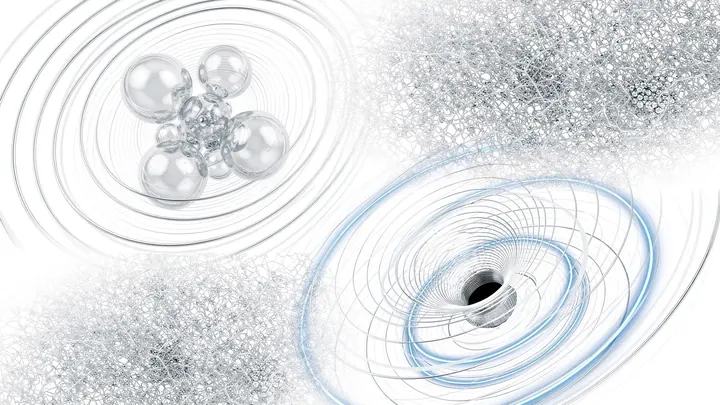
Secondary waves in a black hole's ringdown, born from the nonlinearity of spacetime.
49 related articles

Description

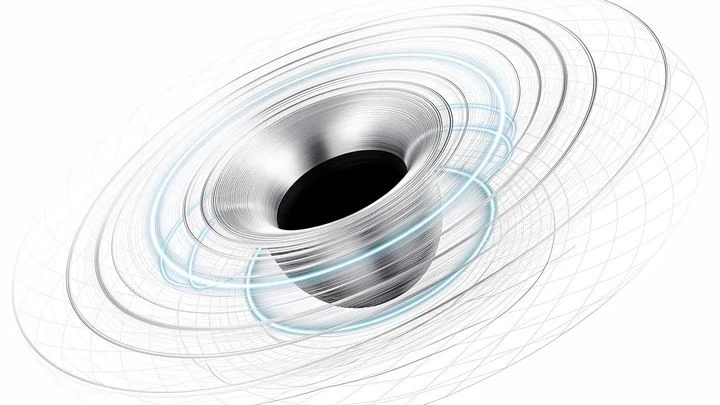
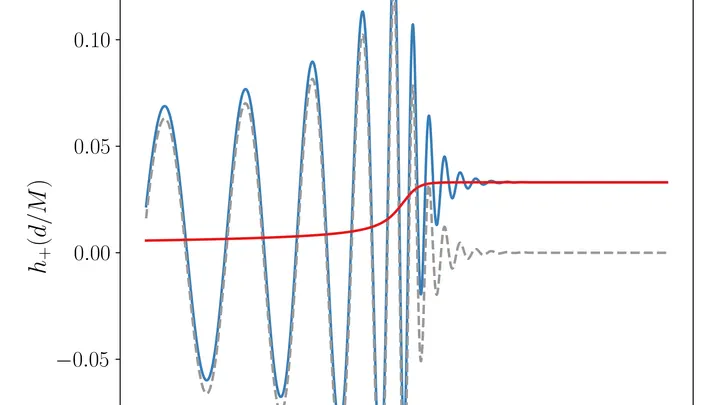
Overtones are additional, higher-frequency oscillations that appear in the gravitational-wave signal emitted by a black hole immediately after it forms from a merger. This 'ringdown' phase is characterized by a dominant fundamental mode, but overtones arise from the nonlinearity of spacetime near the black hole, adding complexity to the signal. Detecting overtones allows scientists to test general relativity in the strong-field regime and to measure the properties of the newly formed black hole with greater precision.

History

The theoretical framework for black-hole ringdown and overtones was developed in the 1970s by Saul Teukolsky and others, who derived the equations governing perturbations of black holes. The first clear detection of an overtone in a gravitational-wave signal was reported in 2019, from the merger event GW150914.

How it works

When two black holes merge, the resulting black hole is initially distorted, and it settles into a spherical shape by emitting gravitational waves. This emission is a superposition of quasi-normal modes—oscillations with specific frequencies and damping times. The fundamental mode is the loudest, but overtones have higher frequencies and decay faster. The nonlinearity of Einstein's equations means that these modes are not independent; they interact, producing subtle features in the signal that can be extracted with careful analysis.

In practice

Overtones are used to test the 'no-hair theorem' of black holes, which states that a black hole is fully described by its mass, spin, and charge. Measuring multiple modes provides a stringent check of this prediction of general relativity.

Fun fact

The overtone frequencies of a black hole are like the harmonics of a bell, but they decay so quickly that they last only a few milliseconds, making them one of the most fleeting signals in astrophysics.


Concept graph →

Related articles · 49

HEP Theory2026-08-102 minarXiv:2608.09797express
Black Hole Rings Like a Hot Bell
Drop a pebble into a pond, and ripples spread across the water. Something similar happens when a black hole merges with another: it emits gravitational waves that resemble the fading ring of a bell.
General Relativity2026-08-102 minarXiv:2608.09811express
How Light Particles Put the Brakes on Black Holes
A black hole is like a spinning top that never stops on its own. But if a cloud of ultra-light particles, bosons, forms around it, the picture changes. This "fog" acts like an invisible brake: the particles drain the hole's spin, slowing it down.
General Relativity2026-08-072 minarXiv:2608.06798express
A Black Hole Under the Microscope of Ripples
When two heavy balls merge into one, ripples spread across the water's surface for a long time. A black hole behaves similarly: after a merger, it 'rings' for a while, emitting special gravitational oscillations — quasinormal modes. Usually, this ring fades quickly, like an echo dying out in an empty hall.
Cosmology2026-08-032 minarXiv:2608.01919express
The Dim Glow of Black Holes Won't Save the Universe
Cosmologists are facing a curious situation: two reliable tools draw slightly different maps of the same universe. One tool is the map of ancient light (the cosmic microwave background), and the other is the map of galaxy distribution. They broadly agree, but in details they diverge.
General Relativity2026-08-031 minarXiv:2608.02259express
The Black Hole and Its Secret Twin
A rotating black hole is no calm whirlpool. Space around it shudders and rings at the slightest disturbance, like a guitar string after a pluck. These oscillations are described by the Teukolsky equation — a complex mathematical construct that physicists have studied for half a century. Recently, a strange symmetry was noticed in this equation.
High Energy2026-07-312 minarXiv:2607.29121express
A Black Hole's Shadow with a Secret from Other Dimensions
A cosmic object spins, but its shadow isn't round. Astrophysicists examined a black hole in an unusual version of gravity — the so-called brane world (where our universe is a three-dimensional surface in a space of higher dimensions).
General Relativity2026-07-281 minarXiv:2607.25311express
How Black Holes Ring After a Strike
A stone falls into still water — ripples spread across the surface. A black hole behaves similarly when something falls into it or when it merges with another black hole. The hole begins to oscillate, and these oscillations propagate through space as gravitational waves.
HEP Theory2026-07-282 minarXiv:2607.26124express
Cosmic Strings: Echoes of the Universe's Birth
In the first fractions of a second after the Big Bang, the universe was a stage of rapid change. A stretched rubber sheet that cools quickly becomes covered with microscopic cracks. A similar process on a cosmic scale could have given rise to cosmic strings — ultra-thin but super-dense threads of energy stretching across the entire universe. These strings are not just defects in space.
General Relativity2026-07-222 minarXiv:2607.20107express
A Graviton's Quantum Conversation with a Detector
A massive aluminum cylinder weighing a ton hangs in a vacuum. A gravitational wave, a ripple in spacetime, passes through it, and the bar begins to tremble almost imperceptibly. That trembling can be heard as sound: gravitational waves turn into a phonon — a quantum of sound vibrations.
General Relativity2026-07-212 minarXiv:2607.18627express
Black Hole with a Soft Core Changes the Music of Gravitational Waves
The spiral of water draining into a sink spins faster and faster toward the center. In an ordinary black hole, that funnel ends in an infinitely sharp point — a singularity where the laws of physics break down. But this new work considers a different picture: the funnel doesn't taper to a needle but ends in a smooth, swelling bubble.
General Relativity2026-07-212 minarXiv:2607.18919express
Echo Fades into the Silence of a Black Hole
Space is full of invisible waves — ripples in the fabric of spacetime left behind by cataclysms like black hole mergers. An ordinary black hole swallows everything without a trace. But there are hypothetical exotic objects — ultradense clumps of matter without an event horizon (a surface from which not even light can escape).
Sapphire Tuning Fork: How to Hear the Echo of the Big Bang
The Universe is humming, but our ears catch only the bass. LIGO hears the rumble of black hole mergers — the infrasound of space. Higher up, in the gigahertz range, the flutes and violins of primordial gravity ring out.
Galaxies2026-07-063 minarXiv:2607.05208
The Ocean of Spacetime: The Hum of Black Holes and the Precision of Simulations
In the ocean of space, every storm of birth or merger of supermassive black holes generates ripples — gravitational waves traveling at the speed of light. Over billions of years, these waves superimpose, merging into a low-frequency hum, like a distant surf.
Cosmology2026-07-023 minarXiv:2607.01818
High Energy2026-06-292 minarXiv:2606.30144express
Gravitational Lenses Distort Black Hole Portraits
The cosmos sets its own lenses in the path of gravitational waves. When two black holes merge, the resulting ripple travels through the universe. If it encounters a massive galaxy cluster along the way, its gravity bends the path of the waves — much like glass focuses light.
Ghosts at the Horizon: How Black Holes Whisper with Sound
Imagine a river at a rapid: the current accelerates until no wave can go against the flow. So it is with gas near a black hole: reaching the speed of sound, it locks itself in — an acoustic black hole is born, a twin of the gravitational abyss. Here the event horizon is woven from a flow faster than its own sound.
General Relativity2026-06-261 minarXiv:2606.28161express
Gravitational atoms of axions sing in black hole pairs
A black hole, like a spinning wheel, twists a cloud of light particles, axions, around itself. These particles are the leading candidates for dark matter. The cloud follows the laws of quantum mechanics, resembling a giant atom: there are levels, and there are transitions between them.
General Relativity2026-06-191 minarXiv:2606.21332express
Black Hole with a Monopole: A Thermal Shield
The focus is on a black hole, but not an ordinary one. It carries a magnetic monopole and is surrounded by a dilaton — a field that blurs the familiar boundaries of space. The authors tested how stable such a system is to thermal jolts. A magnetic monopole is a hypothetical particle with a single magnetic pole.
General Relativity2026-06-152 minarXiv:2606.16125express
General Relativity2026-06-052 minarXiv:2606.07070express
How Higher Dimensions Change the Gravitational Chorus
Drop a pebble into a pond — ripples spread across the water. In much the same way, a massive body circling a black hole perturbs the fabric of spacetime, generating gravitational waves. But what if the pond itself isn't flat, but has hidden folds — extra dimensions invisible to the eye?
General Relativity2026-05-291 minarXiv:2606.00166express
How a Black Hole Amplifies Gravitational Waves
In the usual picture, a black hole is a featureless pit in spacetime. But if a shell of matter vibrates around it, the gap between the edge of the abyss and this shell becomes a resonant cavity.
General Relativity2026-05-251 minarXiv:2605.25623express
How the Ringing of Black Holes Reveals Their Secrets
After a merger, the newborn black hole emits a fading tremble — gravitational waves, similar to a ringing bell. By analyzing the overtones of this signal, spectroscopy can determine its mass and spin rate.
General Relativity2026-05-201 minarXiv:2605.21640express
When Black Holes Just Wave Hello
Usually, black holes inch closer gradually, circling in a tightening spiral. This dance births a long ripple of gravitational waves — a tremor in the very fabric of spacetime. Detectors LIGO and Virgo routinely catch such mergers. But GW190521 is the exception.
General Relativity2026-05-191 minarXiv:2605.20320express
How Black Holes Play Hide-and-Seek with Gravitational Light
Two black holes smash head-on at full speed — while a third one circles nearby. In ordinary life, such a crash would produce a burst of gravitational waves (ripples in space, like the ripples from a stone thrown into a pond). But here, part of the ripple passes by the massive neighbor, and changes, like light in a funhouse mirror.
Cosmology2026-05-143 minarXiv:2605.15197
Invisible Drums: How Gravitational Waves Give Birth to Black Holes
The mystery of dark matter, first glimpsed in the stellar whirlpools by Vera Rubin, has been tormenting physics for nearly a century. One of the boldest hypotheses: primordial black holes, born in the scalding broth of the early universe.
General Relativity2026-05-141 minarXiv:2605.15429express
Stellar Echoes: What Neutron Stars Conceal
We know about neutron stars thanks to the work of Fritz Zwicky, Subrahmanyan Chandrasekhar, and Jocelyn Bell Burnell. They are former cores, squeezed to city size: a teaspoon of their matter weighs as much as Mount Everest.
General Relativity2026-05-122 minarXiv:2605.11364express
A Black Hole Rings Differently If There's No Singularity at Its Core
Drop a pebble into a well, and the sound tells you its depth. That's roughly how astrophysicists listen to black holes: after a merger or other disturbance, the hole vibrates, emitting gravitational waves. The frequency and damping of this 'ring' depend on what's inside the hole.
General Relativity2026-05-112 minarXiv:2605.10874express
Black Holes Latch Onto Each Other with Beaks
Two black holes fly toward each other and collide head-on. In the familiar picture, their horizons (the surfaces from which not even light can escape) stretch toward each other like water droplets and merge into one smooth shape. But calculations show otherwise: before merging, a sharp beak, a cusp, extends from each horizon.
General Relativity2026-05-082 minarXiv:2605.07187express
Black Hole Without a Singularity: Particles Dancing to Quantum Music
A stone falls into a well, and a second later, a splash. A star falls into a black hole, and disappears beyond the horizon, leaving only a ripple in space. But what if the bottom of the well is not a dead end but a passage? In the usual picture, matter compresses into a point of infinite density — a singularity.
General Relativity2026-05-081 minarXiv:2605.07879express
Gravitational Memory: A Key to Testing Gravity
A black hole collision isn't just a burst of gravitational waves; it also leaves a lasting trace: an eternal curvature of spacetime — gravitational memory. Like a boat on water leaves a lingering wake, the cosmos 'remembers' the catastrophe.
Cosmology2026-05-072 minarXiv:2605.05679express
Cosmic Orchestra Tests Dark Matter
Two heavy balls orbit on the surface of a pond. Ripples spread from them: these are gravitational waves. As the balls spiral closer, the waves carry away energy, and the ripples become more frequent.
General Relativity2026-05-051 minarXiv:2605.03576express
The Quiet Overtones of a Black Hole Are Now Heard Louder
When two black holes merge, the resulting black hole 'rings' for a while, emitting gravitational waves — like a dying bell. This ringing is captured by giant detectors created by Rainer Weiss and Kip Thorne.
General Relativity2026-05-051 minarXiv:2605.03756express
The Invisible Spring Around a Black Hole
A swing swings higher and higher if you push it in rhythm. A similar mechanism kicks in when a dead star orbits a massive black hole shrouded in a cloud of ultralight particles. These particles are candidates for dark matter — the invisible substance that keeps galaxies from flying apart.
Cosmology2026-05-041 minarXiv:2605.03156express
Cosmology2026-04-292 minarXiv:2604.26513express
A Cosmic Horn from the Universe's Infancy
A huge orchestra is tuning up before a concert. Each instrument makes its own noise, and in the general hubbub it's hard to pick out individual sounds. But if the conductor gives a special flick of the baton for a second, all the violins will simultaneously hit one high note, and that pure tone will cut through the cacophony.
General Relativity2026-04-272 minarXiv:2604.24813express
The Acoustic Portrait of a Quantum Black Hole: The Influence of Dark Energy and String Fields
A black hole, perturbed by a merger, vibrates at characteristic resonant frequencies — much like a bell ringing after being struck. Each hole has its own spectrum of these oscillations, allowing astronomers to reconstruct its parameters.
General Relativity2026-04-162 minarXiv:2604.15431express
The Dance of Black Holes on Stretched Orbits
Two black holes spiral around each other not in a smooth dance, but like two stones thrown from opposite banks into a deep whirlpool. Their orbit resembles a highly flattened oval — the eccentricity is nearly one. When they finally collide, a powerful burst of gravitational waves is born — a shudder of space itself.