Scientist

Lev Landau

1908–1968 · Theoretical physics, condensed matter, hydrodynamics, quantum theory
Soviet theoretical physicist, founder of a powerful school of theoretical physics. Contributed to quantum mechanics, condensed matter physics (superfluidity), nuclear physics, astrophysics. Nobel Prize laureate for the theory of liquid helium.

Biography

Born in 1908 in Baku. At age 14 entered Baku University, then transferred to Leningrad University, which he graduated in 1927. Trained in Europe under Bohr, Pauli, Heisenberg. Returning to the USSR, worked in Kharkov and Moscow, founded the Institute for Physical Problems. Arrested in 1938, released thanks to Kapitza's intervention. Developed the famous course of theoretical physics with Lifshitz. Received the Nobel Prize in 1962 for the theory of superfluidity of helium. A severe car accident in 1962 cut short his scientific work.

Key discoveries

💡 Landau created a humorous scale of physicists' genius, giving Newton 0, Einstein 0.5, and himself 2.5. He was known for his sharp tongue and intolerance of ignorance. When asked why he didn't write textbooks alone, he replied: 'I find it boring to write the same thing twice, so I dictate to Lifshitz.'
"He described science as what we know and what we are just beginning to understand, and thought a physicist must be crazy enough to assume things that boggle the mind."
Concepts
heliumneutron starQuantum Fieldsuperposition
Laws
quantum Hall effect
Scientists
Subrahmanyan ChandrasekharJocelyn Bell BurnellAlain AspectFred HoyleMargaret BurbidgeDavid DeutschLouis de BroglieWolfgang Pauli

Related articles

Quantum Physics2011-07-131 minarXiv:1107.2617express
Quantum Bridge Through Magnetic Storms
Hidden within the bulk of a diamond are tiny flaws — places where a carbon atom is replaced by nitrogen, with a vacancy gaping nearby. These defects, like beacons, can store and transmit quantum information. But around them rages a magnetic storm: the nuclei of atoms in the crystal jostle, creating interference.
Strongly Correlated2011-12-252 minarXiv:1112.5783express
The Magnetic Knot That Refuses to Come Undone
A crowd in a square. At first, everyone spins to their own rhythm, but suddenly the music changes, and they all start moving in sync, as one. That's roughly how electrons behave in some metals: they either cling to magnetic impurities or break away and form a collective order.
How Ripples on Water Steer the Planet's Winds
The planet's winds are not free-flowing currents but rather obedient jets that can be nudged from an unexpected direction. The ocean surface, covered with waves, acts like a tuning knob: change its roughness, and giant air rivers shift by hundreds of kilometers.
How an Orchestra Falls Apart: Chenciner Bubbles in a Climate Model
The conductor of an orchestra gradually loses control of the tempo. First, the second violins fall slightly behind, then the cellos speed up, and soon every musician is playing in their own rhythm, even though a minute ago they all followed the same melody.
nlin.AO2021-07-023 minarXiv:2107.00843
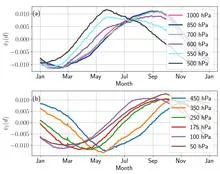
Ozone Sings in Many Voices: How Climate Stratifies by Altitude
In the vast concert hall of the atmosphere, ozone plays a part that changes from tier to tier. Near the surface, its notes sound alarming, for there it is a pollutant that irritates lungs and leaves. At 25 kilometers up, the same gas becomes a protective shield that absorbs harsh ultraviolet radiation.
Sumatra's Cyclone Factory: Ten Years of Observations
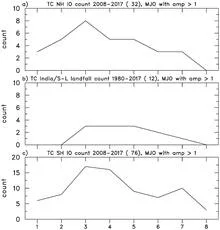
Sumatra's mountain range works like a stamping press: easterly winds hitting the slopes leave a chain of rotating imprints in the air behind the island. These vortices, like blanks on an assembly line, detach from the land and drift over the ocean, where some of them grow into tropical cyclones.
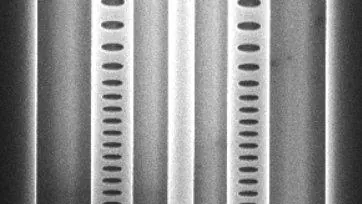
Whisper in the Hall: How to Build a Material That Silences Sound at Two Frequencies at Once
A steel plate with an 8×8 grid of cells dampens elastic waves in two frequency corridors at once. This is not a lucky accident but the outcome of a calculation using a new scheme: first a coarse template for the low frequency, then fine-tuning within free pixels for the high frequency.
A Sprint Without a Run-Up: How Heat Flies Through Aluminum Nitride Films
Thirty nanometers is the distance over which a phonon sprinter hasn't yet had time to accelerate. In thin aluminum nitride films, thermal resistance remains almost unchanged up to this thickness: heat transport proceeds in the ballistic regime, where phonons (quanta of crystal lattice vibrations) fly…
El Niño: Fading Out or Self-Sustaining?
The Pacific Ocean breathes. Every few years, its warm western "lung" exhales eastward, and from Peru to Indonesia, rains, droughts, and hurricanes shift. This breath is called El Niño–Southern Oscillation, or ENSO.
Dance of the Octopus Electron: What Quantum Tunneling Says About the Nature of Reality
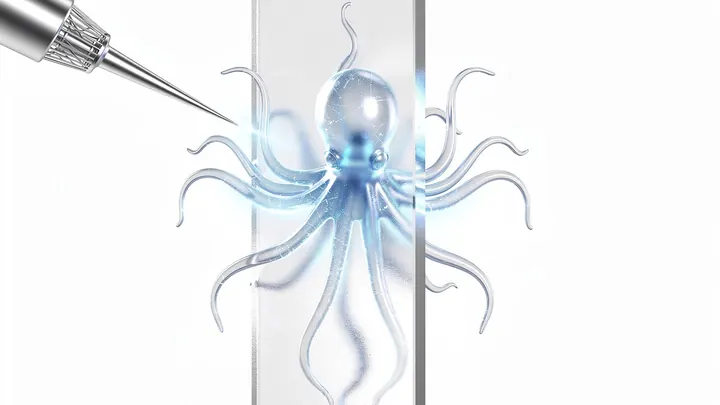
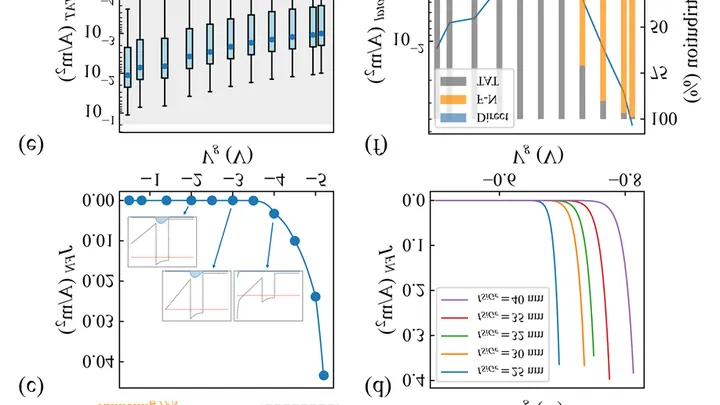
A tiny tungsten tip with a radius of less than a hundred nanometers is the perfect stage for watching a quantum performance. Apply an electric field of a few volts per nanometer, and electrons start flying out of the metal: that’s field emission.
Materials2025-06-023 minarXiv:2506.01292
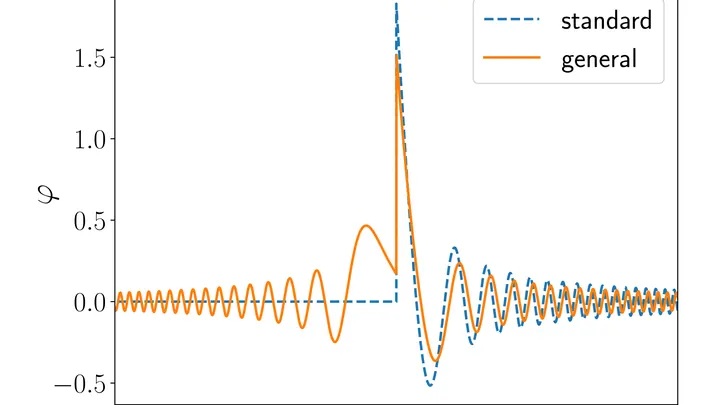
Time Reversed: What the Schrödinger Equation Misses
Two translators listen to the same symphony. One hears only the fundamental tone: a clean, predictable melody. The other catches the overtones that color every note.
Symphony of Chaos: How W3 Symmetry Accelerates Operator Growth
In the concert hall of quantum theory, strict discipline long reigned: it was believed that operators, those performers of complexity, could only grow at a certain speed. The universal operator growth hypothesis stated that Lanczos coefficients, the numbers measuring an operator's growth rate, could not grow faster than linearly.
A Diamond Bridge Between Rubidium and Optical Fiber
A beam of visible light enters a cloud of billions of rubidium atoms cooled to near absolute zero, and emerges on the other side already in the telecom range.
Tunnel Resonance: How Diodes Learn to See
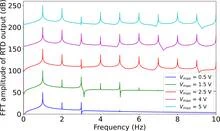
In 1974, physicists first described a device in which electrons pass through an energy barrier thanks to quantum tunneling. Today, that device, the resonant tunneling diode, is becoming the heart of an unusual computing architecture.
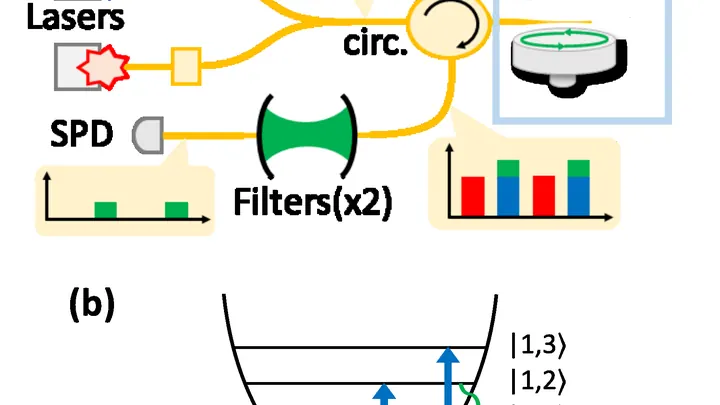
Quantum Filter: How Entanglement Pierces Murky Media
When light passes through biological tissue or frosted glass, it scatters and loses the image. Researchers at the Paris Institute of Nanosciences have shown that a scattering medium can be tuned to transmit images encoded in the correlations of entangled photons while remaining opaque to classical light.
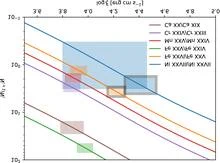
A Veil over the Beacon: The Slow Wind of GX 13+1
About 25,000 light-years from Earth, in the constellation Sagittarius, a dense veil wraps around the neutron star GX 13+1. It scatters X-ray photons the way fog scatters streetlight, and for a long time it hid the source's true power from astronomers.
Materials2025-10-161 minarXiv:2510.15091express
Resistance Paints the Secret Angles of a Magnetic Dance
Using a method similar to spectroscopy (magnetic sensing), scientists pass a current through a multilayer film and observe the orientation of the microscopic magnetic arrows inside. Previously, everything was predictable: in some materials, the arrows aligned only along the current, in others — strictly across it. But in bismuth ferrite with a platinum coating, a glitch occurred.
Nuclear Experiment2025-10-161 minarXiv:2510.21768express
Tantalum Nucleus Reveals Electric Asymmetry
Measured dipole moment of tantalum-181: 3.39 × 10⁻³² e·cm — like spotting a one-atom shift across the entire Solar System. An ordinary atomic nucleus is perfectly balanced, like a spinning top. In tantalum, that balance is broken: the positive and negative charges are slightly offset from each other.
Quantum Physics2025-10-172 minarXiv:2510.15724express
Chip Royal: How Optomechanics Tamed Thermal Noise and Turned Phonons into Error-Free Qubits
In the world of microchips, where streams of photons, quanta of light, carry information, a fundamental problem arises: light passing through matter inevitably heats it. This heating spawns thermal fluctuations — chaotic, unpredictable jostling of atoms that disrupts precise device operation.
Quantum Physics2025-10-251 minarXiv:2510.22394express
Quantum Engines Powered by a Look
In the quantum world, particles can walk through walls: this is quantum tunneling. If you place a detector right in the path of such a 'ghostly' passage, the moment of detection acts like a starting pistol: the particle gets a sharp kick and flies out of the barrier with excess energy, turning into a tiny engine.
Optics2025-11-011 minarXiv:2511.00570express
A Quantum Turnstile Chip for Photons
A turnstile lets you through only forward, and not a step back. Physicists have implemented a similar principle on a tiny semiconductor chip for single photons — particles of light.
Quantum Physics2025-11-131 minarXiv:2511.10155express
Quantum Particles: When Moving Backward Becomes Reality
A quantum particle quantum particle can exhibit backward motion even if its overall direction is forward. Imagine a river: the main current rushes toward the mouth, but individual currents suddenly swirl and momentarily dart against the flow, creating local disorder.
Quantum Physics2025-11-191 minarXiv:2511.15492express
A Shivering Disk Cooled to Quantum Stillness
Cooled nearly to absolute zero with liquid helium, the semiconductor disk reached such a low level of entropy that its thermal trembling became less than one phonon — a quantum of sound.
Stellar2025-12-031 minarXiv:2512.03611express
Solar Magnetic Poles: First Shots from Beyond the Equator
The Sun is not just a ball — it's a magnetic mansion. Its invisible force lines, like electrical wiring, thread through space and control space weather. But until now, we've only seen this wiring from the landing — the plane of Earth's orbit. The attic and basement, the magnetic poles, remained a mystery.
Quantum Gases2025-12-091 minarXiv:2512.08739express
Supersolidity Is Born at the Liquid Boundary
A supersolid is ice that flows. Think of a pond with a frozen crust, but beneath it, a liquid depth without friction. Usually, creating that crust means changing the liquid's properties throughout its entire volume.
Stellar2025-12-121 minarXiv:2512.11182express
Mixer Waves of the Solar Wind: How the Corona Heats Up
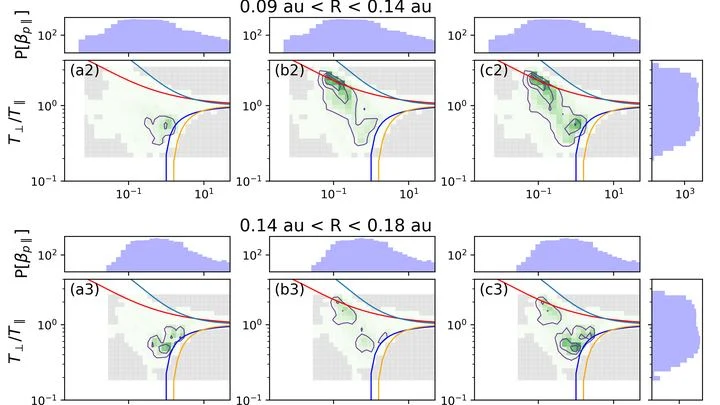
The solar wind isn't a calm stream but a bubbling soup of charged particles. Diving close to the Sun, the Parker probe picked up two types of stirring waves. Left-handed ones, like a whisk in a chef's hand, whip up the material when the temperature differs along and across the flow.
General Relativity2025-12-181 minarXiv:2512.17959express
Heat from the void: how to catch the Unruh effect
The void is deceptive. William Unruh showed that an accelerating observer perceives the vacuum as hot. The effect resembles the particle birth near black holes, predicted by Stephen Hawking, but instead of spacetime curvature, acceleration is at work.
Quantum Physics2025-12-191 minarXiv:2512.17318express
Quantum Turnstile Network: 200 Users Fully Protected
The quantum network works like a series of turnstiles that open only for a pair of perfectly synchronized photons. The central node tells them which turnstile to go to, but cannot forge the synchronization. 200 users can communicate with each other over distances up to 200 km — about the size of a large city.
Quantum Gases2026-01-021 minarXiv:2601.00682express
Atoms on a Ring: The Way Up
Atoms have been caught in a ring of light. This is not a metaphor: laser beams form a ring-shaped trap in which atoms move in circles. The light not only holds them but also couples the atom's rotation to its internal 'compass'—the spin. As a result, an atom running around the ring senses which way it's going, and this changes its internal state. This coupling is not just elegant.
Materials2026-01-032 minarXiv:2601.01059express
Light Makes a Crystal Conduct Current
A crystal without a center of symmetry is like a staircase where all the steps are tilted in the same direction: electrons, given a kick by light, roll predominantly in one direction. This is how a direct current is born — the photogalvanic effect.
Biological Physics2026-01-041 minarXiv:2601.01560express
A Switch Protein: How to Catch a Quantum Current
Every breath you take and every muscle twitch runs on a stream of electrons flowing through proteins inside your cells. These proteins aren't static: they constantly change shape, like a spring that compresses and releases. But until now, no one has seen exactly how these movements open or close the path for electrons.
Stellar2026-01-061 minarXiv:2601.03344express
Wind for the swift: how turbulence heats the solar corona
In a hot gas of charged particles — plasma — chaotic electric fields work like a sieve. A slow particle gets surrounded by a cloud of opposite charges, which cancels the external field. A fast one sheds this armor and gets accelerated.
Optics2026-01-081 minarXiv:2601.04933express
How a Magnesium Atom in Silicon Holds a 20-Millisecond Pause
In a silicon crystal, the stuff of microchips, there sometimes sits a foreign atom, like magnesium. It behaves like a tiny magnet with several 'pointer positions.' If you illuminate such a crystal with a short flash of light, the atom momentarily gets excited, then returns to its ground state.
Classical Physics2026-01-111 minarXiv:2601.06855express
Sound Passes Through a Wall
Sound in a thin plate behaves like ripples on water: it travels, reflects off edges, and changes shape. But sound has a peculiar trait: it can pass through places where waves are forbidden to exist. It's as if ripples on a pond suddenly vanished before a stone barrier and reappeared on the other side, without going around it.
Mesoscale2026-01-112 minarXiv:2601.06927express
Traps at the Interface: How Defects Mess with Quantum Chips
A quantum chip is like a musical instrument that goes out of tune at the slightest touch. In devices made from strained germanium, a material where atoms are slightly stretched for better conductivity, the main source of off-key notes is defects at the interface between the semiconductor and the insulating layer.
Galaxies2026-01-122 minarXiv:2601.07907express
How the Milky Way's Wind Tears Apart Clouds
A hair dryer aimed at a block of ice strips vapor and droplets from its surface, and the ice slowly melts. The wind from the center of our Galaxy works in much the same way: it picks up cold gas clouds and carries them away, heating and shredding them along the way. Astronomers decided to systematically search this flow for molecules, the coldest and densest form of gas, for the first time.
Exoplanets2026-01-121 minarXiv:2601.07983express
When the Sun Dived into a Cloud
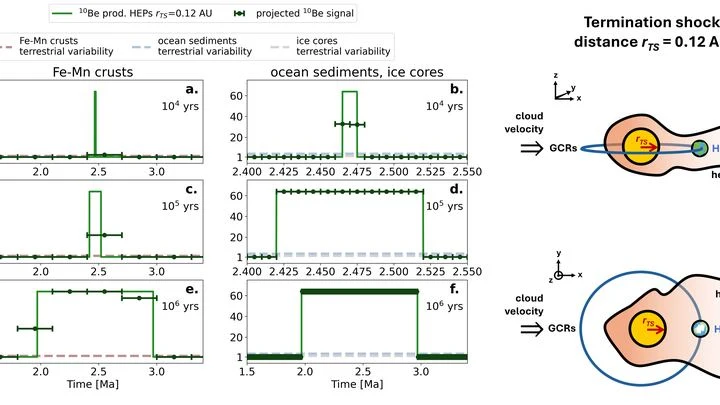
As it travels through the Galaxy, the Solar System occasionally dives into thick interstellar clouds — clumps of tenuous hydrogen and dust.
Plasma Physics2026-01-131 minarXiv:2601.08329express
The Solar Wind Whispers: How to Catch Its Wave
The scorching gas streaming from the Sun is not a continuous flow but rather a soup of charged particles. In this soup, waves constantly boil up: electric fields flare and fade like ripples on water from a tossed stone. One such wave is the ion-ion acoustic wave.
Strongly Correlated2026-01-141 minarXiv:2601.09847express
Metal Locks Magnetic Flux
Metals are full of free electrons: they dart between atoms like a swarm of bees around a hive. If you poke such a metal with a thin magnetic filament, the electrons start to feel its field. A new calculation shows they don't just go around the field; they trap it inside, like a cork sealing water in a bottle.