A Salt Electrolyte That Behaves Like Water express
Next-generation batteries don't just use a liquid electrolyte; they use water with a huge amount of salt dissolved in it — lithium ions and bulky organic molecules. There are so many ions that they constantly collide, like a crowd in a narrow corridor. Tracking every ion in such a crowd is no easy task.
The usual approach is to solve quantum mechanics equations for every step of motion. It's like trying to describe every step of every person in a crowd: the accuracy is immense, but the calculation takes forever. So the researchers took a different route. They used a computer model that learns from examples: first, they showed it a few short, accurate simulations, and then it learned on its own to predict where ions would move, without complex equations.
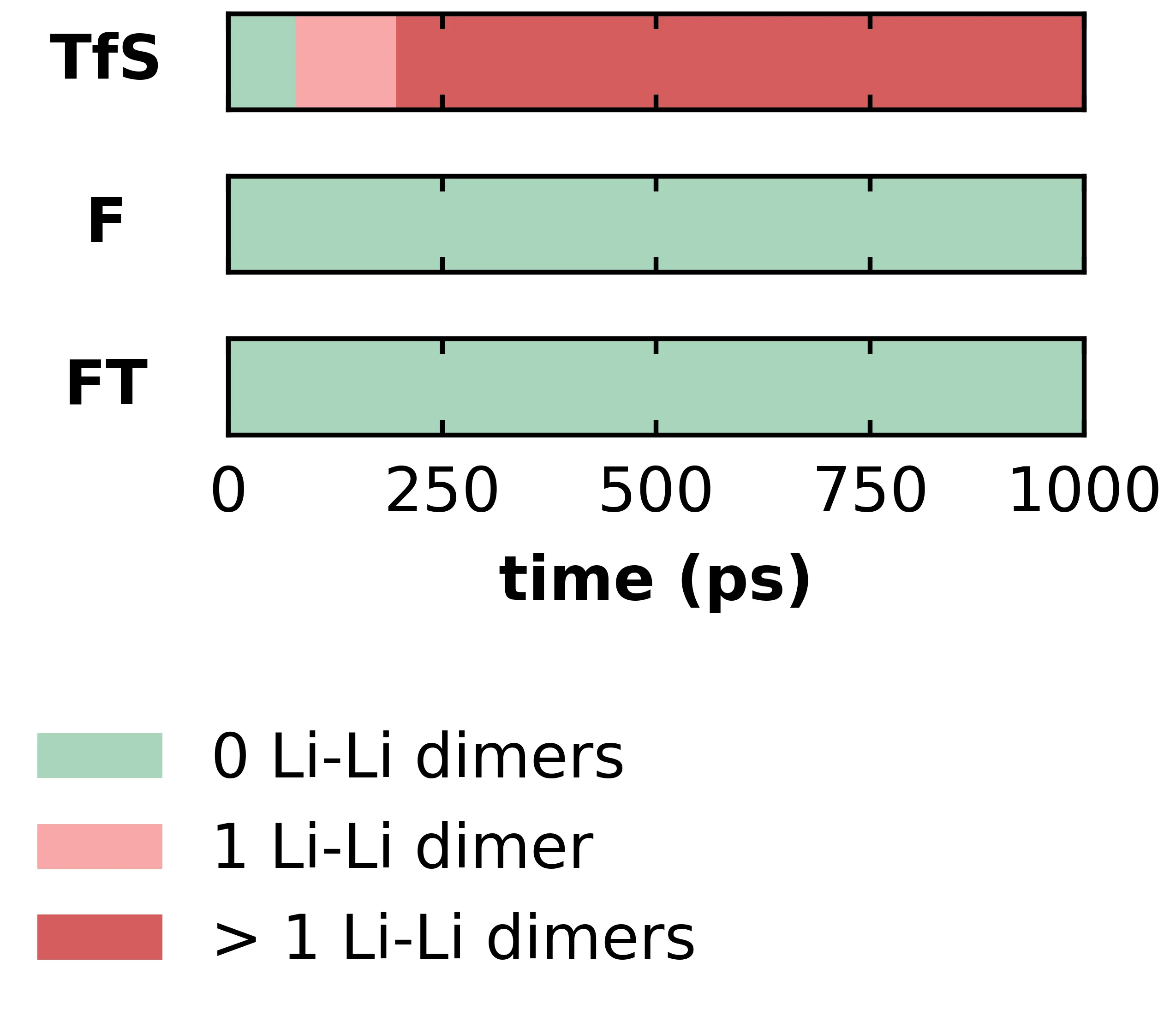
The authors tested the model on a solution of lithium salt in water. The model accurately reproduced experimental data — for instance, how X-rays scatter off the solution. This means it correctly describes the arrangement of ions. Moreover, the model allowed them to peek into situations that are hard to capture in experiments: when two lithium ions end up very close to each other.
It turned out that a model first trained on general data and then fine-tuned on the specific solution performed better than one trained from scratch. It's like a chef who knows many cuisines picking up a new dish faster than a novice.
Now researchers have a tool to study superconcentrated electrolytes over long timescales — from picoseconds to nanoseconds and beyond. This is important for developing safer, higher-capacity batteries.
Original abstract
as written by the authors arXiv:2603.22099
Machine-learned interatomic potentials hold the promise to enable the modeling of highly concentrated liquids over meaningful timescales, far from reach for current ab initio electronic structure methods. Here we evaluate the performances of various MACE potentials in modeling a $$21 m$$ water-in-salt electrolyte based on lithium bis(trifluoromethanesulfonyl)imide. We test out-of-the-box foundation models, as well as both fine tuning and from scratch training strategies. Our simulations demonstrate that surrogate models allow to overcome sampling limitations of ab initio molecular dynamics, reaching an excellent agreement with experimental observables such as the structure factor. We also demonstrate the benefit of fine tuning a foundation model over training from scratch: in terms of data efficiency, but most importantly as a means to provide information regarding configurations hard to sample, such as short Li$$^+$$--Li$$^+$$ distances. Finally, we show that depending on the reference exchange-correlation functional, empirical dispersion correction schemes can be detrimental. All in all, our work shows that machine-learned interatomic potentials are a good fit for the modeling of highly concentrated electrolytes over long timescales.
In a superconcentrated lithium salt solution, each lithium ion has only about two water molecules around it, like dissolving half a glass of salt into a glass of water.