A lithium ion is a positively chargedatom of lithium that moves between the anode and cathode of a battery during charging and discharging. In lithium-ion batteries, these ions are the charge carriers that store and release energy. The movement of lithium ions is what allows the battery to power devices, from smartphones to electric vehicles. The efficiency and longevity of a battery depend heavily on how smoothly these ions can travel through the electrolyte and electrode materials.
History
The concept of lithium-ion batteries was developed in the 1970s and 1980s, with the first commercial lithium-ion battery introduced by Sony in 1991, based on work by John Goodenough, Stanley Whittingham, and Akira Yoshino.
How it works
During discharge, lithium ions migrate from the anode through the electrolyte to the cathode, while electrons flow through an external circuit, providing electrical power. During charging, an external voltage drives the ions back to the anode. The electrodes are typically made of materials that can host lithium ions in their crystal structures, such as graphite for the anode and metal oxides for the cathode. The intercalation and deintercalation of lithium ions cause slight structural changes in the electrodes, which can lead to degradation over time.
In practice
Lithium-ion batteries power portable electronics, electric vehicles, and grid energy storage systems, and are also used in aerospace and medical devices.
Fun fact
Lithium is the lightest metal and the third lightest element, which makes lithium-ion batteries particularly lightweight and energy-dense compared to other rechargeable battery technologies.
Water and metal: a partnership humanity has used for two hundred years, yet still hasn't fully learned to control. In a typical battery, the zinc electrode gradually degrades: during charging, metal deposits on it in uneven growths resembling frost crystals. If one such growth reaches the other electrode, it shorts the circuit and kills the battery.
The helium atom is like a tightly stretched string: every note it plays is strictly predicted by theory. But in recent years, precise measurements of one such "note"—the energy needed to strip an electron from an excited helium atom — have started to sound slightly higher than they should.
A neuron transmitting a signal is like a tiny battery that quickly discharges and recharges. For nearly 70 years, it was believed that a special "potassium valve," opening with a delay, was responsible for the recharge phase. New work claims this current is a ghost.
Any battery, from a AA to a quantum one, is simple in principle: there's a store of energy, and there's a way to get it out. In the quantum world, this 'way' looks like a careful switching between particle states, akin to moving a ball from a high shelf to a low one.
Crystals glued to the outside and inside of a metal wall act as an invisible channel. One, receiving current, starts to tremble, and these vibrations, like ripples on water, spread out in all directions through the metal. The inner crystal catches this tremor and generates electricity again.
Two pendulums on a shared string trade motion: push one, and the second starts swinging, and a moment later the first gets a push back. In a thorium-229 atom, energy flows nearly loss-free between the electron shell and the nucleus.
In absolute silence, you need to hear a feather drop. But someone keeps rustling a plastic bag. For the space-based LISA observatory, that 'rustling' will come from charged particles in space.
An ionic conductor resembles a crowded bus where passengers (ions) try to squeeze toward the exit. Previously, it was thought that fast exit could be achieved either by a gently swaying bus (soft lattice) or by passengers standing in chaotic order (geometric disorder). The new work shows these are not two different tricks but the same one.
A lithium battery is like a tiny city: lithium ions are the residents who move between electrode neighborhoods, generating current. But to understand how much energy the city can deliver, you need to know not only the street layout (the material's structure) but also how residents interact with neighbors, transportation, and even the weather.
In diamond quantum devices, there's a tiny defect — the nitrogen-vacancy center (a nitrogen atom plus a vacancy where a carbon atom should be). It acts as a switch that spontaneously flips back and forth: it can carry an extra electron or not, and this determines whether it emits light or not.
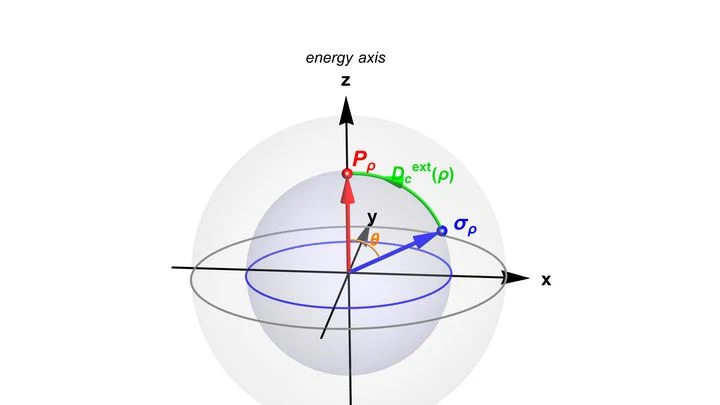
Quantum batteries harness quantum effects to circumvent the limitations of ordinary devices imposed by entropy — a measure of disorder and energy losses. Imagine a bucket under a powerful jet: filling is lightning-fast. But the bucket has holes: the environment constantly drains the energy.
Ordinary batteries lose charge like tea cools down. A quantum battery works differently: its heart is a tiny cavity with darting photons. If you illuminate it with special photon pairs, energy flows into a chain of qubit cells instantaneously — much like a swing gets a boost from strong pushes.
A quantum battery is not a box of chemicals but a chain of tiny magnets (spins) capable of storing energy. Its main trick: charge many particles at once, using their quantum entanglement. But there's a catch — not all entanglement works.
In a crystal of water and caustic cesium, oxygen and cesium atoms sit in place like beads in a rigid lattice. Hydrogen atoms behave differently: they are like passengers constantly changing seats. In this layered material, each oxygen is linked to three neighbors via hydrogen bridges, forming a honeycomb-like pattern.
A lithium-ion battery is like a multi-story building where lithium ions live on every floor. When you charge the battery, the ions move from floor to floor, and the whole building warms up a bit. Usually, this heat dissipates evenly, like from underfloor heating. But sometimes one spot gets too hot, and then the whole building can go up in flames.
A dust grain hangs in the air, held by an invisible beam of light. Around it is ordinary air, but sometimes a tiny spark jumps across the grain. For the first time, scientists have observed such discharges up close and found that they are triggered not by the grain itself, but by invisible visitors from space and from the ground.
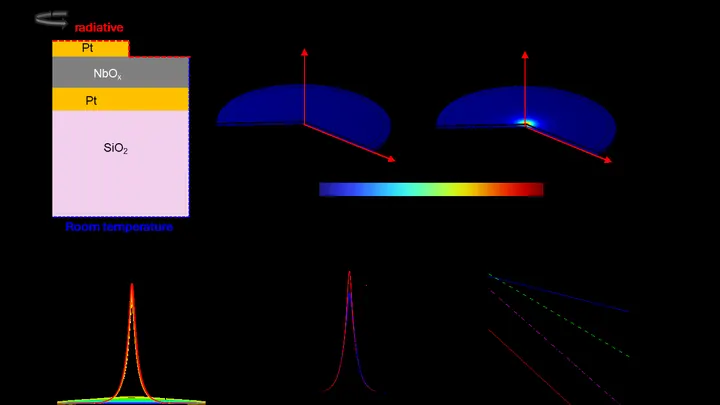
A memristor is a resistor with a memory: after the current is turned off, it retains its resistance. Inside, a thin film of metal oxide is sandwiched between two metal electrodes. When a strong current is first passed through the device, conductive filaments of oxygen vacancies form in the oxide, and the resistance drops sharply.
An ordinary transistor in a phone is made in a vacuum chamber, where atoms are deposited layer by layer. Expensive and slow. But indium oxide can be printed like ink — from a drop of liquid metal that, in air, coats itself with a thin oxide film.
The authors took indium, melted it, and rolled it over a substrate at 250 degrees.
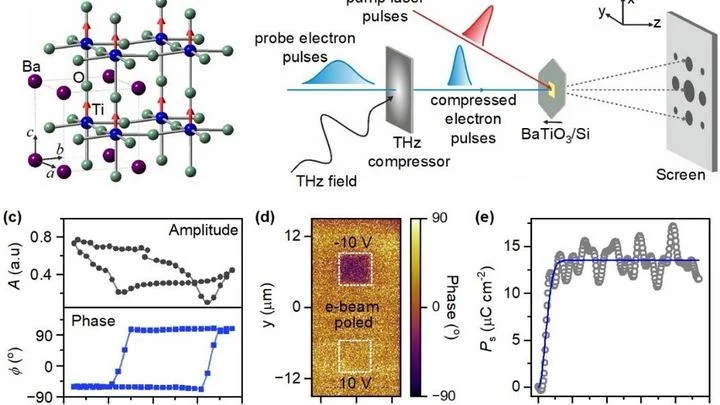
Inside a barium titanate crystal, there's a built-in electric field, like a permanent magnet, but for charges. When a flash of light hits it, electrons are knocked loose and start darting around, colliding with atoms. But the crystal isn't the same in all directions: it has an axis along which the field is strongest.
A solid electrolyte is like a sponge for lithium ions. In a regular lithium battery, ions float in a liquid, like fish in an aquarium. In a solid-state battery, they have to squeeze through the crystal lattice, like through narrow corridors.
A lithium battery is like a house with a storage room: during charging, lithium goes inside; during discharging, it comes out. But if the storage room gets cluttered, some lithium stays inside forever. How much lithium returns depends on the metal the walls are made of.
The authors of the study took four metals: aluminum, magnesium, silver, and copper.
A quantum computer is like an orchestra where every musician must hit their note without going flat. But superconducting qubits share a common ailment: random charges accumulate on their electrodes, and the 'note' drifts. Engineers call this charge offset drift, and usually battle it for years.
A laser strikes a strontium atom, and two electrons fly out at once. Previously, it was thought that in such double ionization each electron acts on its own: one is knocked out first, the second later, randomly.
Two phones with identical batteries: one charges in a basement with a weak signal, and the process goes slower. The battery percentage here plays the role of a clock hand. Physicists applied the same logic to the quantum world. Their clock is a microscopic battery that stores energy. The charging rate depends on a hidden quantum 'mode'—like a switch.
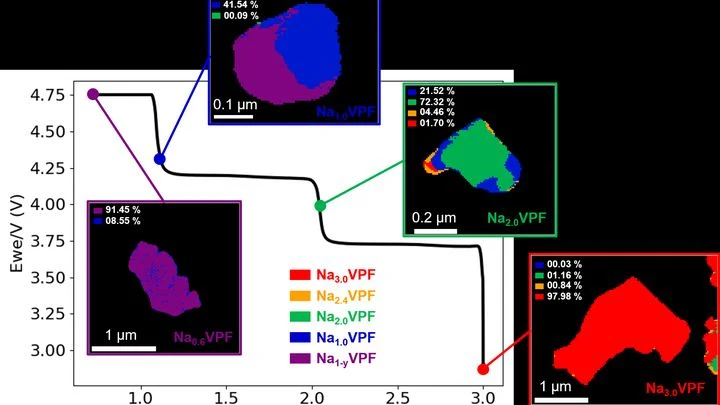
Inside each tiny particle that makes up the cathode of a sodium-ion battery, sodium is unevenly distributed — like sugar clumping in tea. This reduces the battery's capacity and lifespan. To see this hidden landscape, scientists used X-ray microscopy and trained artificial intelligence to interpret the data.
A semiconductor film just one atom thick is like a communal apartment: it houses negatively charged electrons and positively charged 'holes.' When light hits such a film, an electron and a hole can pair up into an exciton — a bound state of an electron and a hole, akin to a hydrogen atom.
A quantum computer is like an orchestra where every musician must come in exactly on the beat. The faintest rustle in the hall throws off the violinist, and the melody falls apart. In silicon chips, that rustle is electrical noise: random fluctuations of charge inside the material. They make quantum bits err.
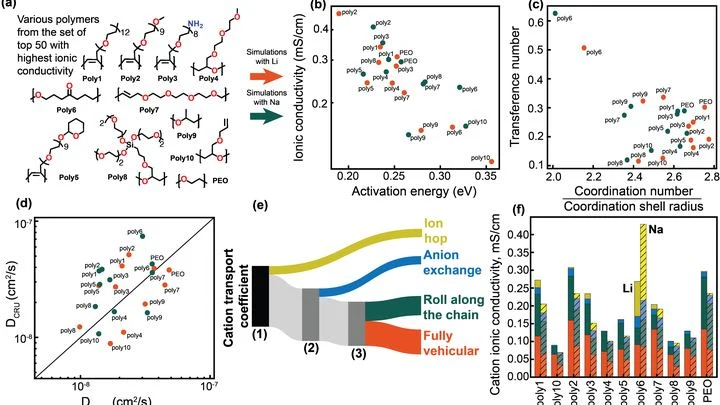
Modern batteries with liquid electrolytes can leak or catch fire. Polymer electrolytes (solid, plastic-like materials) solve that problem, but ions move through them more slowly, so the battery loses power.
Researchers set up a virtual assembly line: a computer program generated new polymer structures the way a chef experiments with new dough recipes.
Light in semiconductors is born from pairs of charges, an electron and a hole, that attract each other like a magnet to a fridge. Such a pair is called an exciton. If you add one more charge to the pair, you get a trion — a trio of three particles.
Lithium in a battery sometimes behaves like ivy on a building facade: instead of a uniform layer, it sprouts thin, sharp tendrils. These needles can pierce the separator inside the battery and cause a short circuit. So engineers are looking for ways to make lithium grow calmly.
One trick they've found is to put a thin silver film under the lithium.
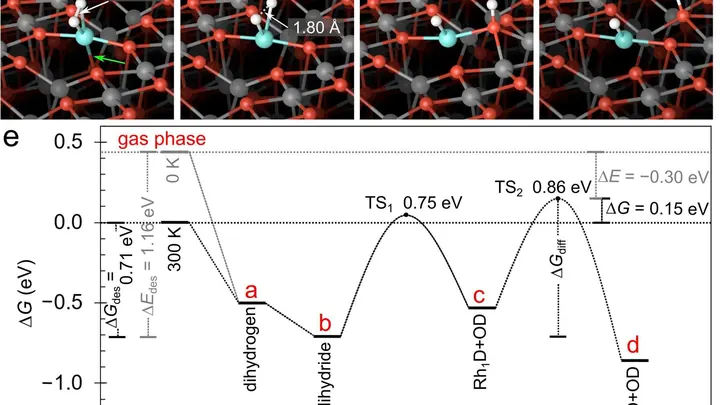
Chemistry has two worlds: in one, the catalyst is a solid particle and the reaction happens on its surface; in the other, it's a dissolved molecule where everything occurs around a single metal center. These worlds rarely meet. But in a new study, they collide.
The researchers took iron oxide, a black powder used in magnetic tapes, and scattered single rhodium atoms across its surface.
Diamond is not just a gemstone. This crystal can conduct electricity when free charge carriers, electrons and holes, appear in it. But how fast do they move? In scientific papers, numbers vary by tens of times. One lab reports a mobility of 1000 cm²/(V·s), another 4000.
A graphene sheet is placed in a solution of sodium sulfate — an ordinary salt, similar to table salt. Near the surface, water stops being uniform: it arranges into layers, like a stack of pancakes. Between and within these layers, ions, charged particles from the dissolved salt, distribute themselves.
A piece of chromium exposed to air gets covered in invisible armor, an oxide film, within a minute. That film protects the metal from rust, but for a battery it's a disaster: the film blocks chromium ions, so no current flows.
Scientists mixed five metals — chromium, bismuth, copper, tin, and nickel.
A heavy ion beam in an accelerator is like a crowd of people shoving each other with elbows: the more people, the wider the crowd. Charged particles repel each other, and at currents above a few microamps the beam spreads and loses its shape.
Quantum batteries lose energy due to entropy — the tendency toward disorder. Just as parallel wires pick up interference, the battery's contacts with the environment create leakage channels. The solution: braid the giant atoms, which act as both charger and storage, into a braid.