An electrolyte is a substance that contains free ions and conducts electricity through their movement. In the context of the cited experiments, it is the working fluid — typically a salt dissolved in water or another solvent — that enables the flow of charge between electrodes. Electrolytes are central to electrochemistry: they are the medium in which chemical reactions at electrodes are balanced by ionic transport, enabling batteries, fuel cells, and electrolyzers to function.
History
The term 'electrolyte' was coined by Michael Faraday in the 1830s, who also introduced the terms 'electrode', 'anode', and 'cathode' based on his experiments on electrolysis.
How it works
When an electric field is applied, positive ions (cations) migrate toward the negative electrode and negative ions (anions) toward the positive electrode. This ionic motion constitutes the electric current. The conductivity of an electrolyte depends on the concentration and mobility of the ions, which in turn depend on the solvent's viscosity, temperature, and the ion's size and charge. In water, ions are often surrounded by a hydration shell that affects their movement and interactions.
In practice
Electrolytes are used in all electrochemical devices: lithium-ion batteries, fuel cells, electrolyzers for hydrogen production, and supercapacitors. They are also essential in biological systems, where they maintain nerve and muscle function.
Fun fact
In some electrolytes, ions of the same charge can attract each other due to the structured arrangement of water molecules around them, a counterintuitive effect that has been observed in recent experiments.
In the dark chamber of the trap, thousands of charged particles dance under electric fields. At first they move freely, like a crowd in a square, but cool the cloud and the dance slows: ions begin to sense each other, their steps become constrained.
Picture a long thread trapped inside a sphere with charged walls. The thread is the virus's RNA; the sphere is its protein shell. The thread tries to settle so that its charges sit as close as possible to opposite charges on the wall.
Turn off the stove, and water stops boiling almost instantly. In the world of catalysis, researchers expected a similar picture: stop the reaction, and all intermediate particles vanish right away. But fresh observations of platinum nanoparticles tell a different story.
Every battery or supercapacitor has an unassuming player — the polymer glue. It binds the active material particles together and helps them stick to the current collector. Previously, it was considered just inert mass: it's there, as long as it doesn't get in the way. But in this work, the glue takes center stage.
In dark interstellar clouds where new stars are born, chemistry starts with a tiny particle — the trihydrogen ion (H₃⁺). It collides with other atoms and sets off a cascade of reactions that build ever more complex molecules. For a long time, it was thought that the main reaction producing it, H₂⁺ colliding with H₂, only happens in the gas phase.
To probe deeper into the workings of the universe, physicists accelerate electrons and smash them together. An ordinary electron is like a spinning top that wobbles randomly. For delicate experiments, you need particles whose spins all point in the same direction: this is called polarization.
In a tight row of atoms, spaced closer than the wavelength of light, a remarkable state hides. The excitation is distributed among all particles so that their radiation cancels itself out. This quantum 'silence' is an ideal vault for a photon: it can be stored there hundreds of times longer than usual.
Two pendulums on a shared string trade motion: push one, and the second starts swinging, and a moment later the first gets a push back. In a thorium-229 atom, energy flows nearly loss-free between the electron shell and the nucleus.
Energy transfer in photosynthesis is like a children's slide: it bends under the weight of one, reshaping the path for the next. That's what happens in a leaf: an excited molecule instantly reshapes the 'landscape' of its neighbors.
Physicists reproduce this effect using ions suspended in a vacuum trap.
Two grains of salt fall into a glass of water. They dissolve, and sodium and chloride ions spread throughout the volume. The schoolbook truth is simple: like charges repel, opposite charges attract. But recent experiments with tiny spheres in liquids have revealed a picture that breaks this rule.
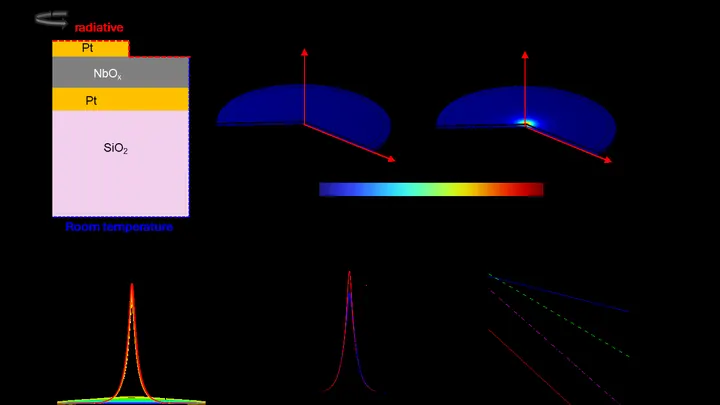
A memristor is a resistor with a memory: after the current is turned off, it retains its resistance. Inside, a thin film of metal oxide is sandwiched between two metal electrodes. When a strong current is first passed through the device, conductive filaments of oxygen vacancies form in the oxide, and the resistance drops sharply.
In the cold heart of a pure crystal, electrons flow like a viscous fluid — an idea predicted by Lev Landau. But the vortices of this fluid remained invisible, like a painting inferred from the noise of a crowd. Now scientists have created a nanostring: a semiconductor tuning fork with a circular cavity.
A water molecule, finding itself near a carbon ring, starts to vibrate, and immediately falls under the sway of an invisible conductor. The ring's electron cloud, like a maestro, dampens some vibrations while amplifying others.
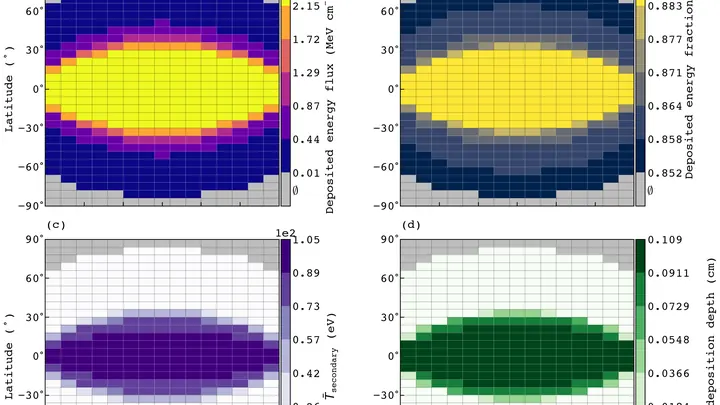
Europa's surface is an icy armor continuously bombarded by charged particles from Jupiter's magnetosphere. Electrons slam into the ice's crystal lattice, lose energy, and kick off chemical reactions. Until now, there was no tool to show how deep such bombardment pierces the ice.
Splitting water into hydrogen and oxygen with electricity is an age-old dream of clean fuel. But tiny gas bubbles stand in the way: they cling to the electrodes like foam on the side of a soda glass, interfering with the current's work. Each bubble is a tiny plug, blocking part of the surface where the reaction should occur.
A thin semiconductor layer at low temperatures behaves like a pot of honey: electrons flow not as individual particles but as a thick liquid. If you run an alternating current through such a layer, the resistance responds with a smooth curve.
Inside every battery sloshes a liquid electrolyte, and how ions jostle within it determines how much energy the battery delivers and how long it lasts. Previously, peeking into that crowd meant either running long experiments or launching ultra-precise calculations that devour weeks of computer time.
A membrane for water electrolysis is like a sponge soaked with water. Inside it, hydroxide ions, particles that carry electric charge, must move freely. But exactly how they move has long been a mystery: tracking each ion in an experiment is too difficult.
A solid electrolyte is like a sponge for lithium ions. In a regular lithium battery, ions float in a liquid, like fish in an aquarium. In a solid-state battery, they have to squeeze through the crystal lattice, like through narrow corridors.
A lithium battery is like a house with a storage room: during charging, lithium goes inside; during discharging, it comes out. But if the storage room gets cluttered, some lithium stays inside forever. How much lithium returns depends on the metal the walls are made of.
The authors of the study took four metals: aluminum, magnesium, silver, and copper.
Gold on carbon is a classic pairing in chemistry. Such materials speed up important reactions, like producing vinyl chloride for plastics. But until now, no one had seen in detail how gold atoms behave on a graphite surface when the whole thing is immersed in a liquid.
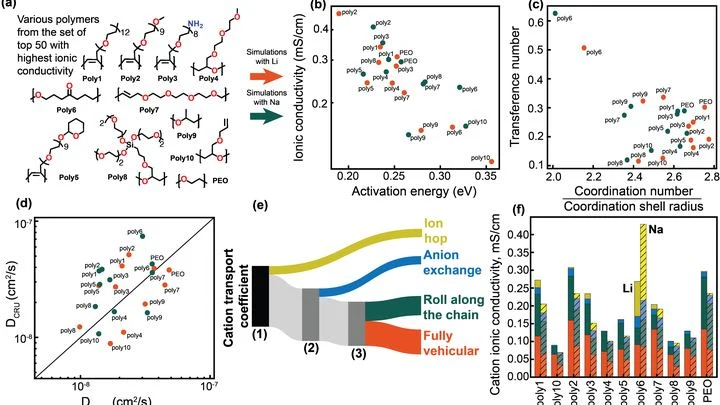
Modern batteries with liquid electrolytes can leak or catch fire. Polymer electrolytes (solid, plastic-like materials) solve that problem, but ions move through them more slowly, so the battery loses power.
Researchers set up a virtual assembly line: a computer program generated new polymer structures the way a chef experiments with new dough recipes.
Hydrogen is the lightest fuel, and its conversion into electricity on a metal surface resembles a game of ping-pong: hydrogen atoms alternately attach to and detach from the electrode. But the score in this game depends on solution acidity in ways that were unexpected. Classical formulas predict a smooth change, while experiments show jumps and kinks.
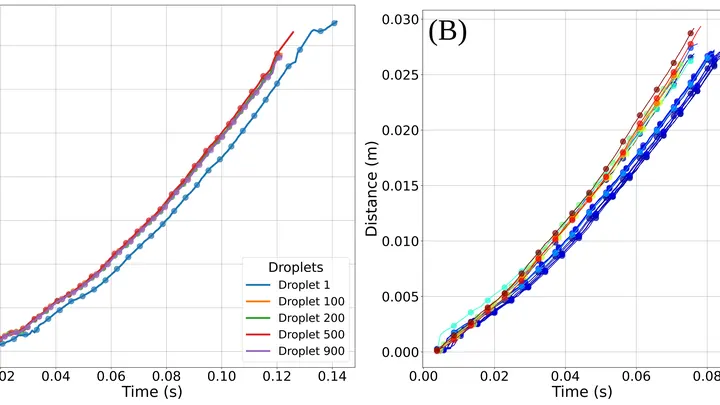
A water droplet races across a taro leaf like a bead on a freshly waxed floor. But it doesn't just glide: it picks up electricity. Thirty years ago, scientists explained why lotus leaves stay dry: their surface is covered with microscopic bumps that trap air. Now it turns out that water on leaves has another, hidden power.
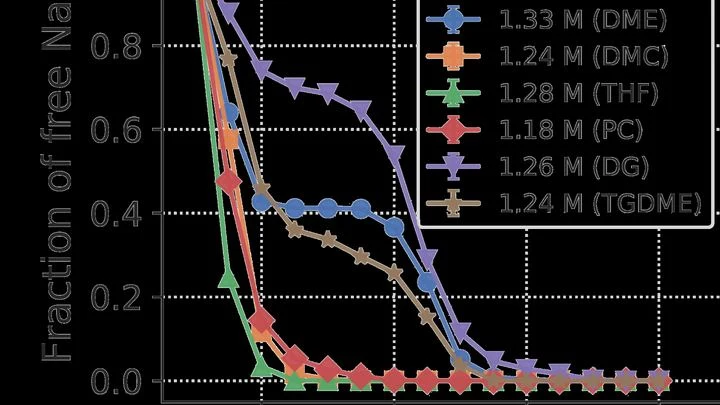
Salt in a glass of water is a crowd of charged particles. When there's plenty of water, each particle floats on its own, wrapped in a thick fur coat of water molecules. But as you keep adding salt, the water runs out for everyone, and the particles start seeking each other out. First, they stick together in pairs, then in larger clumps.
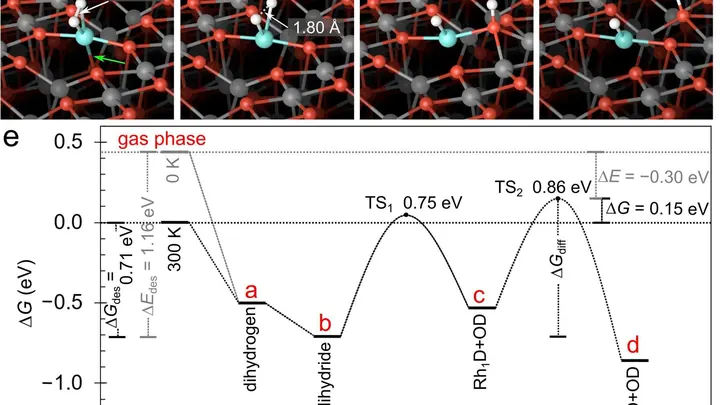
Chemistry has two worlds: in one, the catalyst is a solid particle and the reaction happens on its surface; in the other, it's a dissolved molecule where everything occurs around a single metal center. These worlds rarely meet. But in a new study, they collide.
The researchers took iron oxide, a black powder used in magnetic tapes, and scattered single rhodium atoms across its surface.
A piece of chromium exposed to air gets covered in invisible armor, an oxide film, within a minute. That film protects the metal from rust, but for a battery it's a disaster: the film blocks chromium ions, so no current flows.
Scientists mixed five metals — chromium, bismuth, copper, tin, and nickel.
Electrons in a conductor usually behave like a gas: they dart around chaotically, collide, and don't hold formation. But if you spread them far apart and cool them down, their mutual repulsion can force them into place, like attendees in an overcrowded hall who settle into every other seat.
Two water droplets tremble in sync — because they're connected by a straw. So it is with entangled particles: their unity may be held together by a microscopic wormhole.
A laser on a lithium niobate crystal comes to life with a current of 40 milliamps. Its light splits into two streams, each passing through a six-millimeter waveguide, where twin photon pairs are born. One stream rotates the polarization of its twins, after which both flows merge into a common channel.