Training data are the examples—images, texts, or measurements—used to teach a machine learning model to recognize patterns and make predictions. The quality and diversity of this data determine what the model learns and how well it generalizes to new situations. Without representative training data, even the most sophisticated algorithm fails.
History
The concept emerged in the 1950s with perceptrons, but modern deep learning relies on massive datasets and computational power that became available in the 2010s.
How it works
During training, the model adjusts its internal parameters to minimize the difference between its predictions and the correct answers in the training data. This is done iteratively, often using gradient descent, where the model learns to extract relevant features from the examples. The process is analogous to fitting a curve to points, but in high-dimensional spaces.
In practice
Training data power neural networks that diagnose diseases from medical images, predict weather patterns, and translate languages in real time.
Fun fact
Some trainingdatasets contain billions of examples, such as the text corpus used to train large language models, which includes a significant fraction of the public internet.
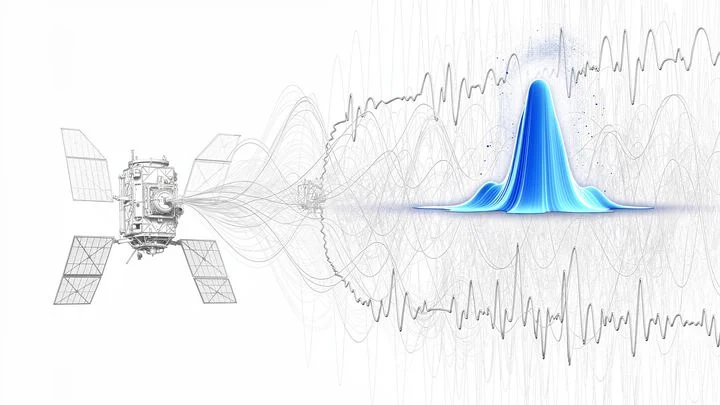
In the Antarctic ice, a ghost particle leaves behind only a faint flash of blue light. The IceCube detector captures these flashes, and from them we need to infer where the particle came from. The PolarBERT model has learned to do this, but what exactly it sees inside has remained a mystery.
A protein in a cell doesn't hang motionless like a mannequin in a store window. Its atoms are constantly jiggling, stretching, and bending, like a plucked guitar string that keeps vibrating after you strum it. To understand how a protein works, you need to know how tightly each part holds onto its neighbors.
A protein engineer is like a chef trying to make a dish that is tasty, healthy, and cheap all at once. Change one ingredient, and you risk ruining another. In the past, computer assistants could only evaluate protein properties one at a time, missing how they are connected.
A person flips a coin to make a decision. They stand still — the coin lands heads. They take a few steps, and flip again. It would seem walking shouldn't affect the coin. But what if the walk itself changes how often they decide to simply repeat the previous toss?
That's exactly what researchers tested.
A hundred thousand stars in the dense core of a globular cluster move like steel balls in a giant pinball machine. Each 'bump' — a gravitational encounter between a binary system and a single star — triggers a cascade of unpredictable events.
Imagine a vast library where every book is a precise instruction manual for assembling one protein molecule. AlphaFold2 read millions of such books and learned to instantly produce a ready-made 3D model. But inside this network, in its very 'brain,' something more remained — not just assembly rules, but an entire atlas of possible protein motions, its hidden life.
In combat, a pilot needs to instantly understand what an object is and what its intentions are. Conventional systems wait for complete radar data — like a goalkeeper who only reacts after the shot. The new algorithm works like an experienced goalkeeper: from the attacker's first moves, it predicts the target's maneuver.
Radio signals in a room act just like sound in a concert hall: bouncing off walls and objects, they create a unique pattern — a silent melody for every location. Your phone, like a keen ear, catches this melody amid noise and distortion. It remembers which chord matches the corner of the couch, and which one fits the doorway.
The robot juggler catches and throws balls in precise rhythm with a human, like two пульсара sending pulses in unison. Juggling three balls is a classic cascade, governed by a steady beat, like the uniform rotation of a cosmic lighthouse. Break the rhythm and the pattern crumbles.
An AI predicting room acoustics is like a student taking an exam with a cheat sheet. If the test points are the same as the training ones, the model simply memorizes the acoustic 'fingerprint' of each position — like a student recognizing a question by the dog-eared corner.
Models that turn text into audio are good at recreating single sounds, but get confused when the script has several in a row. For example, the script might call for a ring, then footsteps, then a door slam. The generator might shuffle events, so the listener hears footsteps before the ring.
The modern standard approach to AI training is like a child locked in a library: he remembers millions of books but doesn't know that fire burns and falling hurts.
The brain communicates in short electrical clicks. Previously, to learn this language, thousands of examples with translations from the experimenter were needed. MOJO takes a different path: like learning a language through immersion, it first listens to the 'stream of consciousness' without any hints and finds recurring patterns on its own.
Assessing image quality is a job for a meticulous inspector with a toolbox. The IQA-T1 neural network acts exactly like that: it doesn't just stare at the picture, but applies either a spectroscope or a light meter.
Traditionally, machine learning algorithms operate in a static environment, like water flowing along a pre-cut channel without changing its shape. The new method flips this paradigm: it lets an agent simultaneously master actions and deliberately modify the very environment it inhabits.
When you type 'salad' and the keyboard suggests 'Caesar,' behind the scenes millions of phones are jointly learning to predict words. They share not your messages, but only improvements to the common algorithm, like a coach who sends athletes only the tweaks to the plan: 'add 5 push-ups to yesterday’s routine.' Information entropy helps send only unexpected, valuable updates.
Researchers took 16 everyday activities — from washing dishes to squatting — and broke the movements down into elementary components, much like a spectroscope splits light into a spectrum. Comparing three approaches, they found an unexpected key to recognition: a single averaged snapshot is enough. Only nine joints out of dozens carried the crucial information — the rest hardly mattered.
A family tree becomes a tangle if you account for adopted children and remarriages. Evolution often resembles such a tangle: although the Standard Model, the traditional view of divergent evolution where species branch like a tree, paints a neat tree of species, in reality genes travel not only by inheritance but also directly between unrelated organisms — a process…
Complex machinery, from drones to surgical robots, sometimes behaves like a wild mustang: full of disorder and whims, where the slightest touch triggers a storm. Instead of rote memorization of formulas, the new method observes the system like a horse breaker.
A living power system is like an organism: power lines are vessels, current is blood. Data, however, are nerve impulses that used to be lost. mAIEnergy connects these 'nerves' to a shared 'brain'. This data repository combines satellite images, electricity meter readings, articles, and weather reports.
An experienced detective doesn't calculate a criminal's path using the laws of physics: he checks a file of similar cases. The new prediction method works the same way: instead of complex equations, it has a vast archive of trajectories that have already happened — planetary motions, currency exchange rates, signals from space.
Machine learning has long ceased to be just a tool — it is becoming an investigator, independently fishing out the laws of nature from data. But how does a silicon mind come to understand?
The gamma sky, captured by the Fermi telescope, is a grand symphony of thousands of sources. Here, the rhythmic pulsations of pulsars, the powerful chords of active galactic nuclei, but most of all — unidentified objects, whose part remains a mystery.
Gravitational signals from dying massive stars are whispers reaching us from the most violent laboratories in the Universe. Einstein predicted these gravitational waves over a century ago, but only today, with detectors like LIGO, are we beginning to hear them.
Hybrid perovskites are the rising stars of photovoltaics: their efficiency is growing so fast it feels like we're on the brink of a solar revolution. But these materials, like intricate atomic mosaics, are extremely vulnerable — moisture, heat, and light quickly turn them to dust.
A neuron is like a complex musical instrument. To understand how it responds to a touch, you used to have to connect to each string directly — a delicate, slow procedure that only works for individual cells.
Imagine an audition for a symphony orchestra, where out of hundreds of hopefuls, only those whose instruments sound pure and withstand the furious crescendo remain. In the world of materials, computers have learned to generate 'atomic scores'—thousands of virtual crystals that promise to become the foundation for quantum chips or superconductors.
Almost a century after Фриц Цвикки suspected something was amiss in the motion of galaxies in the Coma cluster, and Вера Рубин measured stellar velocities in spiral arms, the nature of тёмной материи remains one of the most vexing mysteries.
60 mice, 1,980 samples, 234 lung cancer patients. Behind each number lie thousands of genes. Their activity is measured to understand the disease. But the data aren’t uniform: for one patient, you assess a protein level (a continuous number), make a diagnosis (yes/no), and determine the tumor subtype (a category).
A doctor scrolls through a patient's chart and sees a line: "The drug reduces risk." But how much can you trust that? Is the claim based on a couple of case reports or on tens of thousands of patients in a blinded trial? The answer determines the treatment.
Ordinary neural networks learn from examples, like a person memorizing tunes by ear. But networks with physical laws embedded from the start resemble a musician who knows notes and harmony: they can play a new piece from just a few chords. Instead of mindless memorization, they use equations like energy conservation or motion.
A chef doesn't waste ingredients cooking the whole dish to check the taste: they just taste a drop of sauce. The same logic underlies the "information matching" method for predicting metal strength. Instead of expensive calculations of every atom's behavior, scientists "taste" only simple indicators linked to plasticity — a metal's ability to bend without breaking.
Designing machines is like cooking: you need to know exactly where the 'dough' will tear. Old computer simulations check every point on a part for hours, like measuring the entire pot to make sure the handle doesn't fall off.
A supermarket cashier at rush hour doesn't memorize every scanned item: they keep the running total in their head and watch the queue. The brain allocates its resources similarly: the expensive, precise cortex (responsible for deliberation) and the simpler, economical subcortical nuclei (where habits live) work in tandem.
Conventional neural networks learn from thousands of examples, burning hours and gigawatts. Physicists have found a quantum workaround. As early as Max Planck showed the discreteness of energy, today this allows generation without training.
For one person, the disease begins with a tremor in the hand — the cup dances on its saucer as they carry it to the table. For another, the legs suddenly refuse to move smoothly: the step becomes short and shuffling, as if the floor were suddenly covered in a sticky layer. These are not two different diseases but two faces of the same one — Parkinson's disease.
A mosaic of large colored tiles. Each tile is the average precipitation over an entire month for an area the size of a small country. For a general understanding, the picture is fine, but if you need to know whether a downpour hit a specific city yesterday, it's useless.
Every time you mull over a risky move, whether to invest in stocks or hold off, an inner dialogue runs through your head. Usually, scientists try to reconstruct that dialogue from the final choice alone, as if a detective were reconstructing a conversation between two people from a photo of the meeting spot.