A nanosecond is one billionth of a second — a span so short that light, traveling at about 300,000 kilometers per second, covers just 30 centimeters. It is the natural timescale for processes inside computer chips, where electrical signals switch in fractions of a nanosecond, and for the fastest chemical reactions, where atoms move only a few atomic diameters during this interval. In physics, the nanosecond is a practical unit for describing the lifetimes of excited states, the duration of laser pulses, and the timing of particle collisions.
History
The term entered scientific usage in the mid-20th century as electronics and radar technology required precise timing of very short intervals. It became standard with the development of fast oscilloscopes and, later, laser systems.
How it works
The unit is defined by the International System of Units as 10⁻⁹ seconds, derived from the base unit of time. It is measured using electronic oscillators, atomic clocks, or fast photodetectors that convert optical signals into electrical pulses. In practice, a nanosecond is often visualized by the distance light travels in that time — about the length of a standard ruler — making it a bridge between abstract time and tangible space.
In practice
Nanoseconds are the clock cycle times of modern computer processors, the pulse durations of ultrafast lasers, and the timing resolution in particle detectors at colliders.
Fun fact
In one nanosecond, an electrical signal in a computer chip travels only about 15 centimeters — less than the length of a typical laptop keyboard.
Systems:SICGSOne billionth of a second (10^-9 s), defined as a submultiple of the SI base unit second.
It's like a sprint record: to break it, you need a perfect run-up. But for sub-millisecond pulsars, the run-up is too short. The fastest known pulsar, PSR J1748-2446ad, spins 716 times per second — faster than a kitchen blender. If it were the size of Earth, a point on its equator would move at about 0.24 times the speed of light. But why doesn't any pulsar spin even faster?
A protein in a cell is not a frozen sculpture but a restless mechanism. Its parts are constantly vibrating, and these movements determine how it grabs molecules, transmits signals, or builds the cellular scaffold. But filming the life of a single protein was hampered by two nuisances at once. First, the movements last millionths of a second — ordinary cameras simply cannot catch them.
A typical laser is a cavity where light bounces between mirrors and gets amplified. But you can ditch the mirrors and make light circulate inside a tiny particle smaller than the light wave itself. That's how the new lasers work: nanoparticles of indium phosphide sitting on perfectly smooth gold.
In the lab, there's a trap, an invisible 'pit' made of electric fields, where a charged dust grain about a hundred nanometers across levitates. It oscillates back and forth like a pendulum in a clock.
Deep inside the atomic nucleus of thorium-229, there's a stiff lever. To flip it from one position to another, you need to apply force, and that usually takes time. This isotope has two very close energy levels, and the transition between them can be triggered by a laser pulse.
An optical tweezer is a laser beam that holds an atom in place, much like fingers holding a pea. Arrays of these tweezers form the basis of future quantum computers. But there's a catch: not every tweezer catches an atom. Typically, only half of the traps get filled, and for molecules, even fewer. Empty spots break the whole setup.
An ordinary camera flash lingers for hundredths of a second, but for atoms, that's an eternity. Inside molecules, electrons jump in attoseconds: billionths of a billionth of a second. To capture that, you need a light pulse shorter than the event itself.
Physicists take an electron beam in a linear accelerator and compress it so that individual bunches become thinner than a hair — in time.
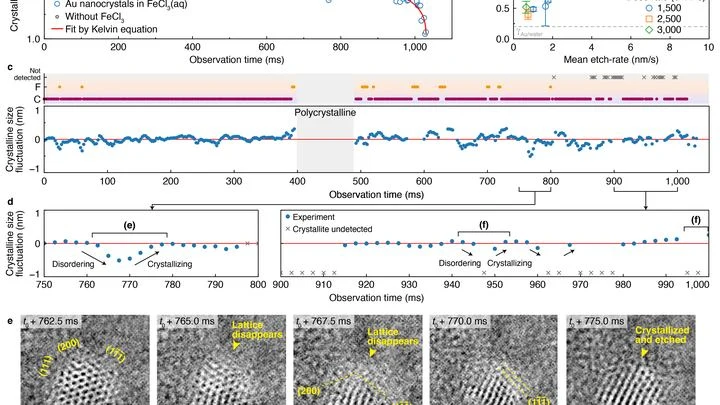
Gold nanoparticles in liquid are like tiny living creatures: they constantly change their internal structure, as if breathing. Scientists managed to peek into this process using an electron microscope that takes snapshots every millisecond, and a neural network that cleans the images from noise.
A laser beam strikes a gold-and-silver film for just a few nanoseconds — in that time, light travels less than a meter. At the point of impact, the metal boils, splatters, and freezes into a random pattern of tiny particles. Each pattern is as unique as cracks in ice or tree branches.
A tiny vanadium oxide particle behaves like a window with adjustable transparency: in one state it lets infrared light through, and in another it starts absorbing it. The switch doesn't happen abruptly but smoothly, like turning a dimmer knob to adjust a lamp's brightness.
A speck of glass floats in a laser beam. Air molecules, photons, even Earth's gravity give it little pushes, and by watching its jitter, you can tell what pushed it. But every measurement has a limit: the particle's own noise hides weak signals. Quantum mechanics sets that limit, but it can be bypassed.
Deep in the Siberian taiga, there are a hundred light traps: each about the size of a small table, but together they cover a square kilometer. At night, these traps gaze at the sky, catching faint flashes of light born when cosmic particles slam into the atmosphere. The setup is called TAIGA-HiSCORE, and it usually works as a giant "eye" for such particles.