A rod in sand: why it falls sideways express
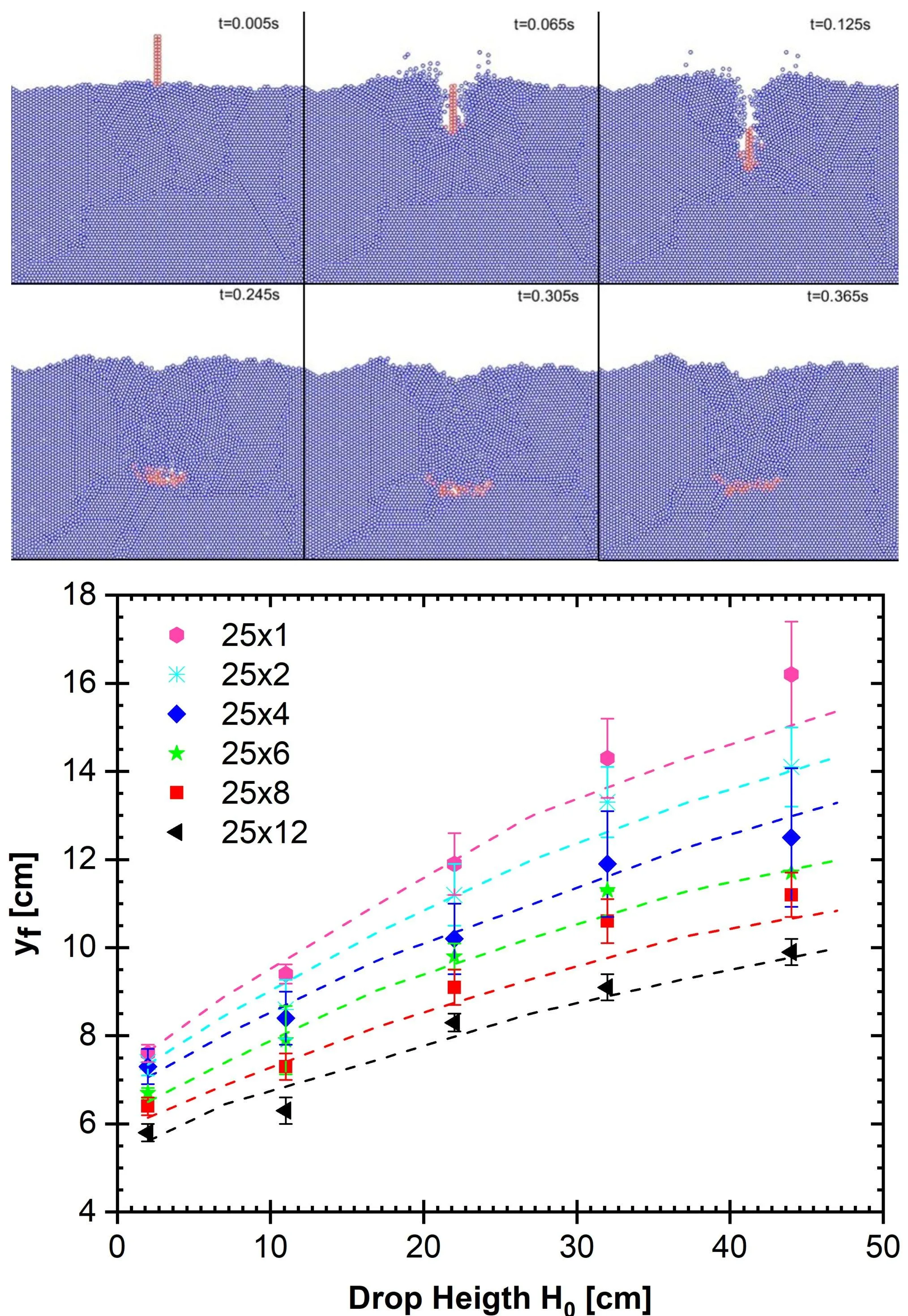
A rod stuck into a granular material (say, sand or a layer of small beads) behaves quite differently from what you might expect. Instead of going straight down, it quickly tilts away from the vertical and ends up lying flat. That's what researchers found when they dropped rigid and flexible rods into a two-dimensional layer of foam beads and tracked their motion with a high-speed camera.
The reason for the tilt is inhomogeneities in the bead packing: in some places the beads are packed tighter, in others looser. When a rod hits a denser region, it experiences more resistance on one side and starts to rotate. A short rod rotates faster than a long one because it has a smaller moment of inertia: it's easier to spin. A long flexible rod doesn't just tilt; it bends (loses stability), and because of that it penetrates shallower than a rigid rod of the same size.
This result helps us understand how long objects behave in granular media — from piles driven into the ground to plant roots or even animals burrowing into sand. Engineers might need to consider that a thin rod won't go straight if the medium is not uniform.
Original abstract
as written by the authors arXiv:2603.27262
The penetration of projectiles into granular materials has been mainly studied using spherical intruders. Here we explore the dynamics of rods penetrating vertically in a two-dimensional granular bed composed of expanded polystyrene spheres. The experiments were performed using rigid rods, flexible rods and vertical arrays of non-cohesive particles, and the dynamics for the three cases was compared. In contrast to the vertical penetration observed for a single spherical projectile, high speed videos reveal that a rod rapidly deviates from its initial vertical direction due to inhomogeneities of the bed packing fraction. Then, the rod rotates due to the torque induced by the resistance force and follows a curved trajectory until be aligned horizontally at a final depth. A short rod tends to deviate faster than a longer rod due to the smaller moment of inertia. Moreover, long flexible rods always lose their vertical alignment and experience buckling, whereas rigid rods of the same size penetrate deeper before being deviated. On the other hand, experiments and molecular dynamics simulations show that a initially vertical array of grains also loses its verticality and stops adopting a final horizontal configuration. The granular array penetrates considerably less than the rods of equivalent mass, and the stopping mechanism is based on vertical-to-horizontal momentum transfer during a collisional process of the constituting particles.
The foam beads in the experiment were about 3 mm in diameter, and the rods were 5 to 20 cm long. At such a scale difference, the rod feels every inhomogeneity in the packing, as if you were walking across a floor strewn with large boulders.