substance

porous material

A solid containing pores or voids that can be penetrated by fluids or particles.
15 related articles

Description

A porous material is a solid riddled with voids — pores, cracks, or channels — that fluids or particles can penetrate. Think of a sponge, sandstone, or even bone. The defining feature is not just that it has holes, but that those holes are connected enough to allow flow, making the material's behavior fundamentally different from a solid block. This field sits at the intersection of fluid dynamics and materials science, explaining everything from groundwater movement to how your coffee maker works.

History

The foundational law was empirically established by Henry Darcy in 1856 while designing a public fountain in Dijon, France. His work on water flow through sand beds laid the cornerstone for the entire field.

How it works

The flow through porous media is governed by the geometry of the pore network — its size, shape, and connectivity. The classic model is Darcy's law, which states that flow rate is proportional to the pressure gradient and the material's permeability. However, modern research, as highlighted in the title about new equations describing flow, goes beyond simple averages. It accounts for microscopic effects like capillary forces, surface interactions, and even the discrete, 'jerky' motion of water molecules in nanoscale pores, where the continuum assumption breaks down.

In practice

Porous materials are central to filtration, oil and gas extraction, groundwater remediation, and the design of fuel cells and batteries, where they manage ion transport and fluid distribution.

Fun fact

The human body is a porous medium: the trabecular bone in your hip has a porosity of up to 90%, and its architecture is optimized for fluid flow that nourishes bone cells.
Concept graph →

Related articles · 15

Fluid Dynamics2026-07-161 minarXiv:2607.15239express
How arterial pulse moves fluid in the brain
The brain self-cleans its waste: cerebrospinal fluid flows through narrow channels surrounding arteries. The channel walls are soft and ripple with each pulse, and the tissue is porous like a sponge. Every heartbeat turns arteries into tiny pumps, driving fluid through the pores.
Statistical Mech2026-07-102 minarXiv:2607.09416express
How Water Chooses Its Path Through Soil
Soil is not a solid sponge but a labyrinth of pores of various sizes. After rain, water does not fill them all at once: first the narrowest ones, then the wider ones. Physicists built a theory of this process based on a simple image — a set of communicating vessels.
Fluid Dynamics2026-05-202 minarXiv:2605.21567express
Cilia Pumps: The Speed-Pressure Trade-off
Millions of cilia, thin hairs, work inside the tiny ducts of our bodies. They beat in synchrony, like the oars of a galley, pushing viscous mucus or fluid along. The authors of a new study propose viewing the ciliary carpet as an active porous medium — something like a sponge that squeezes and releases itself, driving water through.
Chemical Physics2026-04-251 minarXiv:2604.23191express
Porous implant with drug: how blood flow controls the dosage
A porous implant filled with a drug works like a sponge that slowly releases the substance into the surrounding fluid. But if the fluid flows quickly, it washes out the drug differently than in a calm environment. The authors computed on a computer how different flow rates and properties of the porous structure affect drug release.
Fluid Dynamics2026-04-111 minarXiv:2604.10382express
How water and air mix substances in porous media
In porous materials (soil, rocks, filters) fluids move through tiny, winding channels. When two immiscible fluids, such as water and air, are present simultaneously, their interface constantly shifts: air bubbles push water out of some pores and open paths through others.
Mesoscale2026-04-091 minarXiv:2604.07946express
Water in Nanopores: Layer by Layer or All at Once
In a narrow gap between two plates, water from humid air collects on its own: this is capillary condensation. If the gap is only a few nanometers wide, water no longer behaves like a continuous liquid: every molecule counts.
Fluid Dynamics2026-04-061 minarXiv:2604.04779express
How a Soft Lid Changes the Flow
Inside the kidneys, liver, and other organs, fluid flows through channels that squeeze and release like a hose underfoot. The walls of these channels are not rigid: they are porous, elastic, and soaked with moisture.
Fluid Dynamics2026-03-281 minarXiv:2603.27227express
How Slits Turn a Sheet into a Wing
A flat sheet with slits in a flow of water or air behaves like self-adjusting blinds. The pressure opens the gaps, and each strip of material tilts, turning into a miniature wing. Thus, even a sheet placed perpendicular to the flow generates not only drag but also significant lateral lift.
A rod in sand: why it falls sideways
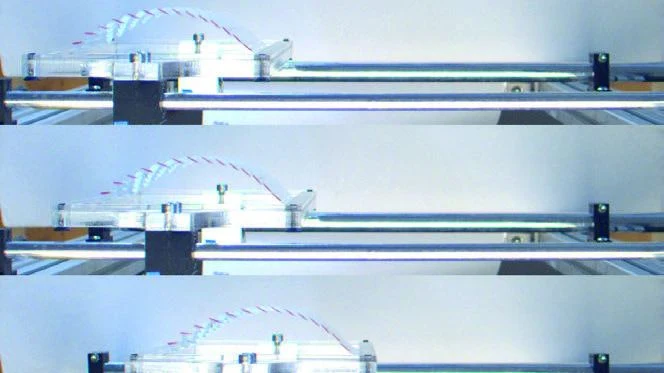
A rod stuck into a granular material (say, sand or a layer of small beads) behaves quite differently from what you might expect. Instead of going straight down, it quickly tilts away from the vertical and ends up lying flat. That's what researchers found when they dropped rigid and flexible rods into a two-dimensional layer of foam beads and tracked their motion with a high-speed camera.
Fluid Dynamics2026-02-161 minarXiv:2602.15176express
How Needles Make Fabric Drink
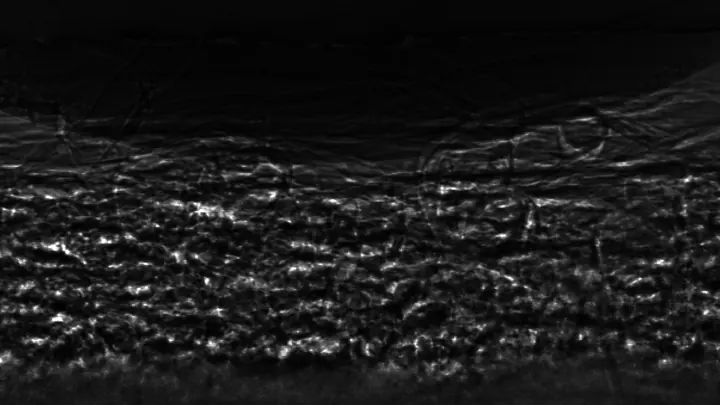
Felt looks like a tangled ball of wool, but under X-rays you can see hidden trails inside. When a water drop lands on such material, it doesn't just spread across the surface — some of the liquid dives deep, like water into blotting paper. Scientists captured this process for the first time with an X-ray camera snapping hundreds of frames per second. The secret lies in the needles.
Chemical Physics2026-02-161 minarXiv:2602.15268express
Record-breaking search for proton conductors
Inside a fuel cell, protons must race through a solid material like commuters through turnstiles at rush hour. If the turnstiles are sparse and narrow, the current is weak. In the past, to find a material with good proton conductivity, chemists had to screen compounds almost blindly, one by one.
Materials2026-02-121 minarXiv:2602.12427express
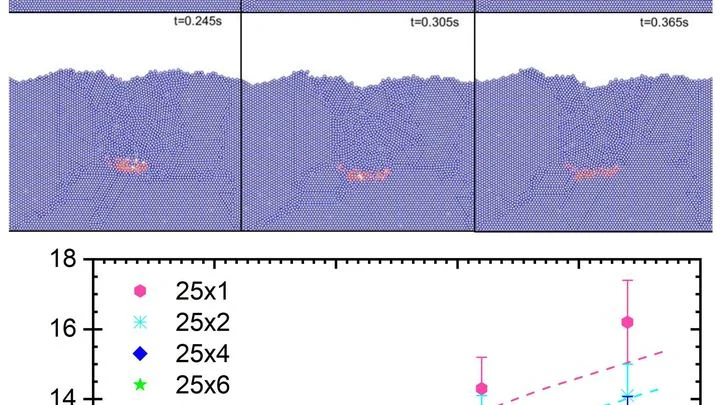
Friction in Faults: How Sand Turns into an Earthquake
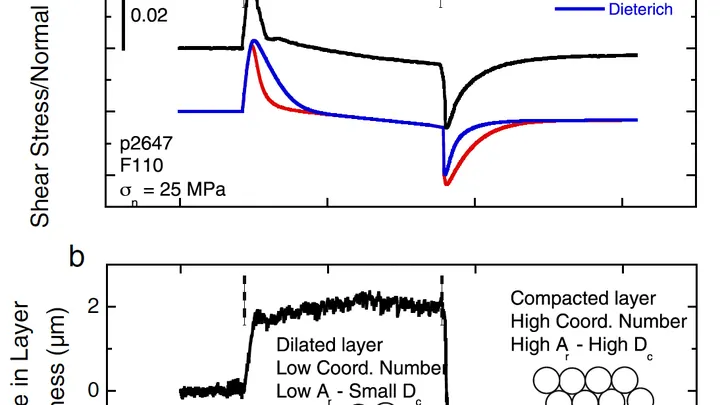
When two tectonic plates grind against each other, a layer of pulverized rock ends up between them, like sand between your palms. This layer, which geologists call fault gouge, behaves not like solid rock but like a thick paste: it can compact, dilate, and slide. Whether a fault ruptures in a devastating earthquake or creeps slowly and safely depends on its whims.
Why a Pile of Odd-Shaped Particles Doesn't Collapse
Pour a handful of dry sand: it will spread into a neat cone. Now grab a box of star-shaped pasta: the pile will stand almost vertical. Why? It's all about particle shape. Physicists built cylindrical piles from particles of different geometries — from smooth spheres to 'polypods' with several arms, like a sea star.
Fluid Dynamics2025-12-021 minarXiv:2512.03240express
How Honey Flows Through a Sponge: New Equations
Drop honey onto a sponge. It lazily creeps, avoiding the voids. But if the honey becomes thinner under pressure, the flow gets trickier. Liquid with variable thickness in an uneven labyrinth of pores — a problem that had defied calculation. The authors of the new work averaged the chaos of microchannels into simple equations.