Fluid dynamics in porous media is the study of how liquids and gases move through materials riddled with tiny interconnected spaces — soil, rock, sponges, filters, even biological tissues. It is the physics behind groundwater flow, oil extraction, carbon sequestration, and how water and air mix to transport nutrients and contaminants through the ground. The field has recently gained new momentum as researchers derive more accurate equations that capture the complex, often chaotic behavior of fluids in these irregular networks, moving beyond classical models like Darcy's law.
History
The foundational law was established by Henry Darcy in 1856, based on experiments with waterflowing through sand columns. Modern developments extend this framework to nonlinear and multi-phase regimes.
How it works
The core challenge is that porous materials have highly complex, tortuous pore structures. Instead of tracking every individual pore, scientists use averaged quantities like porosity (void fraction) and permeability (how easily fluid flows through). Newer approaches incorporate nonlinear effects, inertial forces, and the interaction between multiple fluid phases (e.g., water and air), leading to equations that better predict phenomena like preferential flow paths or the sudden onset of turbulence in seemingly slow flows.
In practice
It is essential for designing groundwater remediation systems, optimizing oil and gas recovery, and predicting the long-term safety of geological CO2 storage.
Fun fact
The same equations used to model groundwater flow also describe how crowds move through a dense corridor, as highlighted by the title 'Толпа как жидкость: гидродинамика давки' (Crowd as a liquid: hydrodynamics of a crush).
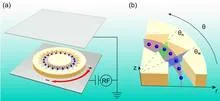
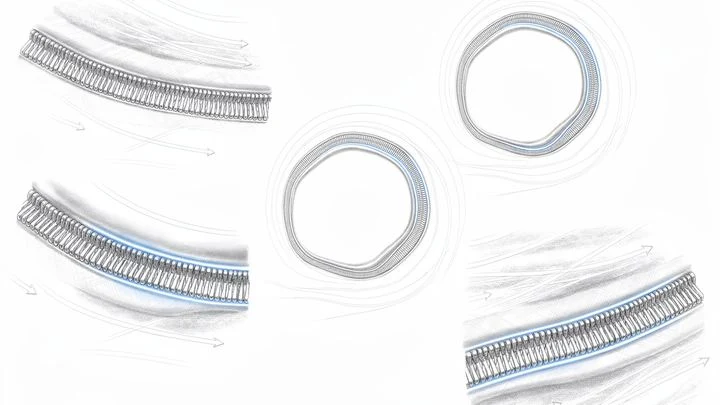
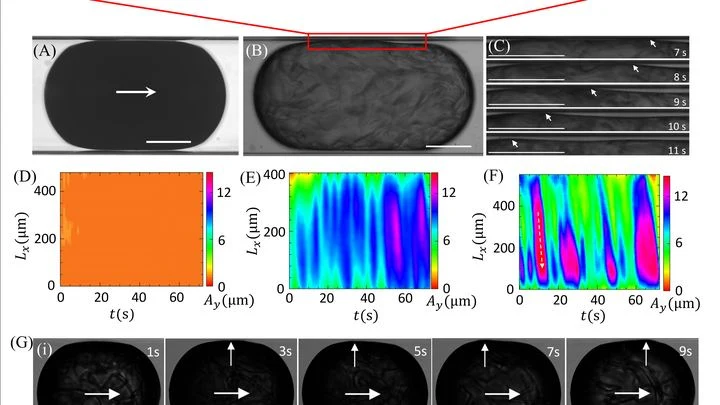
In a ring-shaped channel between two toothed rings, microspheres are suspended: some with a radius of 8 micrometers, others 14. The discharge is switched on, and the particles start moving. The small ones go one way, the large ones the other. It is like a shopping mall where escalators for people of different heights run in opposite directions.
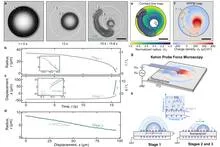
A water droplet on a fluoropolymer film initially behaves as expected: it sits and evaporates. But once it shrinks to a quarter of its initial size, it suddenly takes off and, within fractions of a second, covers a distance several times its own radius. Then it crawls slowly but persistently, leaving behind an invisible trail of electric charges. That trail is what drives the motion.
Water in a tank spins at nearly four revolutions per second, and, as if by magic, a column the size of a dinner table emerges. The vortex lives for dozens of rotations, even though everything around it churns and trembles. Where does such stability come from?
The secret is that the vortex is not isolated.
A hydrogen bubble on a platinum electrode behaves like a swimmer trying to surface, but every time it almost breaks free, something below grabs its legs. In the lab, high-speed cameras captured this behavior: a millimeter-sized bubble hangs near the surface, even though buoyancy pulls it upward with a force thousands of times stronger than surface tension can hold.
A weaver sits at her loom, her hands moving in a rhythm that cannot be predicted in advance. The threads converge and diverge, forming a pattern that seems random yet follows strict rules.
A cluster of glowing dots drifts through the darkness, now compressing into islands, now spreading out in waves. These are not fish or birds: this is a mathematical model of active matter, where each particle spends its own energy on movement, and also is born, dies, and competes with neighbors for space.
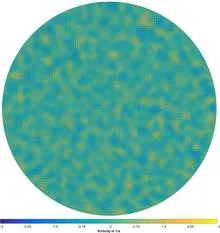
The early universe was less like a calm pond and more like a boiling cauldron. Matter flowed, collided, and swirled against the backdrop of rapid spatial expansion. To understand how stars and galaxies emerged from this hot soup, physicists build digital simulations.
This new work is the third part in a series on lattice-based cosmological modeling. The first two focused on fields; this one deals with fluids.
A subway train races through a tunnel, yet passengers in the last car barely sway. Blood flow in the lungs works much the same way: the heart pumps blood in powerful spurts, but by the time it reaches the veins, the pulsation has almost vanished.
A night river is dotted with tiny sparks. This isn't plankton: it's functional pollen-sensors, millimeter-sized devices that swim on their own and measure the water's chemistry.
Each particle is a tiny lab. Inside, two reagents meet: one triggers a glow upon contact with a pollutant, and the second, a colored filter, blocks out interference.
Glass lenses and mirrors appear perfectly smooth and still. But beneath the surface, a hidden life teems. Atoms in an amorphous material (a substance without a crystalline lattice) are packed haphazardly, and this disorder creates a complex energy landscape, like a mountainous region with countless hills and valleys.
The brain self-cleans its waste: cerebrospinal fluid flows through narrow channels surrounding arteries. The channel walls are soft and ripple with each pulse, and the tissue is porous like a sponge. Every heartbeat turns arteries into tiny pumps, driving fluid through the pores.
Soil is not a solid sponge but a labyrinth of pores of various sizes. After rain, water does not fill them all at once: first the narrowest ones, then the wider ones. Physicists built a theory of this process based on a simple image — a set of communicating vessels.
An ocean current hundreds of kilometers wide lives its own life, fed by energy from tiny eddies. Something similar happens in the atmosphere: small swirls pass their power on to huge air currents. This process, the inverse energy cascade, has been known for a long time.
Membraneless organelles, tiny factories inside the cell, defy conventional rules. Take the nucleolus: here ribosomal RNA is synthesized — long chains woven from carbon sugars, rich in oxygen phosphate groups, and stitched with hydrogen bonds, suspended in the watery environment of the nucleus.
In the new model, each active particle has an internal rhythm: it spins either left or right. Chirality is key: some twirl clockwise, others counterclockwise. But when such a particle bumps into an obstacle or a neighbor, it flips its spin, like a figure skater who, after touching the board, explodes into a reverse pirouette.
A supersolid is matter that is both crystalline and fluid. It is created from atoms cooled almost to absolute zero. In new work, physicists obtained such a substance as a triangular lattice of droplets. Each droplet oscillates in its own rhythm.
Millions of cilia, thin hairs, work inside the tiny ducts of our bodies. They beat in synchrony, like the oars of a galley, pushing viscous mucus or fluid along. The authors of a new study propose viewing the ciliary carpet as an active porous medium — something like a sponge that squeezes and releases itself, driving water through.
A drop of thick shampoo falls into water and freezes into a strange rope. A liquid that both flows and springs back is called viscoelastic. In it, tiny particles under ultrasound behave quite differently than in water. Viscoelasticity is a material's ability to both spread like honey and return to shape like rubber.
When you squeeze ketchup out of a bottle, you're battling its stubbornness: it sits still at first, then suddenly shoots out in a blob. That's typical non-Newtonian behavior — resistance to flow changes with how hard you push. But the authors of a new study found a way to almost completely eliminate that resistance.
In a crystal of water and caustic cesium, oxygen and cesium atoms sit in place like beads in a rigid lattice. Hydrogen atoms behave differently: they are like passengers constantly changing seats. In this layered material, each oxygen is linked to three neighbors via hydrogen bridges, forming a honeycomb-like pattern.
A porous implant filled with a drug works like a sponge that slowly releases the substance into the surrounding fluid. But if the fluid flows quickly, it washes out the drug differently than in a calm environment. The authors computed on a computer how different flow rates and properties of the porous structure affect drug release.
A ship gliding through water constantly rubs against it, like a palm against a rough surface. This friction eats fuel and slows progress. One way to reduce it is to blow air under the hull: water stops sticking to the hull, and drag drops. But air is finicky: sometimes it helps, sometimes it hurts.
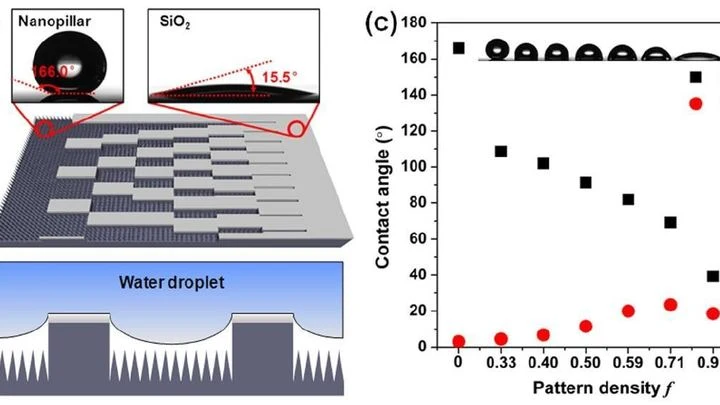
A drop of water on a table usually sits still. But make the table slightly softer on one edge and stiffer on the other, and the drop will crawl toward the stiffer side. This phenomenon is called durotaxis: the liquid itself chooses where to flow, without pumps or electricity.
This trick works because the surface under the drop is not uniform.
A tiny oil drop squeezes through a water channel narrower than itself. In pure water, it crawls along calmly, like a round bead. But add a little soap to the water, and the drop begins to bend, like a caterpillar.
Imagine a city where streets are not straight but winding, with dead ends and hidden passages. A bike courier will take much longer to deliver a package than in a city with a regular grid of roads. Similarly, molecules inside living tissue: their path depends on how "tangled" the tissue structure is.
Scientists built a model that describes the movement of molecules in such a "tangled" environment.
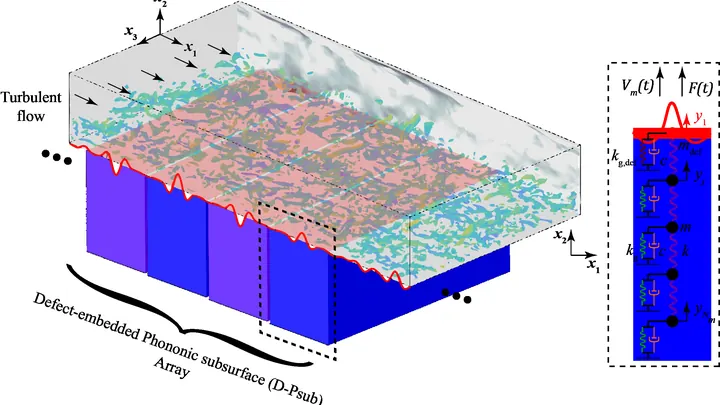
Turbulent flow near a wall resembles a crowd where everyone pushes in their own direction. Vortices form and break apart, creating chaotic jolts. If you embed a defective acoustic lining into the wall, like a tuning fork that rings only on one note, it starts responding only to a narrow range of frequencies.
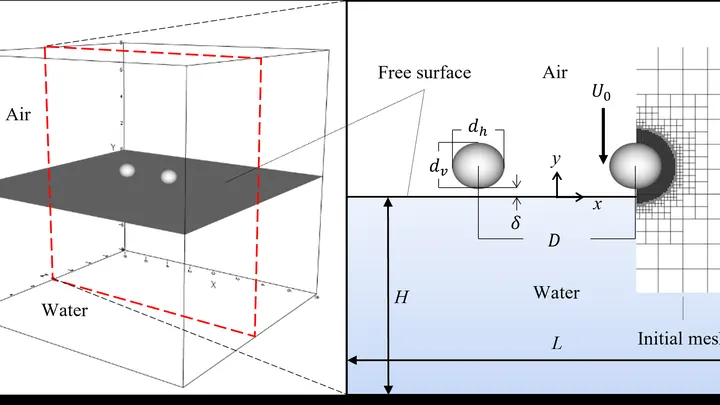
A raindrop falls into a puddle, and the impact sends up a little fountain of fine spray. Each of those droplets is a new, secondary drop. How many there are, how big they are, and how long they live depend on a host of factors: the fall speed, the drop size, the properties of the water. Scientists set out to make sense of this chaos using computer simulations.
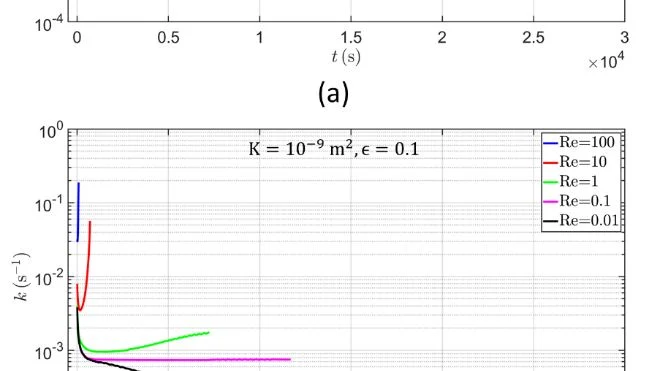
In porous materials (soil, rocks, filters) fluids move through tiny, winding channels. When two immiscible fluids, such as water and air, are present simultaneously, their interface constantly shifts: air bubbles push water out of some pores and open paths through others.
In a narrow gap between two plates, water from humid air collects on its own: this is capillary condensation. If the gap is only a few nanometers wide, water no longer behaves like a continuous liquid: every molecule counts.
Inside the kidneys, liver, and other organs, fluid flows through channels that squeeze and release like a hose underfoot. The walls of these channels are not rigid: they are porous, elastic, and soaked with moisture.
A water molecule, finding itself near a carbon ring, starts to vibrate, and immediately falls under the sway of an invisible conductor. The ring's electron cloud, like a maestro, dampens some vibrations while amplifying others.
Lymphatic vessels are one-way streets. Through them, fluid flows only forward thanks to tiny flap valves. These valves open in just one direction, creating asymmetry, directionality, without which the flow would stop.
In the lab, scientists modeled a vessel and sent compression waves along it, like a parade of gentle nudges.
A living cell is like a bustling city: cargo moves continuously along its streets, and traffic flows are regulated so that everything needed arrives on time. But while you can watch a city from a helicopter, the cell's interior has long been observable only through a narrow slit — the microscope showed just a flat picture.
Water in a river flows around rocks, air bends around an airplane wing: these motions are described by equations that are hard to solve even on a powerful computer. Neural networks can approximate such solutions, but they often err when data is collected at only a few points or is noisy.
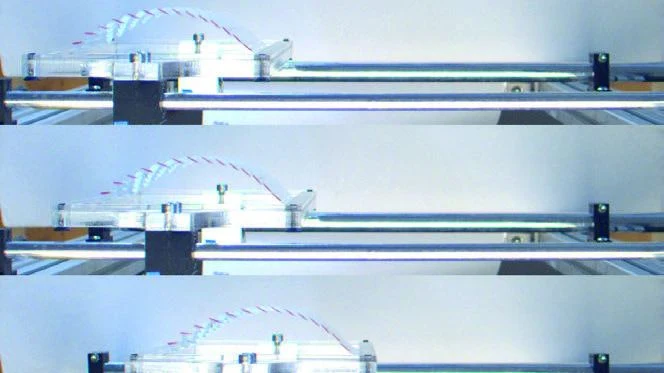
A flat sheet with slits in a flow of water or air behaves like self-adjusting blinds. The pressure opens the gaps, and each strip of material tilts, turning into a miniature wing. Thus, even a sheet placed perpendicular to the flow generates not only drag but also significant lateral lift.
A rod stuck into a granular material (say, sand or a layer of small beads) behaves quite differently from what you might expect. Instead of going straight down, it quickly tilts away from the vertical and ends up lying flat. That's what researchers found when they dropped rigid and flexible rods into a two-dimensional layer of foam beads and tracked their motion with a high-speed camera.
A drop of oil in water, coated with soap molecules, behaves differently from a bare drop. Soap molecules are tiny rods: one end loves water, the other loves oil. In a quiescent fluid, they stand on the surface like a picket fence, lowering the surface tension — the force that pulls the drop into a sphere.
E. coli is a tiny swimmer in a world where water is as thick as jelly. Inside our gut, it doesn't glide freely but fights through mucus — a tangled web of long molecules, like a ball of knotted threads.
When a crowd of bacteria (mostly composed of carbon) gathers in a droplet of water, a synchronized round dance begins: millions of tiny ones glide along giant ellipses, like dancers on a ballroom floor. Without a conductor, complex patterns emerge from simple movements.
The boundary between two liquids is like an invisible skin: it's there, but you can't touch it with your finger. Scientists have found a way to measure its elasticity without touching it. They made a tiny probe oscillate above the surface, and between the probe and the interface lay a thin film of liquid.