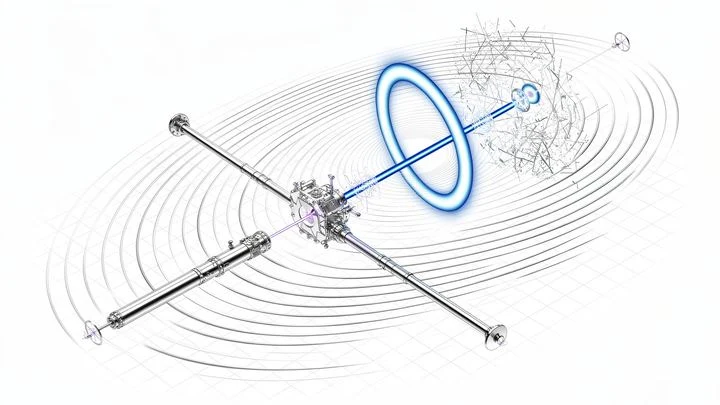
Gravity Looks Sideways
A lead sphere hangs above another lead sphere. According to the usual laws of gravitation, they attract each other exactly along the vertical — along the line connecting their centers.
A measure of an object's resistance to rotational acceleration about an axis, depending on mass distribution.Moment of inertia is the rotational analog of mass. It quantifies how difficult it is to change an object's rotational speed about a given axis. Unlike ordinary mass, which is a fixed property of an object, moment of inertia depends on how that mass is distributed relative to the axis of rotation: the farther the mass is from the axis, the larger the moment of inertia, and the harder it is to spin or stop the object. This is why a figure skater spins faster when pulling their arms in — they are reducing their moment of inertia.
The concept was formalized by Leonhard Euler in the 18th century, building on earlier work by Christiaan Huygens on compound pendulums. The term 'moment of inertia' itself was introduced by Euler in 1730.
Mathematically, for a point mass m at distance r from the axis, the moment of inertia is I = mr². For a continuous object, you sum (integrate) this over all mass elements. The total moment of inertia determines the angular acceleration α produced by a given torque τ via τ = Iα, mirroring Newton's second law F = ma. The concept extends to complex systems like spinning stars, gyroscopes, and even magnetic domain walls, where the effective mass of a wall is derived from its moment of inertia under precession.
Used in engineering to design flywheels for energy storage, in robotics to control arm movements, and in aerospace for satellite attitude control.
The moment of inertia of a neutron star is so large that its spin period can be measured with the precision of a few nanoseconds, making it one of the most accurate clocks in the universe.
| h_0 | variable | gravitational wave strain amplitude — strain |
| ε | variable | ellipticity — ellipticity |
| I_zz | variable | moment of inertia about rotation axis — moment of inertia kilogram metre squared |
| f_GW | variable | gravitational wave frequency — frequency hertz |
| d | variable | distance to source — distance metre |
| G | constant | Newton's constant of universal gravitation — gravitational constant = 6.67430e-11 cubic metre per kilogram per second squared |
| c | constant | Speed of light in vacuum — speed of light = 299792458 metre per second |
| ε | variable | ellipticity — ellipticity |
| I_xx | variable | moment of inertia about x-axis — moment of inertia kilogram metre squared |
| I_yy | variable | moment of inertia about y-axis — moment of inertia kilogram metre squared |
| I_zz | variable | moment of inertia about z-axis — moment of inertia kilogram metre squared |
| I | variable | moment of inertia — moment of inertia kilogram metre squared |
| Ω | variable | angular velocity — angular velocity radian per second |
| Ω̇ | variable | time derivative of angular velocity — angular acceleration radian per second squared |
| I | variable | Moment of inertia about the axis — moment of inertia kilogram metre squared |
| r | variable | Perpendicular distance from the axis to mass element — distance metre |
| dm | variable | Infinitesimal mass element — mass kilogram |
| ∫ | operator | Integration over the entire body — integral operator |
| E_rot | variable | rotational kinetic energy — energy joule |
| I | variable | moment of inertia — moment of inertia kilogram metre squared |
| Ω | variable | angular velocity — angular velocity radian per second |
| I | variable | Moment of inertia — moment of inertia kilogram metre squared |
| k | variable | Dimensionless shape factor |
| M | variable | Mass of the sphere — mass kilogram |
| R | variable | Radius of the sphere — radius metre |