Inhomogeneity refers to the lack of uniformity in a material's composition or structure — the opposite of a perfectly ordered, identical-at-every-point substance. In physics, it is a central concept because real materials are almost never truly homogeneous: they contain grains, defects, impurities, density variations, or layers with different properties. This matters because inhomogeneities often determine how a material behaves under stress, how it conducts electricity or heat, how it scatters light, and even how it fails or holds together.
History
The concept has roots in 19th-century studies of elasticity and optics, where scientists like Augustin-Louis Cauchy and James Clerk Maxwell modeled how variations in material properties affect wave propagation. The term became more prominent in the 20th century with the development of statistical mechanics and condensed matterphysics.
How it works
Inhomogeneity arises at multiple scales — from atomic-level impurities to macroscopic cracks or density fluctuations. In a granular pile, for example, the shapes and orientations of particles create local variations in contact forces, which can either stabilize the pile or cause it to collapse. In plasma physics, density or temperature inhomogeneities can drive instabilities like the Buneman instability, where a non-uniform electron beam interacts with the plasma and transfers energy. In optics, inhomogeneities in a material's refractive index cause light to scatter or bend, which is why the same substance can glow differently depending on its internal structure.
In practice
Inhomogeneity is exploited in engineering to create composite materials with tailored strength, in photonics to design scattering media for LEDs, and in astrophysics to explain the mixing of elements in supernova remnants.
Fun fact
A pile of irregularly shaped particles can be more stable than a pile of perfect spheres because the inhomogeneous contact network creates interlocking forces that resist collapse.
Cosmic ripples begin with tiny clumps. 380,000 years after the Big Bang, the universe was nearly homogeneous — density fluctuations were only one part in 100,000. But gravity turned these weak ripples into galaxies, clusters, and giant voids.
In the microscopic world, noise, random fluctuations, usually destroys fragile quantum states, much like ripples on water break the reflection in a puddle. However, in some systems, collective, coordinated noise from many particles produces the opposite effect: a stable unidirectional flow emerges.
Light from an ordinary bulb seems utterly chaotic: its waves oscillate out of sync, like a crowd where everyone walks in their own direction. Such light is called incoherent. For a long time, it was believed that elegant topological structures (knots, rings, links) could only be created in coherent laser light, where all waves march in step.
A squad of soldiers marches across a parade ground. As long as everyone keeps in step, the movement remains sharp and coordinated. But if someone falls out of line, the order is lost. In the microworld, electrons play the role of such a squad: when their oscillations are synchronized, the substance emits a narrow, sharp line.
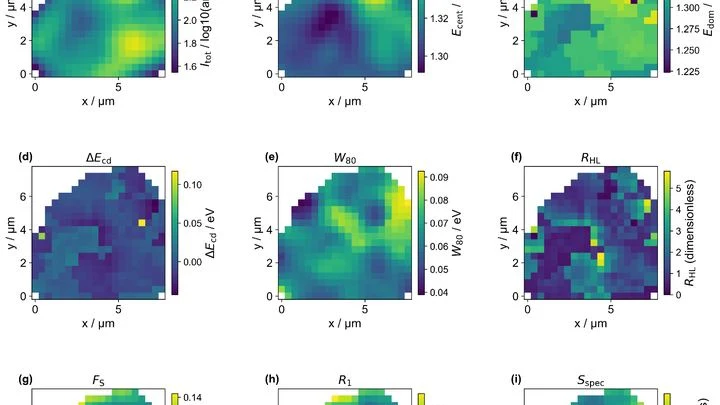
The glow of an ultrathin sandwich made of two semiconductor layers, molybdenum selenide and tungsten selenide, resembles a tangled musical score: many narrow colored lines that merge into a general background. Figuring out which line comes from where is nearly impossible.
The authors did not try to disentangle the lines one by one.
A stream of electrons enters plasma like a jet of water hitting a calm pond. The jet disturbs the surface, giving rise to waves that grow quickly and mix the water. In plasma, this process is called the Buneman instability: the electron beam excites oscillations that then scatter its energy.
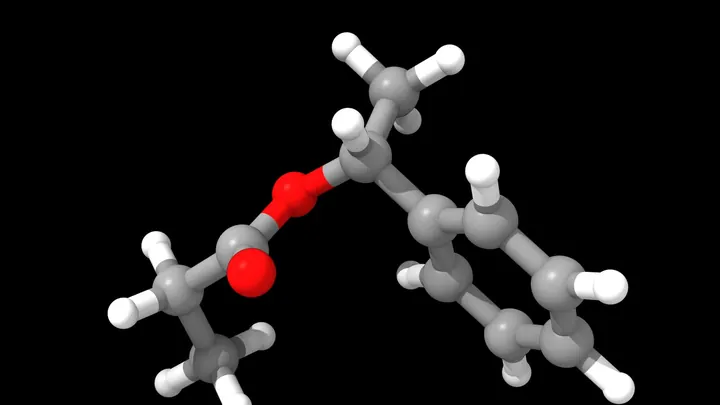
The nose is an amazing instrument. A single coffee molecule entering a nostril can awaken a memory of a morning kitchen. Another, nearly identical in shape, smells like rotten eggs.