The Brain Translator: How Different People Hear the Same Signal express
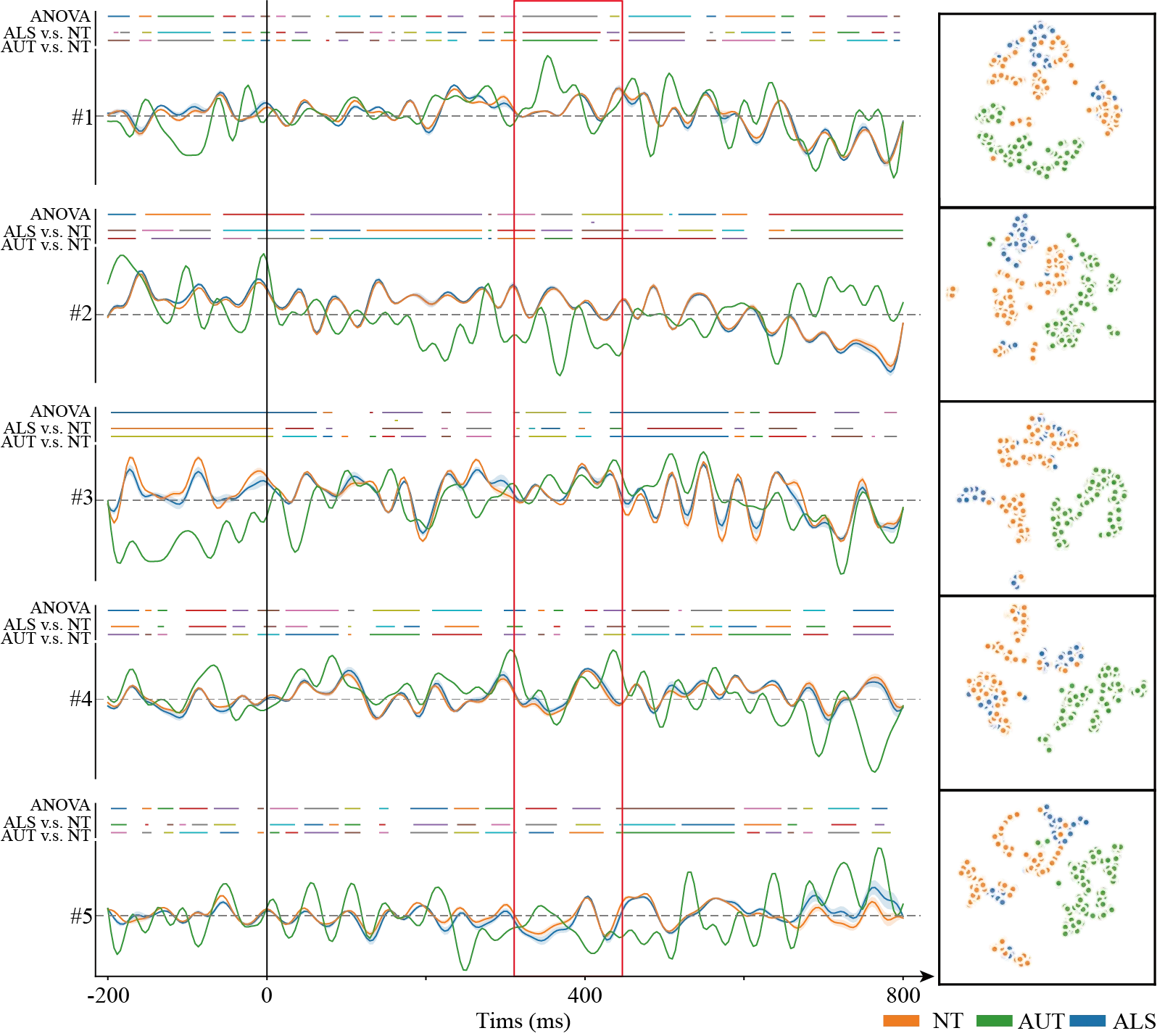
A person looks at flashing letters on a screen, and a computer guesses which one they chose by a burst of brain activity. It's like an interpreter who catches not words but the brain's electrical signals. But different people's brains 'speak' with an accent: one person's signal is bright and clear, another's is quiet and smeared. The scientists decided to figure out exactly how these accents differ.
They collected brain wave recordings from three groups of people: those with amyotrophic lateral sclerosis (a disease that weakens muscles), those with autism, and those without such conditions. For the analysis, they devised a program that not only recognizes the signal but also shows its 'portrait'—what a typical wave looks like for each group. It turned out that the portraits are indeed different: one group's wave is sharper, another's is wider, and a third's is shifted in time.
This finding is important for people who cannot speak or move. For them, brain interfaces are the only way to communicate. If the program knows what this particular person's signal looks like, it will make fewer mistakes. In the future, such systems could adapt to each person from the first minutes of use, like a good interpreter who quickly gets used to the speaker's voice.
Original abstract
as written by the authors arXiv:2604.24765
P300-based brain-computer interfaces (BCIs) are widely used for communication, but population heterogeneity may alter the neural patterns available for decoding. Prior work has mainly examined such differences at the signal or performance level, while the representation structure learned by the decoder remains underexplored. In this study, we propose an interpretable fuzzy spatiotemporal framework for P300 classification and use it to analyze population-level differences across amyotrophic lateral sclerosis (ALS), autism (AUT), and neurotypical (NT) cohorts. The model employs spatial and temporal fuzzy filters with learnable prototypes, enabling both classification and reconstruction of cohort-specific fuzzy centers. Experiments were conducted on ALS and NT subsets from bigP3BCI and on the BCIAUT-P300 benchmark in a within-subject setting. The proposed model achieved competitive performance against multiple deep learning baselines. More importantly, the reconstructed fuzzy centers revealed systematic cohort-dependent differences in waveform morphology and representation geometry. Point-wise statistical analysis identified significant temporal differences between cohorts, including intervals overlapping with the canonical P300 window, and low-dimensional embeddings showed partially separated cohort-specific prototype organizations. These results suggest that population heterogeneity in P300-BCI is reflected not only in decoding performance but also in the discriminative structure learned by the model. The proposed framework provides an interpretable route toward population-aware P300-BCI analysis and design.
The P300 signal appears in the brain about 300 milliseconds after a person notices something important: it's like an instant 'aha!' inside the head.