An electricalsignal is a time-varying voltage or current that carries information or energy. In the context of physics experiments, it is often used to drive or probe physical systems. The seed definition specifies a particular use: an electrical waveform tuned to twice the natural frequency of a resonator, a technique known as parametric pumping or degenerate parametric excitation.
History
Parametric excitation was studied in the 19th century by Michael Faraday and later formalized by Lord Rayleigh, but the specific use of electricalsignals to drive resonators at twice their natural frequency became prominent with the development of radio and microwave engineering in the early 20th century.
How it works
When a resonator is driven at twice its natural frequency, the oscillation amplitude can grow exponentially if the drive exceeds a threshold. This happens because the drive modulates a system parameter (like stiffness or capacitance) at a rate that feeds energy into the fundamental mode, analogous to swinging on a swing by pumping at twice the swing's frequency. The electricalsignal provides this periodic modulation, and the resonator responds by oscillating at its own natural frequency, with the amplitude controlled by the drive strength and damping.
In practice
This technique is used in parametric amplifiers, which are essential for detecting extremely weak signals in quantum computing and radio astronomy, as well as in micro-electromechanical systems (MEMS) for sensing and filtering.
Fun fact
Parametric amplifiers can amplify signals without adding significant noise, which is why they are used to read out the faint microwave signals from superconducting qubits.
A superconducting detector usually works like an honest ruler: absorb a photon, get a pulse whose amplitude is strictly proportional to the energy. This mode is convenient, but it has a ceiling: a weak signal easily gets lost in the amplifier noise.
Now imagine a swing.
Catching light one particle at a time is like hearing a whisper in a roaring factory. An electron-multiplying camera (EMCCD) can do exactly that: it turns a single photon hitting a pixel into an avalanche of electrons that can be measured. These cameras are mounted on telescopes to spot a barely visible planet next to a dazzling star.
A drop of water on glass trembles and shimmers: it seems to have a life of its own. Similar behavior can now be observed in the world of colloids: tiny particles suspended in a liquid. Researchers simulated particles that emit chemical signals. These signals, like scents in the air, spread around and cause neighbors to either draw closer or move apart.
Sound in a solid is waves of compression and rarefaction rippling through atoms, like ripples across a spring mattress. If you place obstacles with just the right spacing, waves at certain frequencies can't pass: they bounce back. Such a periodic structure is called a phononic crystal, and it works for sound the way a multilayer mirror works for light.
If you toss a stone into a pond, ripples spread across the water. Tiny magnetic crystals also host waves — except it's not water that oscillates but the direction of magnetization. These are called spin waves. They travel through the crystal like ripples on a surface and can carry information.
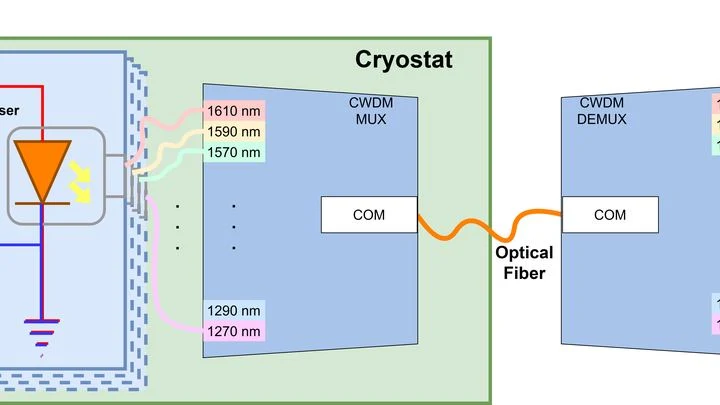
A thermos of liquid xenon cooled to minus 100 degrees Celsius. Inside are sensitive sensors that catch rare signals from dark matter particles. To bring these signals out, copper cables are usually used. But over the long haul, the signal weakens, and adjacent cables start 'cross-talking' — that's called crosstalk.
In a silicon crystal, a phosphorus atom holds an extra electron on two very closely spaced orbits. These orbits are like two neighboring floors in a building where the staircase is almost invisible. A short laser pulse in the mid-infrared range pushes the electron from the lower floor to the upper one, and it starts swinging between them like a pendulum.
Every thought leaves a trace — a faint electrical blip on the scalp. A device with dozens of wires, resembling a swim cap, catches these traces and turns them into wavy lines. From those lines, you can guess what a person feels even if they stay silent. In a new study, three computer programs competed to see which could read such lines most accurately and determine whether the mood was bad, neutral, or good.
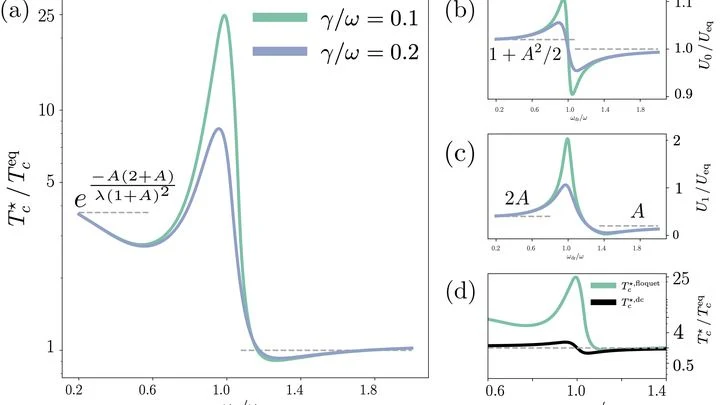
An ordinary superconductor works only in nature's freezer — at temperatures below minus one hundred degrees. The carbon-ball material K₃C₆₀ is no exception: without cold, it resists current like a crowd in a narrow corridor. But physicists noticed something strange: if you shine a laser on it, it starts conducting without loss even in warmth.
Magnetic resonance is like a tuning fork that rings only at its own note. Each molecule has its own frequency, and from that you can tell what the molecule is and what state it's in. But previously, this tuning fork was listened to through a thick wall: the signal was blurred, and you couldn't make out the exact note.
Gravity works like an invisible photographer. When a piece of metal falls, inside it, according to Albert Einstein and the electromagnetism of James Clerk Maxwell, an electric field is born — that's how spacetime curvature…