How a Clot Becomes Strong: The Puzzle of Density express
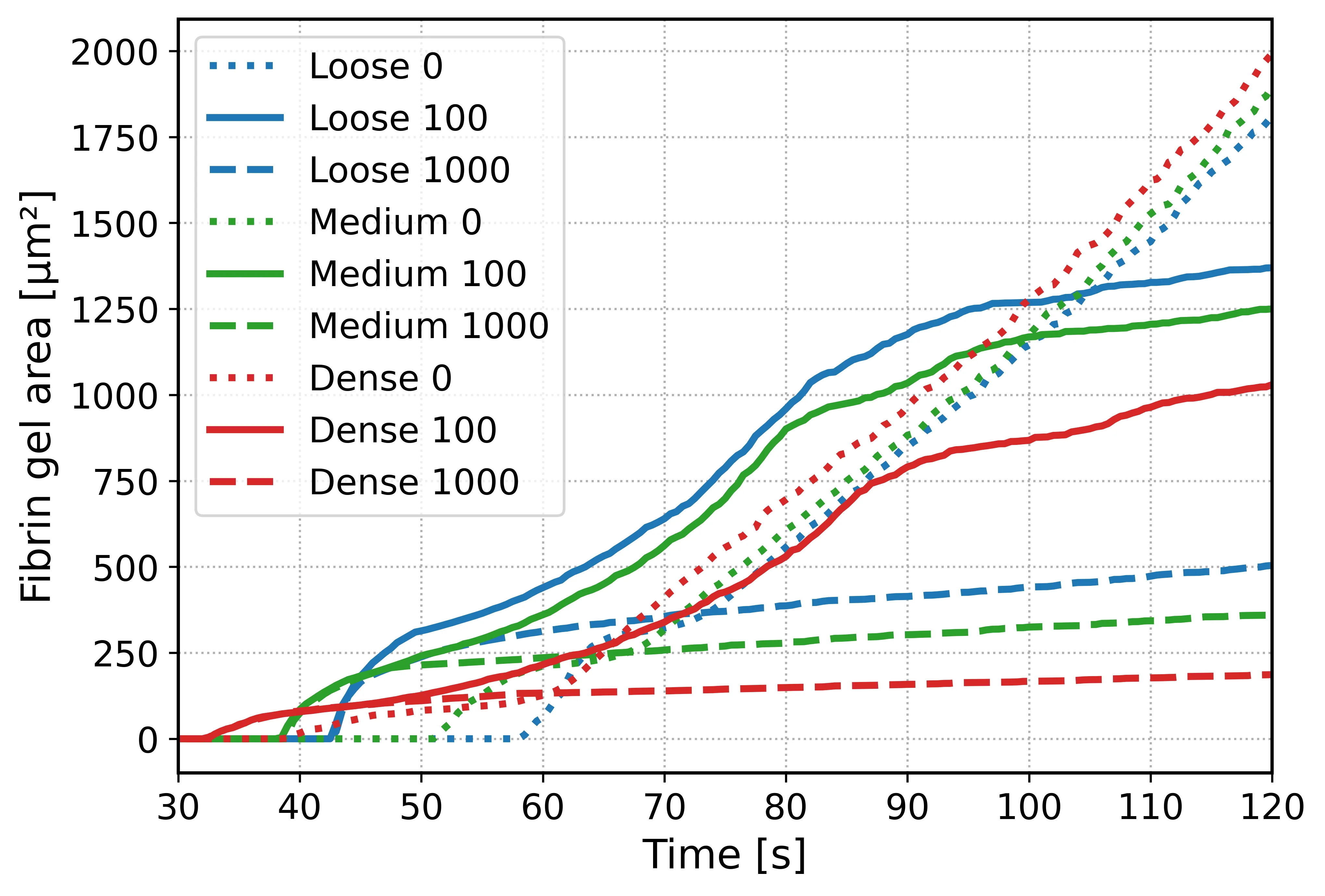
A thrombus is not just a clump of cells. When a vessel wall is damaged, platelets stick together into a plug, but it is still fragile. What makes it strong is fibrin — a protein that forms a network of fibers, like rebar in concrete. The model showed that the plug's density decides where this network appears.
In a dense plug, platelets are packed tightly, and the substances that trigger clotting accumulate between them. Fibrin starts to grow at the edges, where blood can still flow. In a loose plug, blood seeps deeper, bringing the building material — fibrinogen. So fibrin fibers grow throughout the plug, although the start is delayed.
It's a trade-off: quickly block the vessel or make the clot strong right away. A dense plug wins minutes but loses in reliability. A loose plug is slower but more thorough. This explains why some clots dissolve on their own, while others lead to a heart attack.
Original abstract
as written by the authors arXiv:2604.07844
During the formation of a thrombus, the architecture of the growing platelet aggregate is heterogeneous, with areas of dense and loosely packed platelets. The surface of activated platelets facilitate biochemical coagulation reactions that ultimately result in the formation of a fibrin network which stabilizes the thrombus. How platelet-plug microstructure and flow jointly govern the onset and development of fibrin is incompletely understood. We developed a novel 2D computational framework that integrates (1) a pre-adhered, discrete platelet aggregate, (2) a reduced coagulation model that generates thrombin, and (3) a fibrin polymerization model. Three platelet-plug configurations were constructed with prescribed interplatelet gaps and simulations were performed with various wall shear rates. We quantified spatiotemporal clotting metrics, including coagulation factor concentrations, fibrin evolution, and gelation onset. Across geometries, gelation initiation accelerated with increasing plug density. For more dense geometries, gelation emerged first near the plug periphery. As the platelet density increased, intraplug transport was increasingly restricted and the thrombin concentrations in between platelets increased. In contrast, the loose plug supported fibrinogen replenishment deeper into the plug core. Despite slower coagulation initiation due to reduced platelet surface area, monomer generation persisted in the interior, causing gelation to begin at the vessel wall. These results suggest a mechanistic tradeoff: rapid sealing of the injured vessel wall by early platelet contraction, i.e. plug densification, may impede the intraplug fibrin formation needed for durable stabilization. The proposed model provides a basis for studies of platelet-coagulation interactions under flow, including therapeutic developments relevant to prevention of cardiovascular disease.
Fibrin is a protein that forms fibers just 3 nanometers thick. If you stretched all the fibers from one clot into a line, it would be several meters long.