Bubble nucleation is the process by which a new phase of matter forms from a metastable state, starting with the creation of a tiny bubble of the stable phase. In cosmology, this concept is central to the theory of false vacuum decay, where the entire universe could transition from a 'false' vacuum state to a 'true' lower-energy state. This transition would begin with the quantum nucleation of a bubble of true vacuum, which then expands at nearly the speed of light, potentially rewriting the laws of physics as it sweeps through space.
History
The concept of vacuum decay was introduced in the 1970s by Sidney Coleman and Frank De Luccia, who applied the mathematics of bubble nucleation from statistical mechanics to quantum field theory.
How it works
In a metastable state, the system is in a local energy minimum but not the global minimum. Quantum fluctuations or thermal energy can occasionally create a small region of the true vacuum. If this bubble is large enough, it will grow, because the energy gained from the volume of true vacuum outweighs the energy cost of the bubble's surface. This critical size is determined by the balance between volume energy and surface tension. Once a bubble exceeds this size, it expands irreversibly, converting the surrounding false vacuum.
In practice
Bubble nucleation is used to understand phase transitions in materials, such as boiling and cavitation, and it is a key concept in the search for new physics beyond the Standard Model, where the Higgs field's stability is analyzed.
Fun fact
The Large Hadron Collider at CERN has not created a vacuum bubble, and calculations show that cosmic rays hitting Earth are far more energetic than anything we can produce, yet the universe remains stable.
A uranium-235 nucleus that captures a slow neutron doesn't immediately fly apart into fragments. Instead, it seems to get stuck in two 'pits'—states with different shapes. The first, the ground state, is a slightly elongated drop. The second, the isomeric state, is a drop stretched further but not yet torn.
In a pot of water carefully heated above its boiling point, the liquid remains calm. But the slightest disturbance, and it violently turns to steam. Physicists call this a metastable state: it seems stable, but in reality it's ready to break apart at the slightest nudge.
Buried in Antarctic ice, there's a detector the size of a cubic kilometer. It doesn't catch light but ghostly particles — neutrinos. Yet sometimes, a different beast might flash through: a pair of muons born together and flying apart in a wide fan. No known particle of ordinary matter can paint that pattern.
The universe right after the Big Bang was like a boiling cauldron: bubbles of a new state of matter were bursting and growing everywhere. These were first-order phase transitions — exactly like water boiling, only at temperatures reaching trillions of degrees.
A pot of extremely thick and hot glue: that's roughly what the early Universe looked like. It wasn't ordinary glue, but a 'gluon soup': particles carrying the strong force (gluons) zipped freely through space. The temperature was so high that even quarks and gluons didn't stick together into protons and neutrons.
Over time, the Universe cooled.
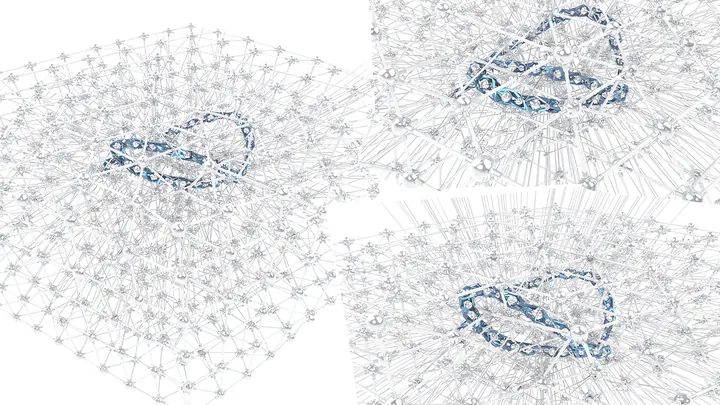
A false vacuum is not just a supercooled liquid, but a quantum hologram, ready to spring to life under the right projection. Its decay is described by the tunneling of a quantum field from a metastable minimum, and the classic calculation via Euclidean instantons is as elegant as a still life under spotlights.
The quantum vacuum is not a dead void but a boiling cauldron of probabilities. In some theories, our Universe is frozen in a metastable state: like superheated water, it's ready to explode into steam at the slightest nudge.
In the first moments of its life, the Universe resembled a boiling cauldron. As it cooled, phase transitions occurred — much like steam turning into water, but instead of molecules, the very state of space changed. In this cauldron, bubbles of the new phase were born, akin to bubbles in a pot coming to a boil.
Diamond is a symbol of perfection, but its true magic is revealed through flaws. Perfect lattice purity gives transparency and hardness, while defects, such as color centers, open a portal to the quantum world, becoming the foundation for quantum computers and quantum sensors.
After the Big Bang, the universe may have been stuck in a false vacuum — a temporary state like a soap bubble ready to pop. A rare true vacuum bubble could then erupt, stretching space in the blink of an eye.
An empty glass on the table seems reliable. But if there's a microcrack in the bottom, one day it will break — not with a crash, but quietly, spreading in a web of lines. So too with the vacuum: it may not be the true vacuum but a false one — temporarily stable, yet ready to transition to a deeper, real state.
An atomic nucleus is like a crowded bus. To free up space, a group of two protons and two neutrons — a helium nucleus, an alpha particle — exits through the front door: this is alpha decay, described by George Gamow as tunneling under an energy barrier.
The origin of the hot Big Bang is one of the greatest mysteries. The familiar picture: after inflation, the inflaton field transfers energy to ordinary particles, reheating the Universe. Yet dark matter and dark energy hint that nature has hidden sectors.
Immediately after the Big Bang, in the seething cauldron of the cooling Universe, much like in unevenly hardening glass, stresses appeared — hairline cracks in reality, cosmic strings. Picture a tightrope walker balancing on an invisible cable stretched across the abyss of warped spacetime.
For almost a century, cosmologists have been grappling with the mystery: what makes the Universe expand ever faster? The standard answer — dark energy — creates a monstrous discrepancy between the theoretical vacuum density and observations. But there's another path, one that turns causality on its head.
A time crystal resembles an eternal clock: its atoms spontaneously perform rhythmic movements. In ordinary clocks, a pendulum is driven by a spring or battery, but here the motion arises without an energy supply — the system simply returns to its initial state at regular intervals. This idea was proposed by Frank Wilczek in 2012.
The birth of the universe resembles not an explosion, but a traffic jam. At first, a tiny fraction of a second after the Big Bang, space expanded sluggishly, like cars stuck in gridlock. Then came a sharp surge — accelerated expansion, which cosmologists call inflation.
Water boils in a pot, and bubbles rise from the bottom. They grow, float up, and pop, and the water remains water. Something similar, physicists have found, can happen to space itself — if it contains dark energy (the mysterious force accelerating the expansion of the universe).
In such an eternally inflating universe, black holes are sometimes born.
A boiling cauldron with the occasional bubble of steam popping: that's what the early universe resembled. All of space was filled with a field in a false vacuum state, like water superheated above its boiling point.
You're inflating a balloon, but with each pump of the bulb, the rubber doesn't just stretch: it subtly changes its elasticity. Gravity works similarly in the new model: not as a rigid stage for the cosmic play, but as a living material that responds to every speck of matter.
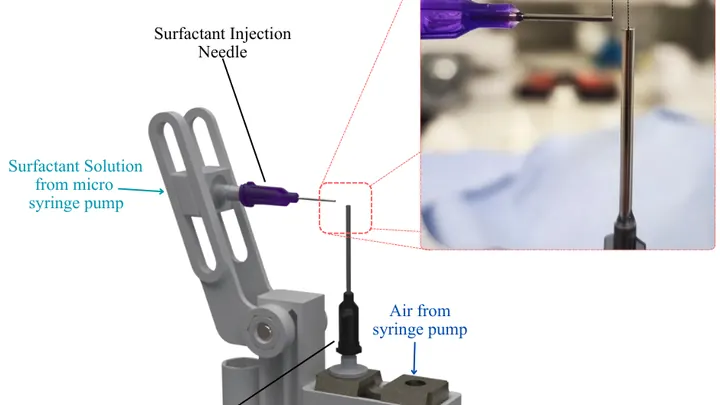
An air bubble escapes from a thin needle at the bottom of a glass and shoots upward. In clean water, it behaves like a spring: it flattens, then stretches, exchanging energy between motion and shape. Add a drop of soap to the water, and the bubble immediately calms down, becomes an almost perfect sphere, and rises smoothly without trembling.
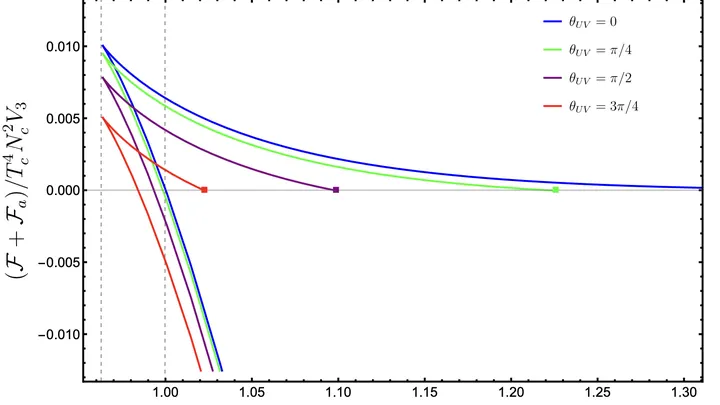
In a pot of boiling water, steam bubbles rise and pop. In the quantum world of a superfluid, bubbles behave differently: they can collide and give birth to vortices — tiny swirling flows, like whirlpools in a river.
Scientists modeled such a liquid using a holographic approach.
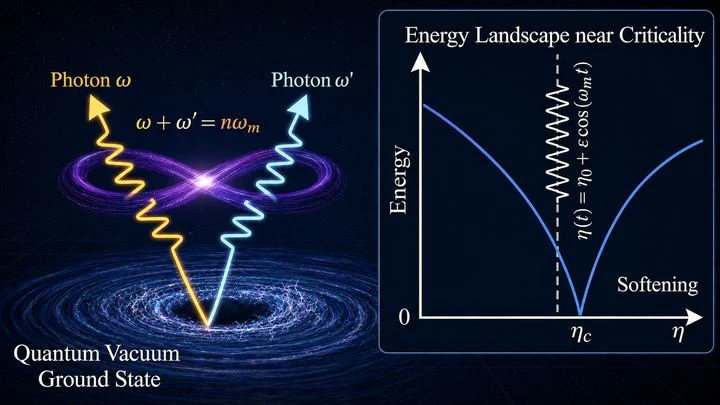
The quantum vacuum is not emptiness, but a tautly stretched string, where particles constantly appear and vanish. Abruptly changing conditions, like shifting the mirrors of a microcavity, causes the 'string' to emit real photons.
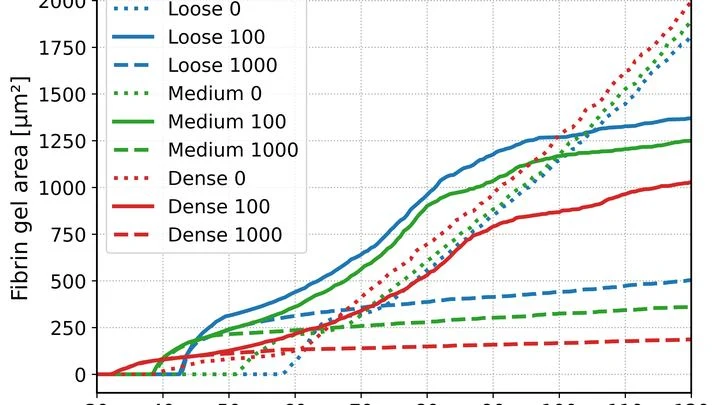
A thrombus is not just a clump of cells. When a vessel wall is damaged, platelets stick together into a plug, but it is still fragile. What makes it strong is fibrin — a protein that forms a network of fibers, like rebar in concrete. The model showed that the plug's density decides where this network appears.
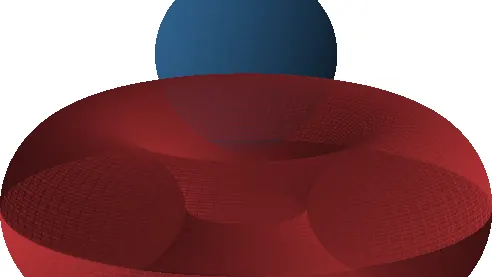
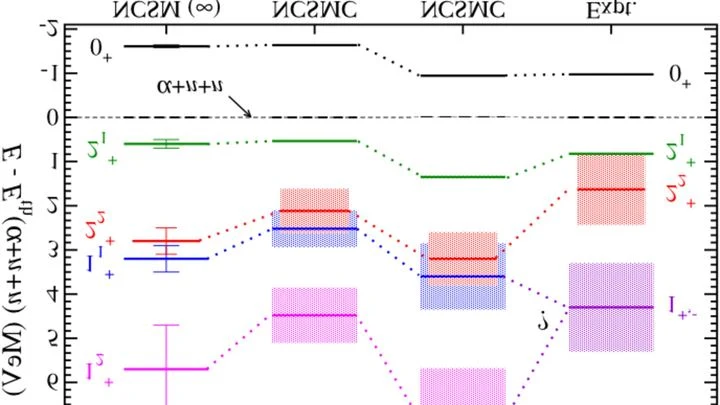
An ordinary atomic nucleus is like a tight ball: protons and neutrons are packed closely together. But some light nuclei, such as helium-6, are different. Two neutrons seem to step aside and form a dilute cloud around the nucleus — called a halo.
Splitting water into hydrogen and oxygen with electricity is an age-old dream of clean fuel. But tiny gas bubbles stand in the way: they cling to the electrodes like foam on the side of a soda glass, interfering with the current's work. Each bubble is a tiny plug, blocking part of the surface where the reaction should occur.
When a massive star dies, its core collapses into a neutron star, and the outer layers are blown off in an explosion. At that moment, an unimaginably dense cloud of neutrinos is born — particles that barely interact with matter but actively 'talk' to each other. There are so many of them that together they behave like a fluid, with waves rippling across it.
Cells on the surface of an embryo resemble grains of rice that can align in one direction. This order is called nematic. It arises when cells start acting in concert, like a school of fish swimming in the same direction.
In a narrow vertical tube, alcohol flows upward, surrounded by water, and carbon dioxide bubbles are born inside it. As soon as they appear, they rush toward the axis of the flow, as if an invisible hand gathers them into a neat chain.
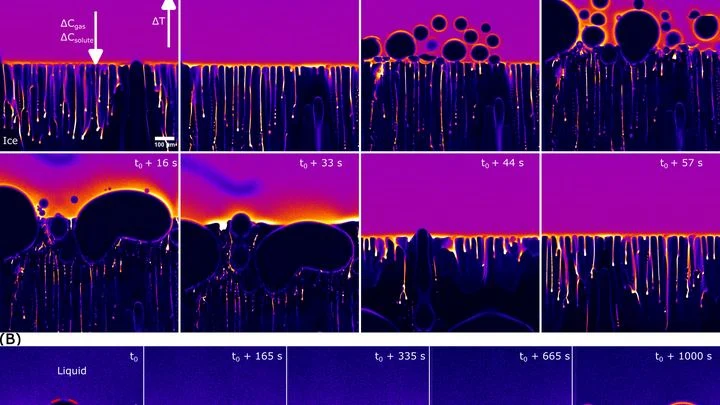
In a glass of soda, bubbles merrily rise to the top. But if you freeze the water, some bubbles end up trapped in the ice. How do they get there? After all, ice grows, pushing gas aside, but it doesn't always manage to.
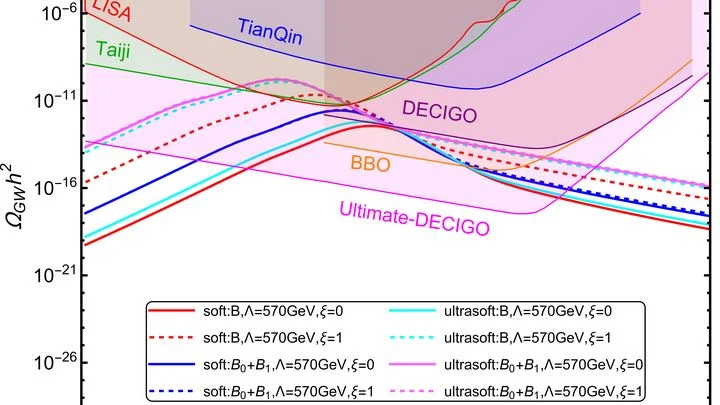
In the infant universe, right after the Big Bang, space was expanding rapidly, and the vacuum resembled a superheated liquid. When 'boiling' began, bubbles of true vacuum emerged. Expanding at the speed of light, they triggered gravitational waves — tremors of space itself that have reached us.
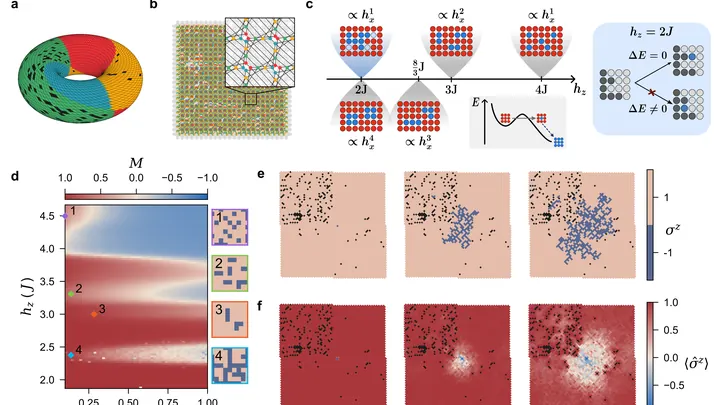
Our Universe may have arisen from a highly unstable state that physicists call the false vacuum. Imagine a glass of water cooled below its freezing point: the liquid remains liquid only until the first jolt, which instantly triggers crystallization into ice.
In the thirties, Pauli realized: without tiny ghost-like particles, the energy of stars doesn't add up. Thus neutrinos were born — intangible wanderers that permeate everything.
Emptiness isn't always empty: it can hide energy, like supercooled water hides ice. Physicists call this false vacuum — a state that only needs a nudge to cascade into the true one.
Two travelers head for the same destination. One starts closer but takes a winding country road. The other starts farther away but immediately hits the highway. The second arrives first. In quantum physics, this paradox is known as the quantum Mpemba effect: a state initially farther from equilibrium reaches it faster than one that starts closer.