Fluid flow is the motion of liquids and gases, governed by the laws of fluid dynamics. It is a fundamental phenomenon that shapes everything from ocean currents and weather patterns to the behavior of blood in our veins and the aerodynamics of airplane wings. In physics, fluid flow is studied to understand how forces and energy are transferred through continuous, deformable media, and it is central to fields like astrophysics, geophysics, and engineering.
History
The systematic study of fluid flow began with Archimedes' principle of buoyancy, but the modern mathematical framework was developed in the 18th and 19th centuries by Leonhard Euler and Claude-Louis Navier and George Gabriel Stokes, who formulated the equations that bear their names.
How it works
Fluid flow is described by the Navier-Stokes equations, which relate velocity, pressure, density, and viscosity. These equations account for the conservation of mass, momentum, and energy. Depending on the flow's speed and viscosity, it can be laminar (smooth and orderly) or turbulent (chaotic and mixing). The behavior is characterized by dimensionless numbers like the Reynolds number, which predicts the transition between these regimes.
In practice
Fluid flow is essential in designing aircraft, pipelines, and pumps, as well as in predicting weather and climate, and in medical applications like drug delivery and understanding blood circulation.
Fun fact
Slime molds, despite lacking a nervous system, use fluid flow to transport nutrients and signals, enabling them to solve mazes and optimize networks.
In 1934 Jean Leray proved that the Navier–Stokes equations always have solutions "in a generalized sense". Whether a solution stays smooth or can break down into a singularity he could not tell, and nobody could for ninety years. In 2000 the Clay Institute made the question one of its seven Millennium Prize problems.
A hydrogen bubble on a platinum electrode behaves like a swimmer trying to surface, but every time it almost breaks free, something below grabs its legs. In the lab, high-speed cameras captured this behavior: a millimeter-sized bubble hangs near the surface, even though buoyancy pulls it upward with a force thousands of times stronger than surface tension can hold.
The orchestra starts playing, but each musician has their own tempo. If everyone plays at roughly the same speed, the music flows in a continuous stream. But if one group of instruments plays noticeably slower than the rest, the sound gathers into a dense clump that slowly moves forward.
Waves on the water's surface usually break against any obstacle — a rock, a piling, an island. But what if you arrange obstacles so cleverly that the wave barely notices them? In a new study, scientists assembled a pattern of many points on the water, arranged according to special mathematical rules, and sent waves through them.
A cluster of glowing dots drifts through the darkness, now compressing into islands, now spreading out in waves. These are not fish or birds: this is a mathematical model of active matter, where each particle spends its own energy on movement, and also is born, dies, and competes with neighbors for space.
A bacterium swims toward food. A chemical signal guides it forward, but with each movement the signal changes. A loop emerges: sensation, action, new sensation. The authors turned this loop into a measurable quantity.
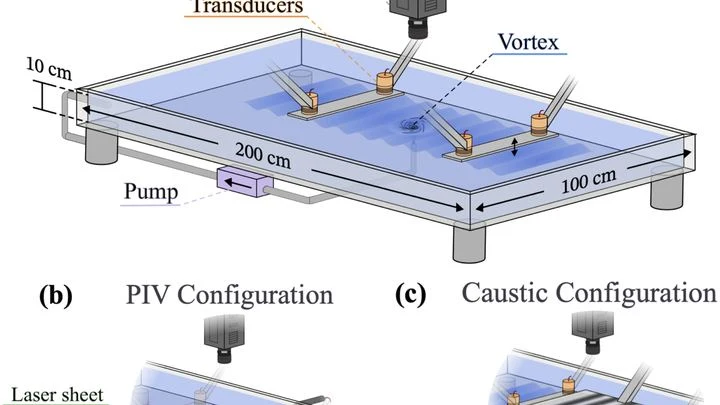
At night, when we sink into deep, dreamless sleep, a tide begins in the depths of the brain. Each heartbeat and each breath sends gentle pulses through the fluid-filled cavities (the ventricles). During the day, these pulses are timid and monotonous — the fluid sloshes back and forth almost in place.
But with the onset of slow-wave sleep, the rhythm changes.
In calm water, the route is clear. But in turbulent flows, a robot needs a different strategy. Typical approaches demand an accurate map of currents, but in reality, you can't get one. Nature does it differently: fish feel pressure and vortices right against their bodies.
An ocean current hundreds of kilometers wide lives its own life, fed by energy from tiny eddies. Something similar happens in the atmosphere: small swirls pass their power on to huge air currents. This process, the inverse energy cascade, has been known for a long time.
In the intricate dance of active turbulence, where invisible engines spawn chaos, a soft droplet takes on the role of a detective. Its shape is not merely an outline but a sensitive cipher: it reads the hidden signals of its environment.
Membraneless organelles, tiny factories inside the cell, defy conventional rules. Take the nucleolus: here ribosomal RNA is synthesized — long chains woven from carbon sugars, rich in oxygen phosphate groups, and stitched with hydrogen bonds, suspended in the watery environment of the nucleus.
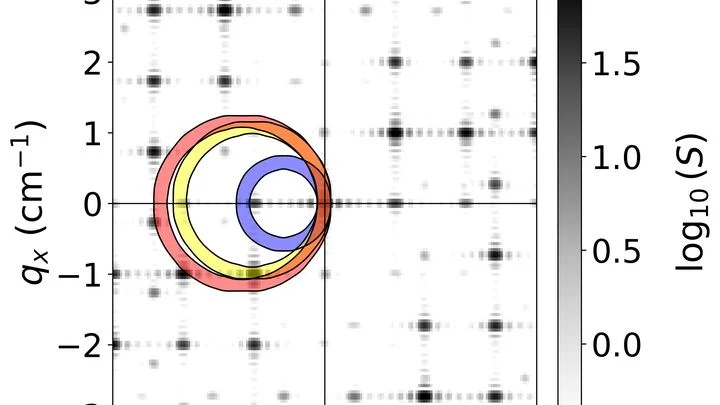
When physicists drive electrons through an ultrapure gallium arsenide channel at helium temperatures, they expect to see a well-behaved, almost ideal fluid.
Millions of cilia, thin hairs, work inside the tiny ducts of our bodies. They beat in synchrony, like the oars of a galley, pushing viscous mucus or fluid along. The authors of a new study propose viewing the ciliary carpet as an active porous medium — something like a sponge that squeezes and releases itself, driving water through.
A drop of thick shampoo falls into water and freezes into a strange rope. A liquid that both flows and springs back is called viscoelastic. In it, tiny particles under ultrasound behave quite differently than in water. Viscoelasticity is a material's ability to both spread like honey and return to shape like rubber.
The crown of a huge tree sways in the wind, but the roots and trunk are hidden underground. On the Sun, magnetic fields play the role of such invisible roots. They emerge from the depths, thread through the entire atmosphere, and govern the motion of the hot gas — plasma.
In a pot of boiling soup, churning currents carry heat to the walls, and the soup cools. In a tokamak, a huge magnetic bottle for plasma, the same thing happens: turbulent eddies carry energy outward, hindering the ignition of a fusion reaction. But sometimes the plasma seems to find a way to calm itself.
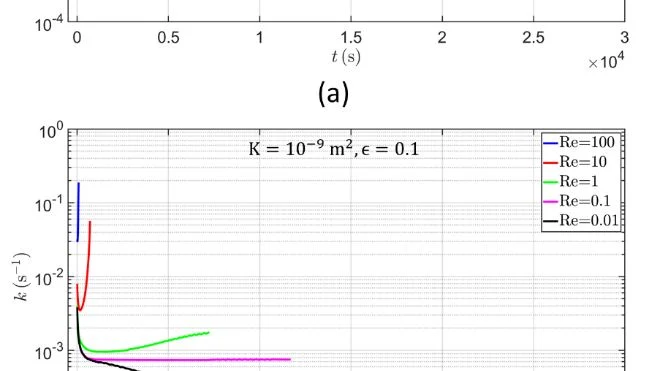
A porous implant filled with a drug works like a sponge that slowly releases the substance into the surrounding fluid. But if the fluid flows quickly, it washes out the drug differently than in a calm environment. The authors computed on a computer how different flow rates and properties of the porous structure affect drug release.
Water going down the drain swirls into a vortex. An everyday sight in the kitchen. But this very vortex turned out to be able to reproduce two effects that physicists usually associate with black holes and the rotation of planets.
The first effect is the shift of a wave as it goes around an obstacle.
A cell about to divide first marks its waist. Beneath its membrane, in a thin gel of protein filaments, movement begins. The filaments flow like a slow river, and a belt forms in the middle of the cell. This belt tightens more and more until the cell is pinched in half.
Scientists built a computer model of this process.
A ship gliding through water constantly rubs against it, like a palm against a rough surface. This friction eats fuel and slows progress. One way to reduce it is to blow air under the hull: water stops sticking to the hull, and drag drops. But air is finicky: sometimes it helps, sometimes it hurts.
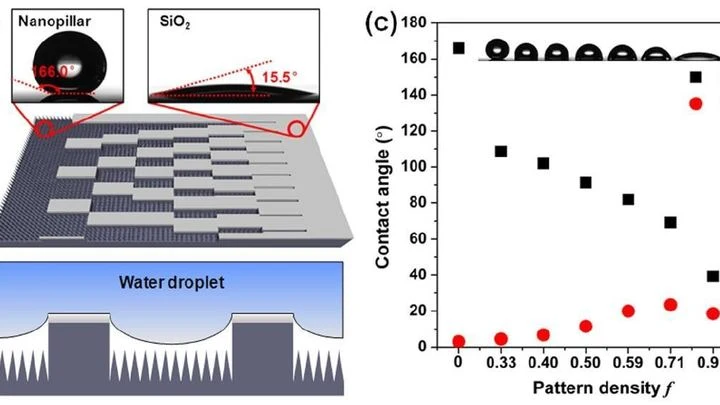
A drop of water on a table usually sits still. But make the table slightly softer on one edge and stiffer on the other, and the drop will crawl toward the stiffer side. This phenomenon is called durotaxis: the liquid itself chooses where to flow, without pumps or electricity.
This trick works because the surface under the drop is not uniform.
In a thin semiconductor channel, electrons behave not like lone runners but like a crowd at rush hour. They constantly bump into each other, and these collisions determine how easily heat and electric current pass through the material.
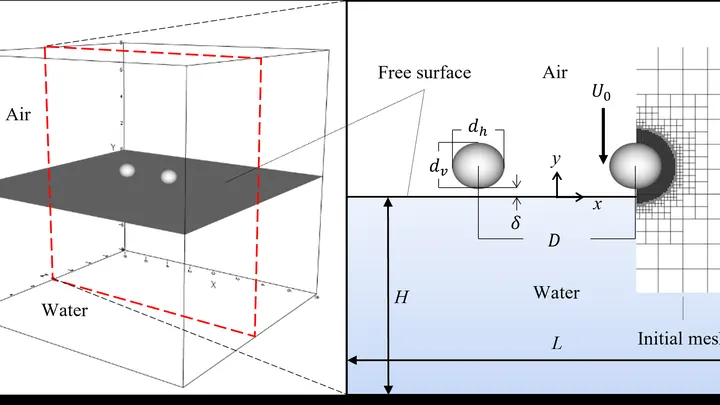
A raindrop falls into a puddle, and the impact sends up a little fountain of fine spray. Each of those droplets is a new, secondary drop. How many there are, how big they are, and how long they live depend on a host of factors: the fall speed, the drop size, the properties of the water. Scientists set out to make sense of this chaos using computer simulations.
In porous materials (soil, rocks, filters) fluids move through tiny, winding channels. When two immiscible fluids, such as water and air, are present simultaneously, their interface constantly shifts: air bubbles push water out of some pores and open paths through others.
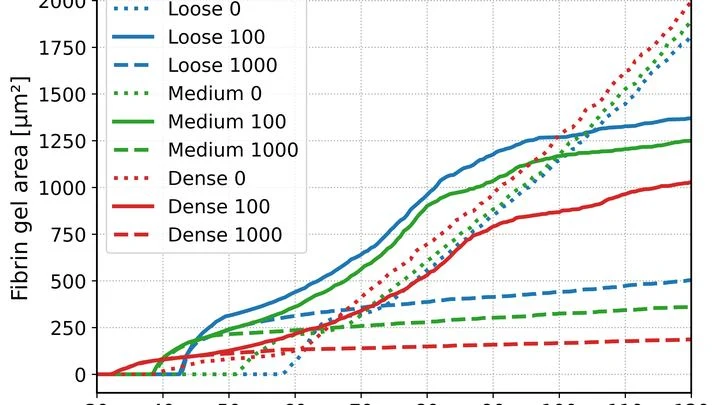
A thrombus is not just a clump of cells. When a vessel wall is damaged, platelets stick together into a plug, but it is still fragile. What makes it strong is fibrin — a protein that forms a network of fibers, like rebar in concrete. The model showed that the plug's density decides where this network appears.
An amoeba turns left. For a long time, this was considered the result of a rigid chain of causes, like dominoes. But at the core of matter, there's a gap for freedom. The 'Agent Choice via Quantum Flux' model shows: each decision corresponds not to one, but to many quantum histories.
Inside the kidneys, liver, and other organs, fluid flows through channels that squeeze and release like a hose underfoot. The walls of these channels are not rigid: they are porous, elastic, and soaked with moisture.
In the cold heart of a pure crystal, electrons flow like a viscous fluid — an idea predicted by Lev Landau. But the vortices of this fluid remained invisible, like a painting inferred from the noise of a crowd. Now scientists have created a nanostring: a semiconductor tuning fork with a circular cavity.
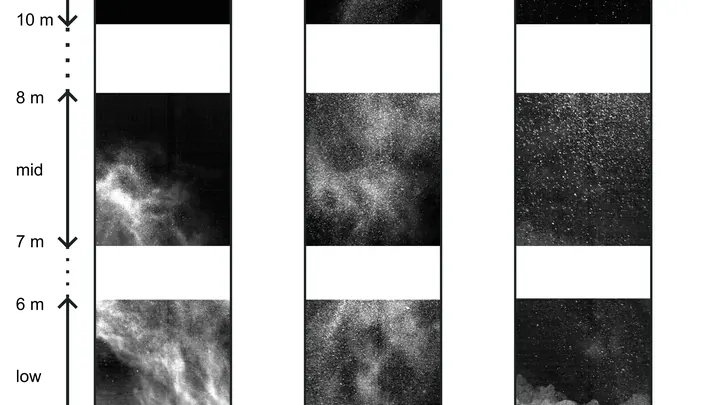
A powder avalanche isn't just a pile of snow sliding down a mountain. It's a cloud racing downhill at car speed. Inside, snow doesn't lie still: it flies: thousands of tiny particles are caught up in air vortices. Until now, no one had seen what actually happens to each snowflake in this chaos. Now scientists have the first footage.
Lymphatic vessels are one-way streets. Through them, fluid flows only forward thanks to tiny flap valves. These valves open in just one direction, creating asymmetry, directionality, without which the flow would stop.
In the lab, scientists modeled a vessel and sent compression waves along it, like a parade of gentle nudges.
A flat sheet with slits in a flow of water or air behaves like self-adjusting blinds. The pressure opens the gaps, and each strip of material tilts, turning into a miniature wing. Thus, even a sheet placed perpendicular to the flow generates not only drag but also significant lateral lift.
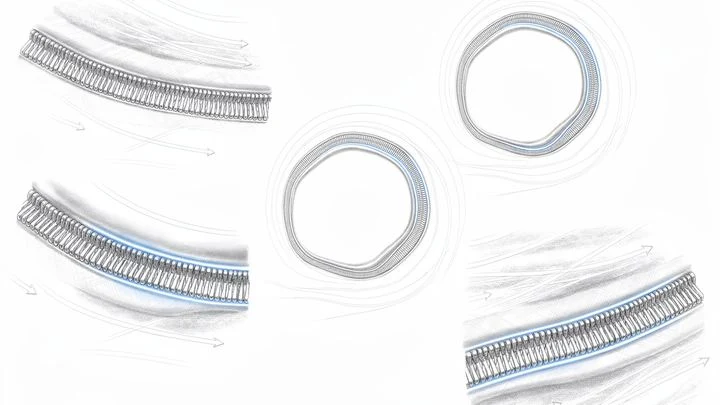
A drop of oil in water, coated with soap molecules, behaves differently from a bare drop. Soap molecules are tiny rods: one end loves water, the other loves oil. In a quiescent fluid, they stand on the surface like a picket fence, lowering the surface tension — the force that pulls the drop into a sphere.
E. coli is a tiny swimmer in a world where water is as thick as jelly. Inside our gut, it doesn't glide freely but fights through mucus — a tangled web of long molecules, like a ball of knotted threads.
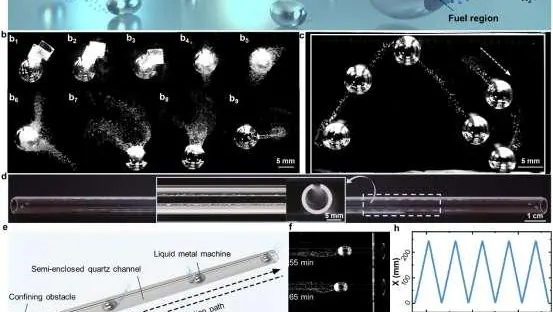
A droplet of liquid metal glides along a narrow channel like mercury from a broken thermometer. It needs no motor — the fuel is a chemical reaction with the surrounding liquid. But what happens when the droplet hits a wall? Previously, such machines were studied in open spaces, and in tight channels they behave differently.
In a protoplanetary disk, a cloud of gas and dust around a young star, dust grains don't just fly in circles. They are carried by the gas flow, like sand by the wind, and in turn alter that flow. Layers emerge, sliding past each other, and at their boundaries an instability arises — waves and vortices.
The Sun drives the water cycle, and rain returns it to the ground. But now, every drop is a tiny hammer striking the surface. Floating plastic particles (microplastics, mostly carbon) upon impact jump up like popcorn kernels on a hot skillet. But instead of popping, they get wrapped in a thin water film and turn into weightless beads.
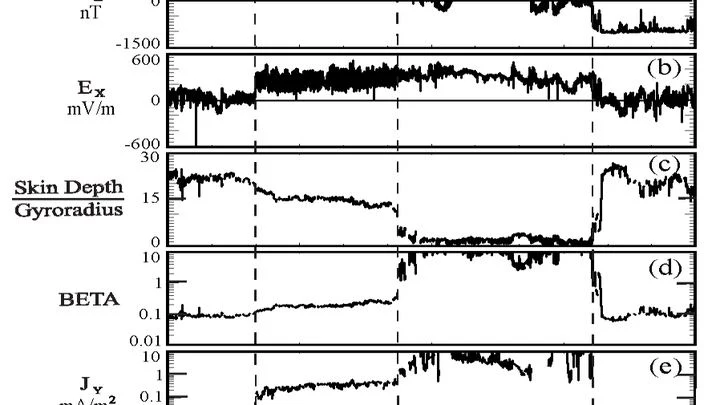
The Sun's corona looks like a shaggy dandelion: bright petal-like loops hold hot gas near the surface, while long, tenuous jets escape into space between them. These jets, the heliospheric current sheet, stretch across the entire solar system.
A cell is a city with gates. Each gate is a protein channel in the membrane: through it, ions, sugars, and signaling molecules pass in and out. Some gates are almost always open, while others open and close randomly, like subway doors that let a passenger through one moment and slam shut in their face the next.
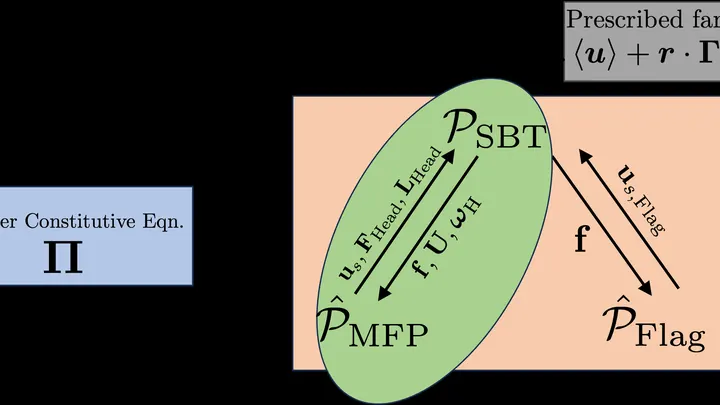
Cilia are tiny hairs on cell surfaces. They beat like oars, moving fluid. In the lungs, they push dust and microbes out. But their lengths vary: in humans, they are thousandths of a millimeter; in comb jellies, several millimeters. How do such different cilia work together?
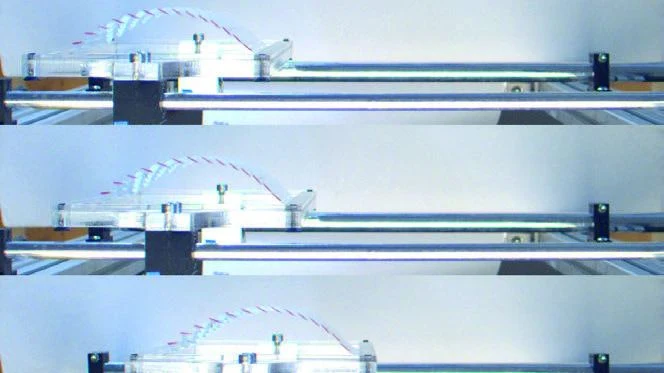
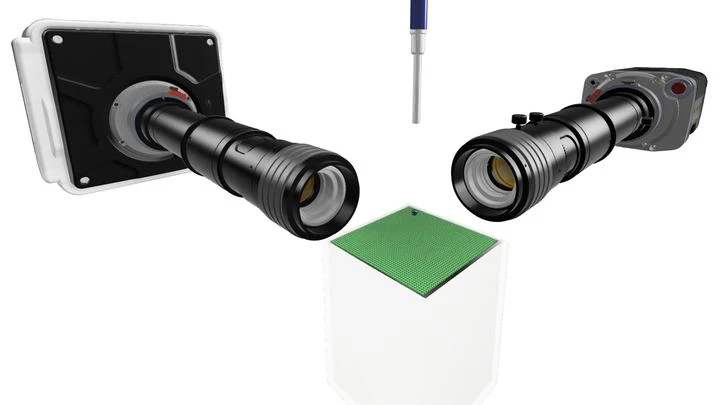
Scientists built a machine that jerks fluid sharply, as if a cilium had struck. They filmed it with a high-speed camera.
Ice on a warm frying pan doesn't just melt: it starts to move. A thin layer of water forms beneath it, and the piece glides as if on oil. The speed of this sliding depends on how quickly heat travels through the water film and how steep the incline is.