In the context of crowd dynamics, density is the number of people per unit area, typically measured in persons per square meter. It is the single most important parameter in predicting whether a crowd will move smoothly, become congested, or escalate into a dangerous crush. At low densities, people move freely; as density increases, individual movement becomes constrained, and the crowd begins to behave more like a granular material or a fluid, with collective patterns emerging.
History
The systematic study of crowd density and its relation to safety began in earnest after the 1989 Hillsborough disaster, leading to the development of pedestrian flow models and the concept of 'crowd turbulence' by researchers like Dirk Helbing in the early 2000s.
How it works
When density exceeds roughly 4–5 people per square meter, the crowd enters a regime where physical contact between bodies becomes frequent, and the forces people exert on each other can propagate like waves through the crowd. At even higher densities, the crowd can become so compressed that individuals lose the ability to control their own movement, and the pressure can cause suffocation or crushing injuries. The transition from orderly flow to dangerous compression is not gradual — it is a phase transition, similar to how a gas condenses into a liquid.
In practice
Density thresholds are used in the design of stadiums, train stations, and pilgrimage sites to set safe occupancy limits and plan crowd control measures, as well as in real-time monitoring systems that alert authorities when a crowd is becoming dangerously dense.
Fun fact
At densities above about 6 people per square meter, the forces between people in a crowd can be strong enough to bend steel barriers, a fact documented in the aftermath of several fatal crowd crushes.
A crowd of pedestrians in a square moves chaotically: each person goes their own way, occasionally bumping into others. If every third person in that crowd wears a protective suit that blocks the pathogen, the rhythm of disease spread changes abruptly. That is exactly the scenario scientists reproduced by simulating 3000 self-propelled particles that repel each other and become infected upon close contact.
A lone fish sees a shadow overhead. Should it flee? If it's just a leaf, it wastes energy and gives away its position to a predator. If it's a heron, hesitation is fatal. That's the eternal trade-off of the solitary individual: quick reactions mean many false alarms, while caution means risking being eaten.
In a school, it's different.
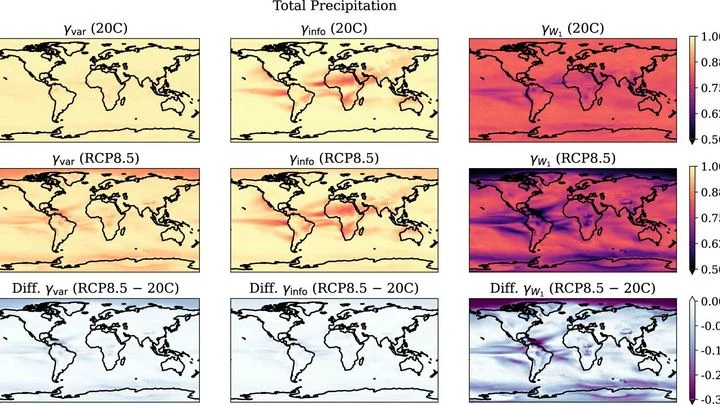
In winter, one part of town gets three times as much snow as the neighborhood next door. One year is a scorcher, the next is a cold snap. That's the whims of weather. But over decades, a different, slow shift emerges: winters, on average, get milder. Telling the two apart is the central challenge for climate scientists.
At a concert, moving through a dense crowd is tough — the tighter the pack, the less you want to move. That's how active matter usually behaves: swarms of bacteria or robot flocks freeze in tight quarters. But one research group found the opposite effect.
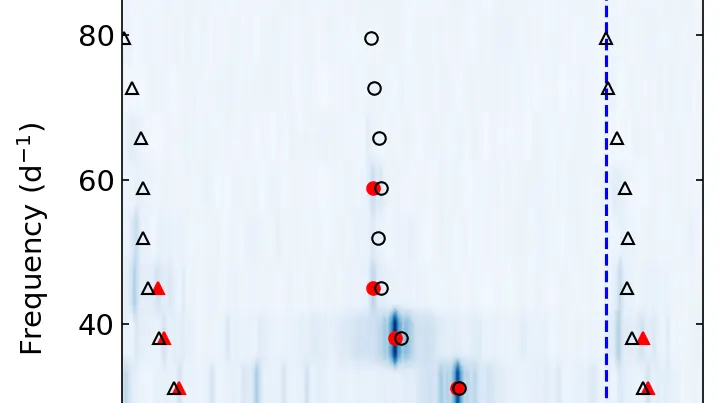
A mosquito swarm resembles a living cloud — hundreds of bodies circle together, but no one lines up or mimics a neighbor's movements like starlings or fish. For a long time, it was unclear what held such unity together. The authors of a new study suggested that the insects communicate by sound.
A young star cluster resembles an orchestra before a concert: each instrument tunes up in its own way, and the overall hum seems like chaos. But if you listen closely, you can pick out individual notes.
Usually, the complexity of systems, from satellite motions to heart rhythms, is assessed with averaged entropy (a measure of unpredictability, as understood by Boltzmann). But that's like evaluating the ocean only by wave height: the average figure hides the full richness of underwater currents.
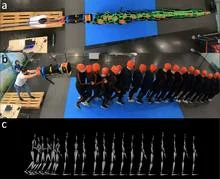
Researchers took 16 everyday activities — from washing dishes to squatting — and broke the movements down into elementary components, much like a spectroscope splits light into a spectrum. Comparing three approaches, they found an unexpected key to recognition: a single averaged snapshot is enough. Only nine joints out of dozens carried the crucial information — the rest hardly mattered.
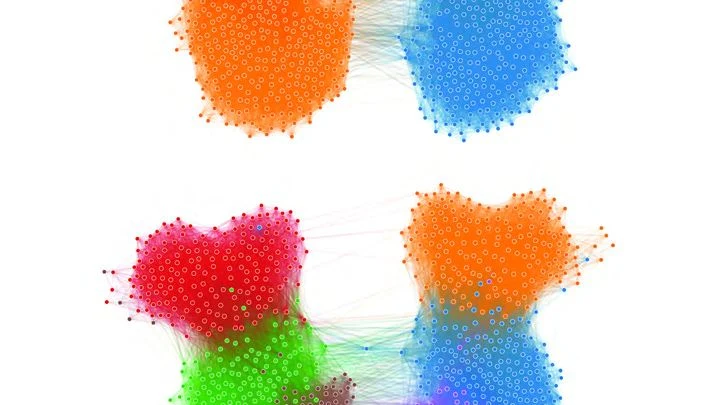
A social network is like a city: there are giant neighborhoods and tiny alleys. When an algorithm looks for tight-knit groups, it often picks out a couple of huge clusters and many small fragments. But the client (say, a municipality) needs districts of roughly equal size to distribute clinics or schools evenly.
Spread a handful of coins on the table. Each coin is a possible outcome: heads, tails, or something else. If we know how chaotic this set is (its entropy), which combinations of probabilities will we encounter more often? It turns out the answer depends on how much chaos we allow.
A neuron in the brain is like a person handing out business cards at a crowded conference. At first, making acquaintances is easy, but as the address book fills up, each new contact requires more effort: there's little room left. The authors based their model on this 'crowding' rule: the more incoming connections a neuron already has, the harder it is to form another one.
Two species of bacteria share a single Petri dish. Both eat the same food, and by all rules, one should outcompete the other. But in reality, they often live together for years. The secret lies in knowing when to leave.
Bacteria don't stay put. When a stranger appears nearby, they start moving faster.
A density of four people per square meter is the threshold beyond which a crowd ceases to be a sum of individual pedestrians and becomes something else. In Pamplona's Plaza Consistorial during the San Fermín festival, local density reached nine people per square meter.