The Wall That Calms Turbulence express
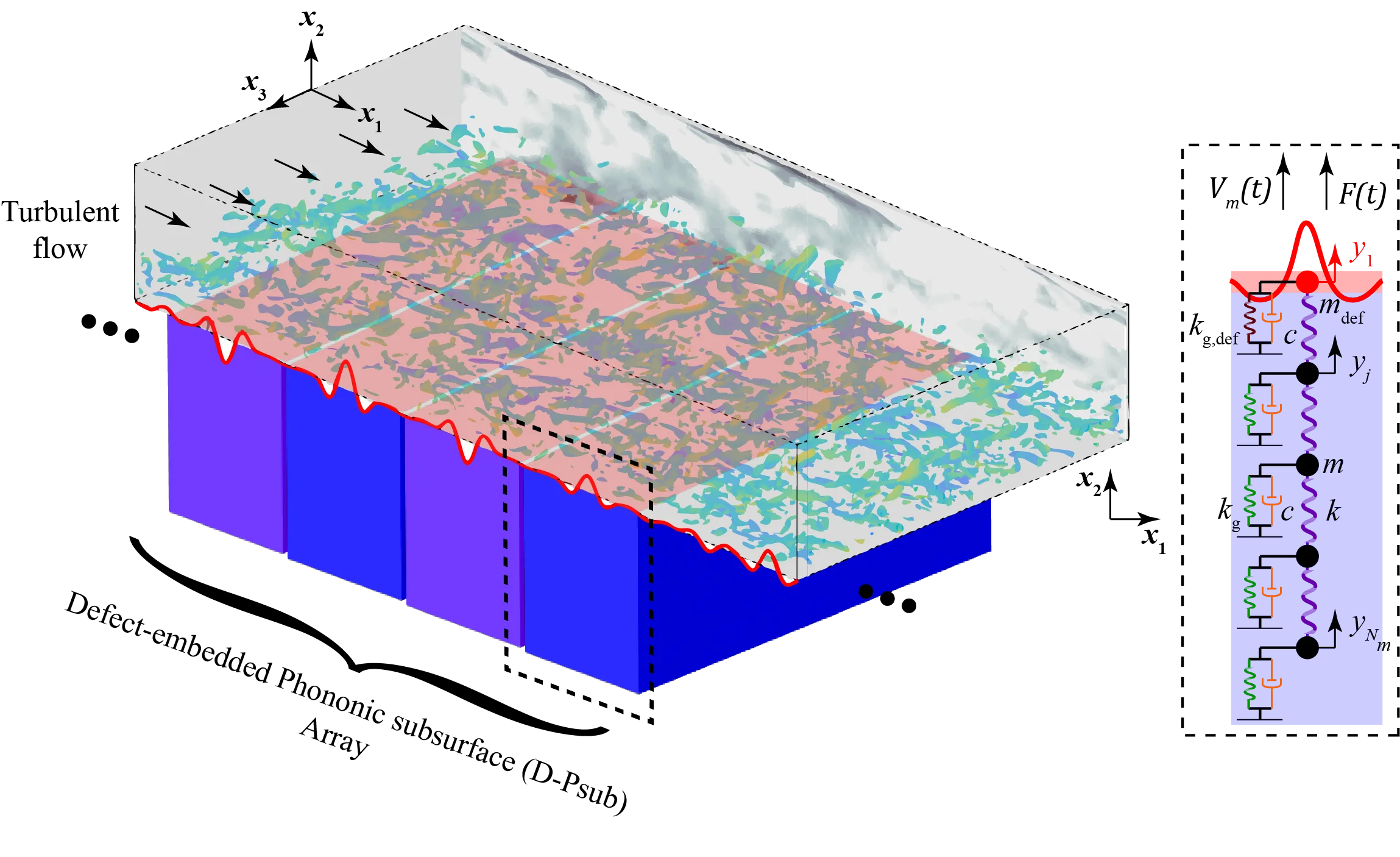
Turbulent flow near a wall resembles a crowd where everyone pushes in their own direction. Vortices form and break apart, creating chaotic jolts. If you embed a defective acoustic lining into the wall, like a tuning fork that rings only on one note, it starts responding only to a narrow range of frequencies.
In the new study, such a layer was placed on the bottom of a channel with turbulent water. The flow pressure hits the wall with a broad spectrum, but the lining responds with a narrow band. In response, the flow pattern near the wall changes: velocity fluctuations weaken, longitudinal streaks become more coherent, and frictional drag decreases.
The main surprise is that the system behaves differently than if the wall were simply forced to oscillate at a given frequency. Due to the fluid-structure interaction, the natural frequency shifts, and the phase between panels is set by vortex convection. It turns out that the lining doesn't just damp disturbances; it redistributes turbulent energy, turning chaos into more ordered motion.
Even a passive resonant surface can reduce frictional drag by a few percent — without a single watt of supplied energy.
The idea of a surface that calms flow on its own evokes the ship hulls in 'Dune' that respond to desert vibrations.