A frequency shift is a change in the frequency of a wave, often caused by the relative motion between the source and observer (Doppler effect) or by time-varyingmodulation of the medium. This phenomenon is crucial in astronomy for detecting exoplanets, measuring the expansion of the universe, and studying the dynamics of stars and galaxies. In physics, frequency shifts also arise in nonlinear optics, gravitational wave detection, and quantum systems.
History
The Doppler effect was proposed by Christian Doppler in 1842 for sound waves and later applied to light by Hippolyte Fizeau. The gravitational redshift was predicted by Albert Einstein in 1916 as a consequence of general relativity.
How it works
When a wave source moves toward an observer, the observed frequency increases; when it moves away, the frequency decreases. The shift is proportional to the relative velocity along the line of sight. In general relativity, gravitational fields also cause frequency shifts: light climbing out of a gravitational well is redshifted. In modulated systems, such as a vibrating grating, the frequency of transmitted light can be shifted by the time-dependentphasemodulation.
In practice
Frequency shifts are used in radar and lidar for speed measurement, in medical ultrasound for blood flow imaging, and in astronomy to measure stellar radial velocities and the cosmic microwave background dipole.
Fun fact
The most precise frequency shift measurements today can detect velocity changes of less than 1 millimeter per second, enabling the detection of Earth-sized exoplanets around nearby stars.
A spotlight with an adjustable beam width sweeps along the shore. Its light is the long ocean waves that are born in the surf zone and spread in both directions: toward the beach and out to the open sea. Previously, this spotlight was considered a point source, but the actual breaking zone, where short waves break, has a finite width, and it changes as the wave front advances and retreats.
Light escaping a massive body loses steam. Its frequency dips slightly, and its color shifts toward red. Physicists call this gravitational redshift. In classical theory, it's all clear, but the moment you bring quanta into the picture, trouble starts.
Previously, this shift was modeled as a kind of mode mixer — a device that entangles different states of light.
When two black holes merge, ripples spread across the fabric of spacetime — gravitational waves. But what if one of them isn't a run-of-the-mill black hole but something else — an exotic compact object?
A massive aluminum cylinder weighing a ton hangs in a vacuum. A gravitational wave, a ripple in spacetime, passes through it, and the bar begins to tremble almost imperceptibly. That trembling can be heard as sound: gravitational waves turn into a phonon — a quantum of sound vibrations.
A pebble tossed into a pond sends ripples spreading in all directions. Now imagine the pond itself suddenly turning into jelly — instantly, faster than the wave can complete a single crest. Some ripples would keep spreading but change their spacing, while others would unexpectedly turn around and run back toward the point of impact, as if time were flowing backward for them.
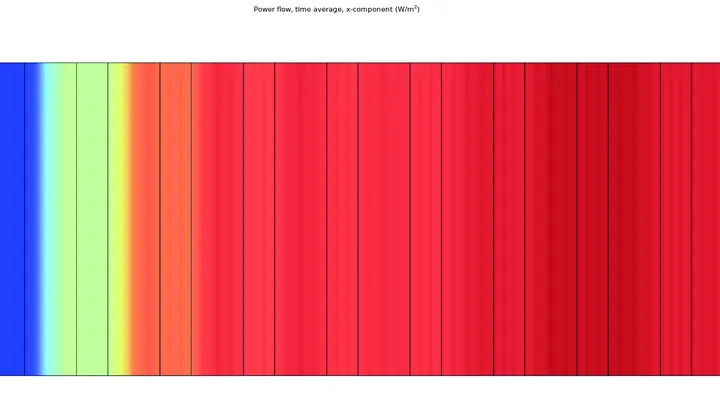
A beam of light passing through a transparent plate usually keeps its color. But if you stack the plate from thin alternating layers, it becomes a grating that reflects and transmits waves selectively. This has long been used in lasers and optical filters. Now such gratings have been made to vibrate, and light started changing color.