An interaction is any influence between physical objects that changes their motion, energy, or state. In particle physics, interactions are the fundamental processes by which particles affect each other — for example, the electromagnetic interaction between charged particles, the strong forcebinding quarks, or hypothetical interactions between dark matter particles and ordinary matter. The concept is central to understanding everything from subatomic collisions to cosmic structure formation.
History
The modern concept of interactions as exchange of force carriers emerged in the mid-20th century with quantum electrodynamics, developed by Feynman, Schwinger, and Tomonaga in the 1940s.
How it works
Interactions are mediated by force carriers: photons for electromagnetism, gluons for the strong force, W and Z bosons for the weak force, and gravitons (hypothetically) for gravity. When two particles interact, they exchange these carriers, transferring momentum and energy. The strength and range of an interaction depend on the properties of the carrier and the charges of the participating particles.
In practice
Understanding interactions is essential for designing particle accelerators, medical imaging devices like PET scanners, and radiation therapy equipment.
Fun fact
The electromagnetic interaction is about 10^36 times stronger than gravity, yet gravity dominates on cosmic scales because it is always attractive and never cancels out.
Two tiny weights, each about the mass of a grain of sand, hang in the dark at a temperature colder than deep space. They don't touch, but an invisible thread connects them — gravity. The experiment physicists are now building aims to catch the moment when that thread tugs one weight due to the motion of the other.
In 1905, Einstein showed that the chaotic motion of pollen in water results from the jostling of invisible molecules. A century later, physicists have learned not only to observe but also to control motion at the quantum level.
Two floats on the waves. Throw a stone into water, and the ripples will spread, rocking both floats one after another — not simultaneously. In the quantum world, such rocking is called entanglement: particles, like floats, begin moving in sync.
Two grains of salt fall into a glass of water. They dissolve, and sodium and chloride ions spread throughout the volume. The schoolbook truth is simple: like charges repel, opposite charges attract. But recent experiments with tiny spheres in liquids have revealed a picture that breaks this rule.
Gravity is like a stretched trampoline: massive bodies press into it, making other bodies roll toward them. This shared curvature of space, gravity, affects everyone, but it doesn't convey secret messages.
A raindrop falling to the ground strikes with a certain force. But what if the drop isn't round but elongated like a cigar or flattened like a pancake? It turns out that shape is everything: the impact force can vary by more than a factor of ten just because of how the drop looks at the moment of impact.
Somewhere above our heads, every second, a proton accelerated to energies millions of times greater than those at the Large Hadron Collider slams into the atmosphere. It strikes an air molecule, and a cascade is born — a wide atmospheric shower of thousands of particles.
Two tiny magnetic vortices, called skyrmions, drift across a thin film. As they approach each other, the force between them isn't a simple attraction or repulsion, but an alternation of the two, as if two floats on water were converging and diverging, obeying an invisible wave.
A snowflake falling from a cloud chooses between a left-handed and a right-handed form. The difference between them is almost imperceptible, like a breath of wind, yet it is that very breath that decides which pattern will grow.
In 1989, John Wheeler proposed a bold idea: "it from bit," meaning everything that exists arises from information. For a long time, this remained a beautiful metaphor, but now physicists have found a concrete mechanism that turns bits into particles.
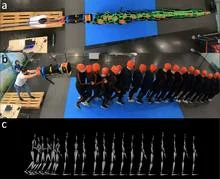
A density of four people per square meter is the threshold beyond which a crowd ceases to be a sum of individual pedestrians and becomes something else. In Pamplona's Plaza Consistorial during the San Fermín festival, local density reached nine people per square meter.