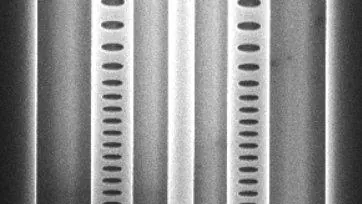
A phononiccrystal is a periodic structure of materials with different elastic properties that affects the propagation of sound and vibrations, much like a photonic crystal affects light. The periodic arrangement creates band gaps—frequency ranges where sound waves cannot travel through the material. This allows for precise control of acoustic waves, enabling sound insulation, vibration filtering, and even waveguiding in compact devices.
History
The concept was proposed in 1993 by Mikhail Sigalas and Eleftherios Economou, and independently by Francisco Meseguer and colleagues. Experimental demonstrations followed in the mid-1990s with structures like arrays of cylinders in a fluid.
How it works
The crystal is made by alternating layers or inclusions of materials with contrasting stiffness and density (e.g., rubber and steel). When a sound wave encounters this periodic pattern, it undergoes multiple reflections and interference. At certain frequencies, the reflections cancel the wave completely, creating a band gap. By designing the geometry and materials, engineers can tune which frequencies are blocked or allowed, and can also create defects to guide sound along specific paths.
In practice
Used in acoustic filters for noise reduction, vibration damping in precision instruments, and in ultrasonic devices for medical imaging and non-destructive testing.
Fun fact
A soft metamaterial made of rubber-like material can be squeezed by hand to tune its vibration-damping properties, effectively changing its band gap on the fly.
Waves on the water's surface usually break against any obstacle — a rock, a piling, an island. But what if you arrange obstacles so cleverly that the wave barely notices them? In a new study, scientists assembled a pattern of many points on the water, arranged according to special mathematical rules, and sent waves through them.
A magnetic vortex is like a tiny whirlpool in the sea, except that instead of water, it's magnetization that swirls. Such vortices could become memory cells in future computers, but to write and read information, you need to be able to move each vortex individually. So far, this is done crudely — shifting a whole bunch at once.
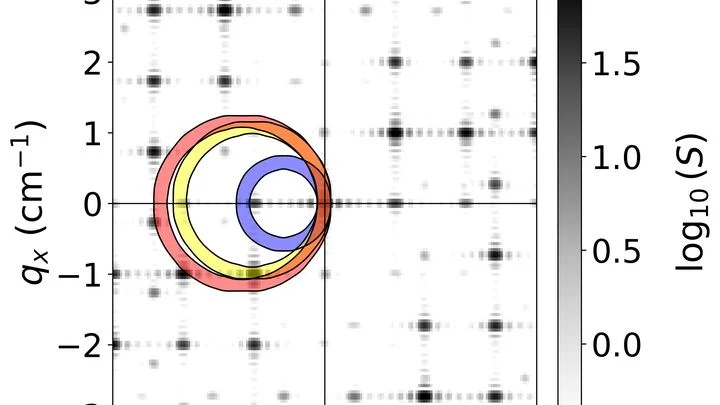
Two transparent sheets with circles drawn on them. If you stack them exactly, the circles align. But give one sheet a slight twist, and a new pattern emerges: in some places the circles bunch together, in others they spread apart. That's roughly how moiré works — an unexpected pattern born from rotating two periodic structures.
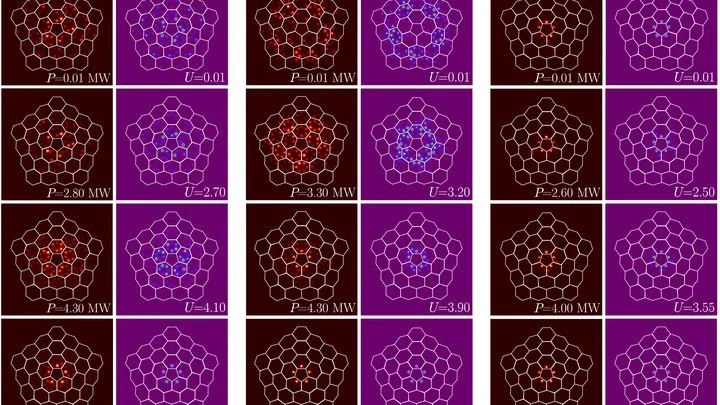
Moiré patterns are familiar to everyone. Two combs with different spacing, placed on top of each other, show dark fringes. Something similar has emerged in time. Physicists took a cloud of Rydberg atoms, particles with unusually large electron orbits, and illuminated it with two lasers.
A mosaic of squares and triangles covers the floor without gaps, yet it never settles into a simple repeating pattern. Such a pattern is a quasicrystal — a solid where atoms are arranged not periodically but according to a pattern of several waves of different lengths. These waves are incommensurate with each other, and together they create long-range order.
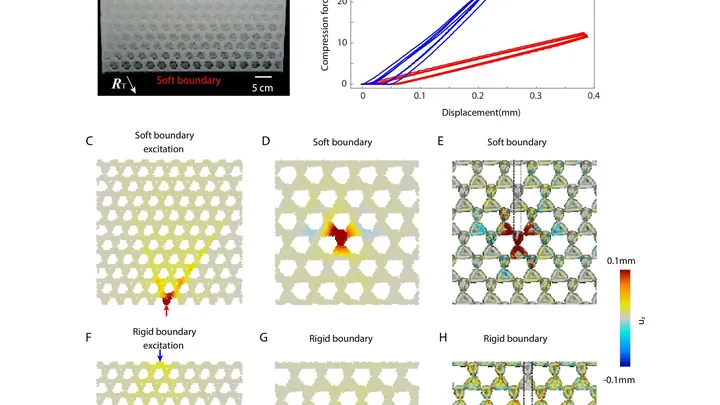
Bending a sheet of paper is easy. But compressing it by pushing from the edge is a different story: the paper will crumple but barely transmit the force further. That's how ordinary elasticity works — deformation depends on where and how you press. The new three-dimensional lattice pushes this contrast to the limit.
In the world of two-dimensional materials, states sometimes emerge that are as extraordinary as they are fragile. One of them — the fractional anomalous Hall crystal (FAHC)—is like a quantum centaur: half ordered lattice, half topological liquid.
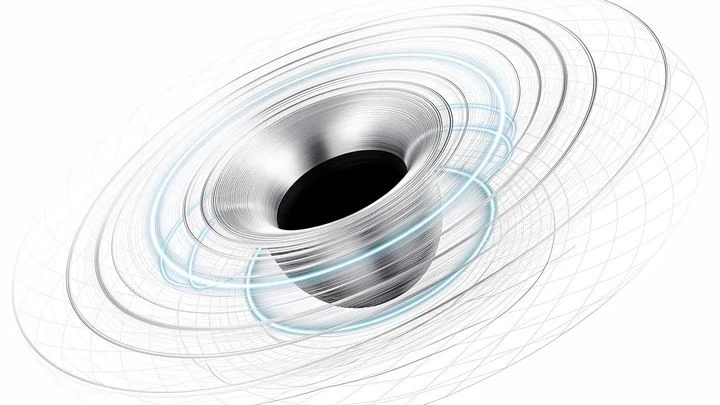
Imagine a river at a rapid: the current accelerates until no wave can go against the flow. So it is with gas near a black hole: reaching the speed of sound, it locks itself in — an acoustic black hole is born, a twin of the gravitational abyss. Here the event horizon is woven from a flow faster than its own sound.
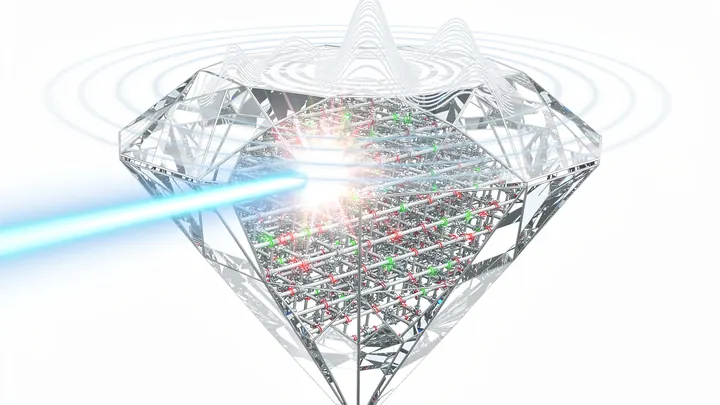
In the depths of a diamond crystal, studded with NV centers, a symphony slumbers. Each defect is like a tuning fork, ready to respond to a passing acoustic wave. But alone, their voices are barely audible: the spin-phonon coupling is weaker than a whisper. A maestro is needed, one who can turn timid vibrations into a resounding choir.
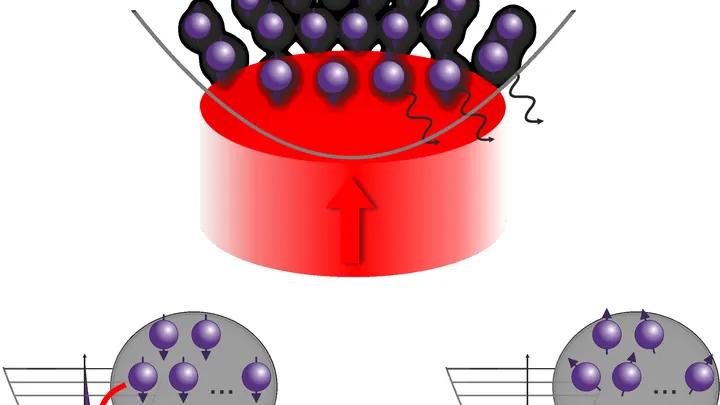
A tiny crystal of charged atoms, trapped in a trap, trembles with heat. Each ion oscillates like a ball on a spring, and these vibrations hinder using the crystal for precise quantum operations. Usually, excess energy is removed with a laser — the beam hits the ions and slows their motion, like a stream of air damping a pendulum.
A pendulum that swings on its own, without any winding — in the quantum world, such 'pendulums' are called time crystals. In them, rhythmic motion arises spontaneously and does not decay. But until now, controlling this rhythm was nearly impossible: any intervention threatened to destroy the fragile order.
A hot spoon in a cup of tea — heat runs along the metal from the hot end to the cold one. Textbooks describe this process as atoms jiggling and passing on their jolts to each other. But atoms don't just jiggle: they also spin, like tiny tops. Until now, physicists had no common language to describe both motions at once.
The authors of the work built such a language.
Imagine a long corridor with an uneven floor: bumps here, pits there. If you roll a toy car along it, it will get stuck in the deepest pit, not where you gave it a push. That's roughly how sound behaves in a phononic crystal — a material made of periodically arranged elements that controls the propagation of elastic waves.
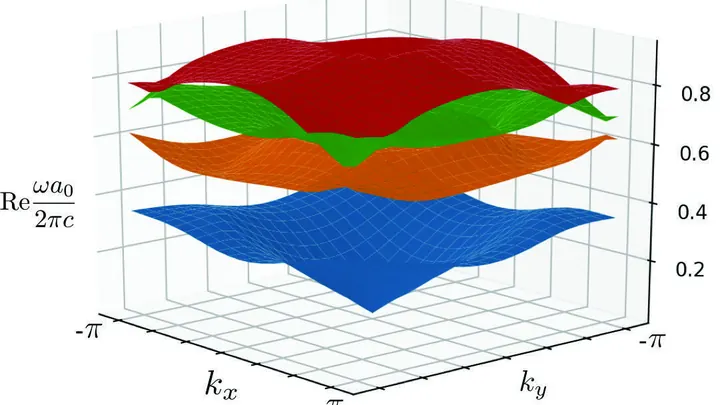
Light, discovered by Maxwell, behaves differently in different media. In a new study, researchers simulated a two-dimensional crystal that absorbs light and has magnetic properties. In it, light waves behave like passengers on a one-way escalator: they relentlessly move toward edges and corners, where they accumulate.
A drummer beats a rhythm, and the drumhead vibrates in time. If you strike often enough, the vibrations overlap, and a nearly stationary zone, a node, forms at the center. A similar effect occurs with microwaves in a material whose properties change over time. When the changes resonate with the wave, its motion freezes.
Shine light on an FePS3 crystal, and it responds with its own glow, like a neon sign, but much fainter and in the infrared range. This glow is not random: it depends on how the crystal is oriented. The scientists took samples from a thick chunk down to a single-atom layer and observed four emission bands — at 1.24 electronvolts, 1.79, 2.3, and 2.56.
Ordinary light scatters in all directions, like water from a shattered glass. But in some crystals, light waves can bunch together into narrow beams and flow in a single direction, like water in a trough. Physicists studied such a material: layered vanadium oxide α-V2O5.
In this crystal, atoms vibrate differently along and across the layers.
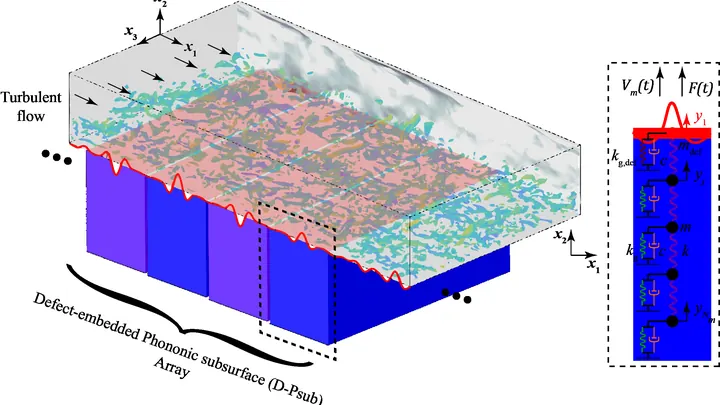
Turbulent flow near a wall resembles a crowd where everyone pushes in their own direction. Vortices form and break apart, creating chaotic jolts. If you embed a defective acoustic lining into the wall, like a tuning fork that rings only on one note, it starts responding only to a narrow range of frequencies.
A sheet of graphene one atom thick hangs in the air like a taut bedsheet. Heat waves, vibrations of atoms that physicists call phonons, ripple across it. Previously, it was thought that these waves quickly scatter due to strong interactions, and heat transfer is poor.
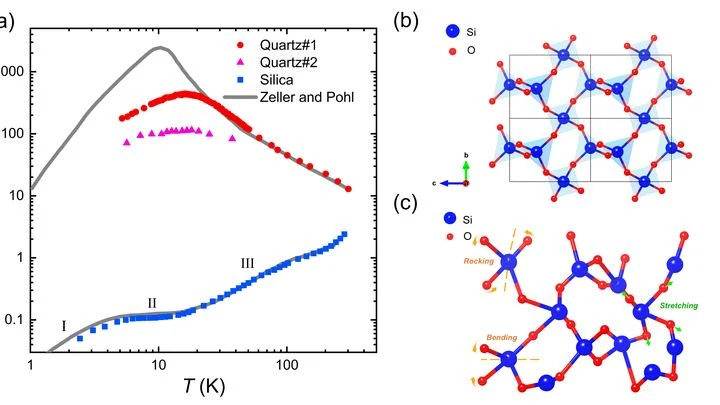
If you push heat through a piece of quartz, it usually goes straight, like water through a pipe. But switch on a magnetic field, and the flow veers slightly sideways, as if the pipe suddenly grew a side branch.
You can launch sound in a crystal at a frequency so high that the human ear can't hear it, and make that sound run in circles, like a train on a loop track. Engineers took a thin film of silicon nitride, deposited it on a lithium niobate substrate, and carved waveguides for sound waves into it.
A laser beam twisted into a spiral looks like a drain vortex in a sink: light moves not only forward but also in circles. Such vortex beams already help move tiny particles and transmit more data. But once they pass through an inhomogeneous medium, the vortex falls apart, like water from a leaky bucket.
A laser beam strikes a gold-and-silver film for just a few nanoseconds — in that time, light travels less than a meter. At the point of impact, the metal boils, splatters, and freezes into a random pattern of tiny particles. Each pattern is as unique as cracks in ice or tree branches.
A tiny diamond bridge vibrates so strongly that it starts to 'sing' at many frequencies at once. Previously, such vibrations would dampen themselves: the harder the resonator swung, the harder it was to add energy. Physicists found a loophole in this rule.
They used light to drive the diamond. Light pushes on the bridge, making it tremble.
The crystal CeB6 is like a box with a secret: inside it, electrons can occupy four nearly identical positions, like four chairs around a table. While no one is watching, the electron seems to sit on all four at once. Physicists call this hidden state quadrupolar, and it affects magnetic properties, but it is hard to see directly.
Sound in a solid is waves of compression and rarefaction rippling through atoms, like ripples across a spring mattress. If you place obstacles with just the right spacing, waves at certain frequencies can't pass: they bounce back. Such a periodic structure is called a phononic crystal, and it works for sound the way a multilayer mirror works for light.
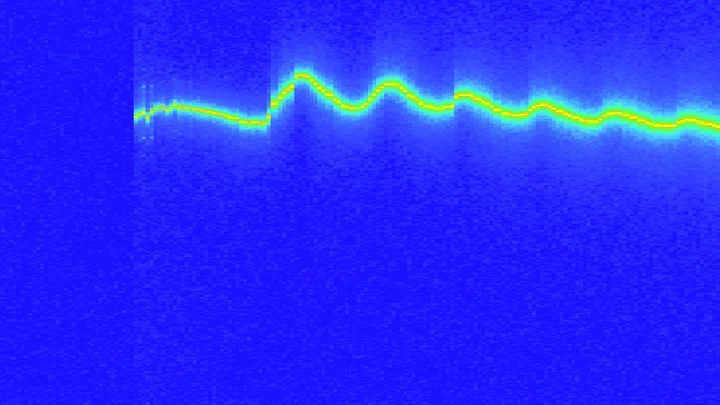
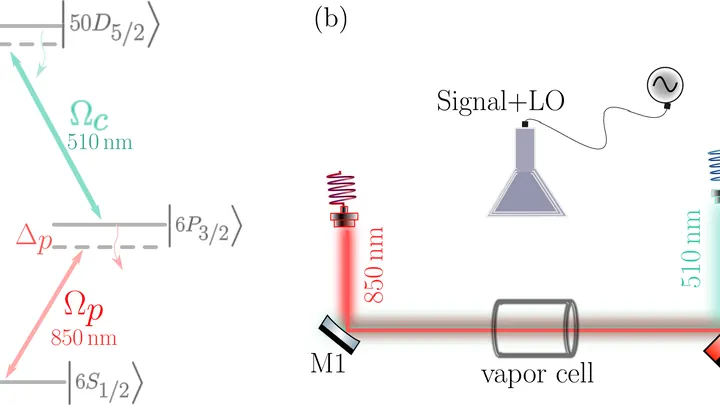
A cloud of cesium atoms was made to behave like a single quantum string. By shining a laser and letting the particles interact, scientists launched self-sustaining oscillations — a rhythm emerged without an external conductor.
Radio waves acted like frets on a fingerboard: it was possible to smoothly vary the sounding frequency.
A light beam inscribes a pattern on a thin crystal, and heat runs along that pattern in the desired direction, like water along a dug channel. This is how the new method works to control energy flows over distances of tens of nanometers — hundreds of times thinner than a human hair.
If you compress a plate with accordion-like cells, a kink wave runs through it, like a wrinkle in a rug when you push it with your foot. Such waves can switch the material between two stable shapes, and this is the basis of mechanical memory. But if a table leg gets in the way of the wrinkle, it gets stuck. In a new study, researchers showed how to nudge it loose without brute force.
A short laser pulse hits a crystal, and instead of a single sound, the crystal responds with a whole ladder of frequencies, each separated by the same interval. This is how a phononic frequency comb is born, a phenomenon that physicists are exploring in a material with an unusual internal structure.
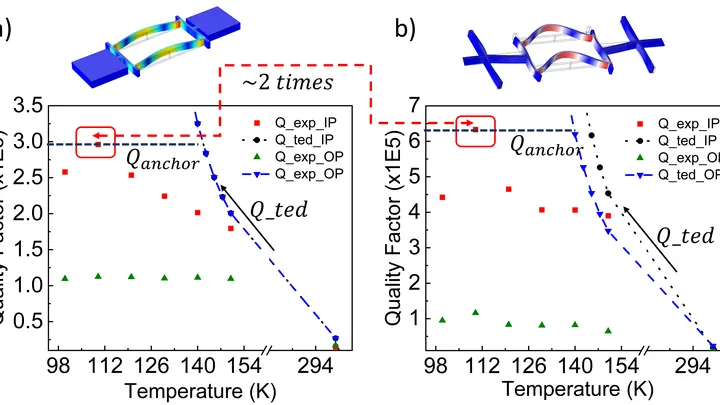
An ordinary rubber pad dampens vibration the way a thick blanket muffles sound: the thicker and heavier, the better. Engineers have long dreamed of a material that is light yet "eats" oscillations as well as a massive damper.
Waves in magnets resemble the vibrations of a string: if you pluck a string, it sounds a single note, but with a strong pluck, overtones appear — sounds at multiple frequencies.
A crystal without a center of symmetry is like a staircase where all the steps are tilted in the same direction: electrons, given a kick by light, roll predominantly in one direction. This is how a direct current is born — the photogalvanic effect.
Scientists have described a new type of invisible star that behaves like a breathing lens. Such a star is made of ultralight boson particles (not yet discovered). Its gravity causes spacetime curvature — this is the lens, which rhythmically expands and contracts, as if breathing.
In the world of microchips, where streams of photons, quanta of light, carry information, a fundamental problem arises: light passing through matter inevitably heats it. This heating spawns thermal fluctuations — chaotic, unpredictable jostling of atoms that disrupts precise device operation.
Thirty nanometers is the distance over which a phonon sprinter hasn't yet had time to accelerate. In thin aluminum nitride films, thermal resistance remains almost unchanged up to this thickness: heat transport proceeds in the ballistic regime, where phonons (quanta of crystal lattice vibrations) fly…
A steel plate with an 8×8 grid of cells dampens elastic waves in two frequency corridors at once. This is not a lucky accident but the outcome of a calculation using a new scheme: first a coarse template for the low frequency, then fine-tuning within free pixels for the high frequency.