Silk and sulfur charge your phone express
Rubbing a comb against wool creates a spark. A similar principle works in triboelectric nanogenerators — devices that convert mechanical touches into electricity. The problem is that ordinary materials produce a weak charge.
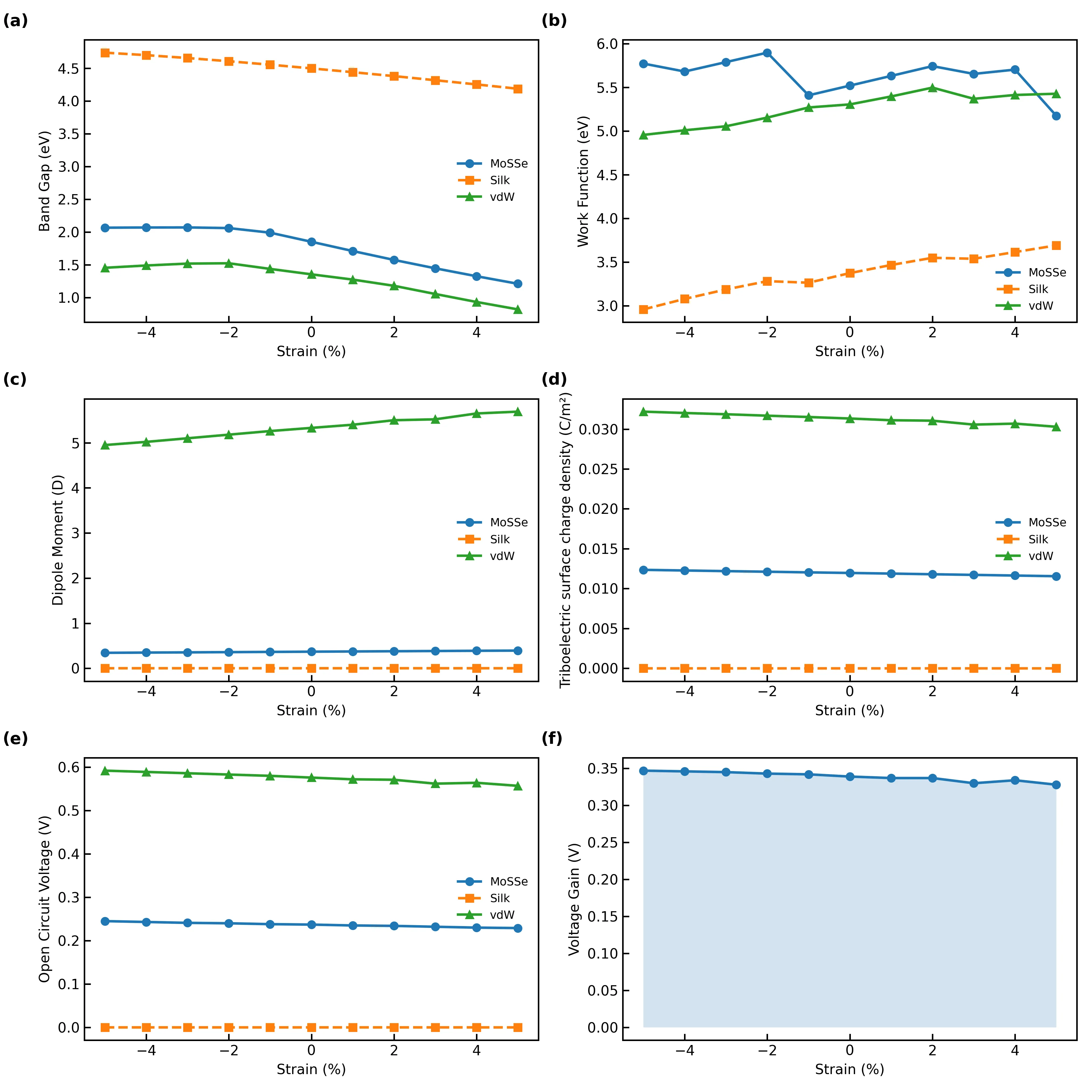
A group of researchers studied the layered material Janus MoSSe: its sheet is covered with sulfur on one side and selenium on the other, like a sandwich with different fillings. They added silk, a protein from silkworm cocoons. Calculations showed that when this composite is stretched, the band gap for electrons narrows more than in each material alone. This means electrons can jump between layers more easily.
As a result, the output voltage increases at all levels of deformation. A thin film of silk and MoSSe could serve as the basis for wearable sensors or for charging gadgets from body movement.
Original abstract
as written by the authors arXiv:2604.10581
Understanding and engineering interfacial electrostatics in hybrid two-dimensional (2D) and biomolecular material systems is essential for advancing high-performance triboelectric nanogenerators (TENGs). In this work, we systematically investigate the strain-dependent electronic structure and triboelectric response of Janus MoSSe, silk fibroin, and their van der Waals (vdW) heterostructure using first-principles calculations. Tensile strain induces a pronounced band-gap reduction in the MoSSe/silk interface, exceeding that of the isolated constituents and indicating enhanced interlayer electronic coupling. The vdW heterostructure exhibits a significant work-function shift and a substantially larger dipole moment compared to MoSSe and silk alone, revealing strong interfacial charge redistribution driven by Fermi-level alignment and asymmetric polarization. This enhanced polarization directly amplifies the triboelectric surface charge density, producing values more than double those of pristine MoSSe and several orders of magnitude higher than silk. Consequently, the open-circuit voltage and overall triboelectric output are markedly improved across all strain levels. These results demonstrate that synergistic interfacial polarization and strain engineering can effectively elevate charge separation, storage, and transfer efficiencies, establishing the MoSSe/silk vdW heterostructure as a promising material for next-generation high-efficiency TENGs.
Silk is a natural piezoelectric: when compressed or stretched, it generates a small voltage on its own, which is why it is added to smart clothing.