Scientist

Charles-Augustin de Coulomb

1736–1806 · Physics, Electrostatics, Mechanics, Engineering
French military engineer and physicist, best known for discovering Coulomb's law, which describes the force of electrostatic interaction between charged particles. His work laid the foundations of electrostatics and the theory of elasticity.

Biography

Charles-Augustin de Coulomb was born in Angoulême, France. He studied at the Paris School of Engineering in Mézières, after which he served as a military engineer in the West Indies. Returning to France, he held various engineering positions and worked on fortification construction. In 1781 he became a member of the French Academy of Sciences. During the Revolution, he retired to Blois, where he continued his scientific research. His main work—memoirs on electricity and magnetism—was published between 1785 and 1789. He also studied friction, the stiffness of threads, and the operation of windmills.

Key discoveries

💡 Coulomb built his famous torsion balance from improvised materials, including a silk thread, and used it to measure extremely small forces, which allowed him to discover the law of interaction of charges.
Concepts
electromagnetismgravity
Laws
Coulomb's law
Scientists
Robert HookeJacob BekensteinJames Clerk MaxwellKarl SchwarzschildJoseph WeberShuji NakamuraWilhelm WienAlbert A. Michelson

Related articles

Biological Physics2025-10-071 minarXiv:2510.05600express
How to Watch the Electron Dance in Living Cells
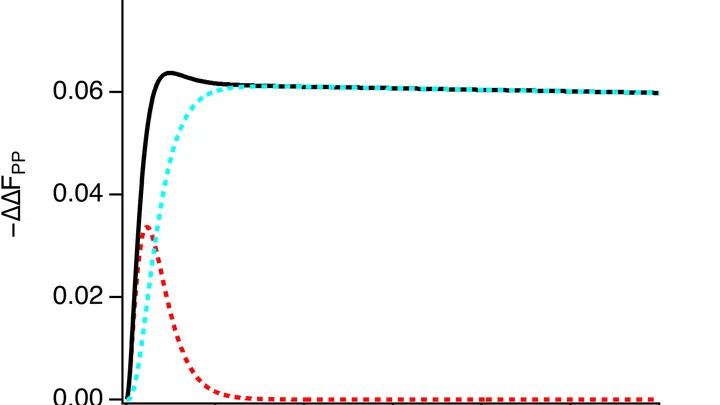
Inside every living cell, chemical transformations are constantly taking place. Some of them create unstable particles whose electrons behave like paired magnets. Their interaction resembles a dance: each movement of the pair responds to external magnetic fields, as if to a changing rhythm.
q-bio.BM2026-01-092 minarXiv:2601.14273express
Oxygen from Water: How Plants Build It Brick by Brick
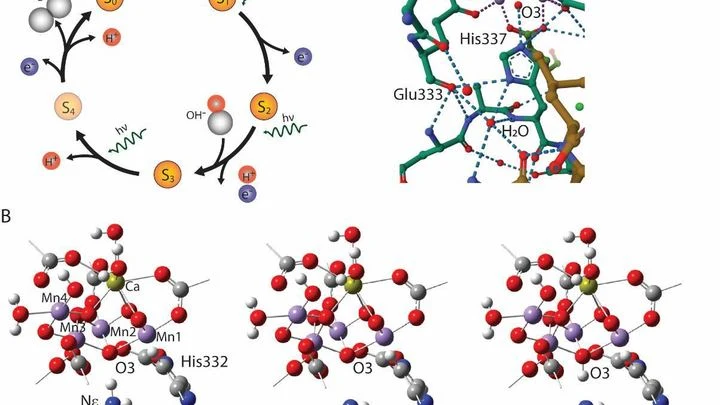
In every leaf, in the light, a factory works that splits water into oxygen and hydrogen. The oxygen goes into the air we breathe, and the plant uses the hydrogen for food. The heart of this factory is a protein complex with four manganese atoms and one calcium atom.
Electron in a Magnetic Field: Measuring Its Mass at Minus 273 Degrees
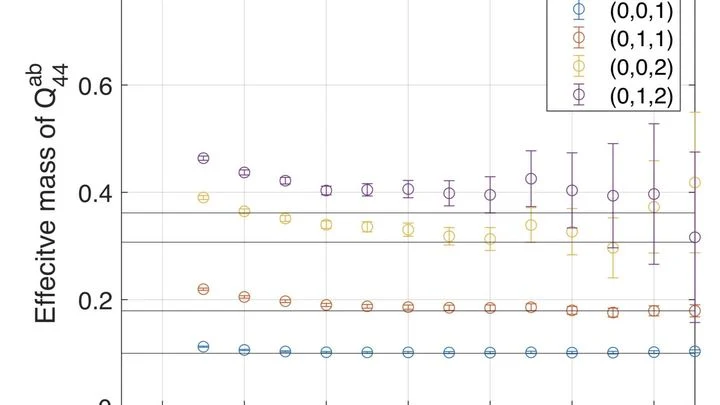
The electron is a tiny particle, but inside a crystal it behaves as if it had a different mass. Physicists call this the effective mass. To measure it, they make electrons run in circles in a magnetic field, like a speed skater on an ice rink who is kept from leaving the orbit.
Space Physics2026-01-211 minarXiv:2601.14719express
Lunar Oxygen: Breathing Without Earth
Lunar dust looks like gray sand, but there's not a breath of air in it. Oxygen is there — tightly bound in the rocks, like sugar in caramel. To get it out, you need to break chemical bonds, and scientists are looking for the simplest way. In the lab, they took artificial lunar soil made from samples from the Apollo missions and China's Chang'e.
Mesoscale2026-01-211 minarXiv:2601.15231express
Spin Waves Running Backward
An ordinary wave in a magnet is like ripples on water: the shorter the wavelength, the higher the energy. Physicists call such waves magnons. But in a thin film of bismuth yttrium iron garnet, they managed to create waves with the opposite behavior: their energy decreases as the wavelength gets shorter. These are antimagnons.
Optics2026-01-231 minarXiv:2601.16747express
Weak Light, Long Acceleration
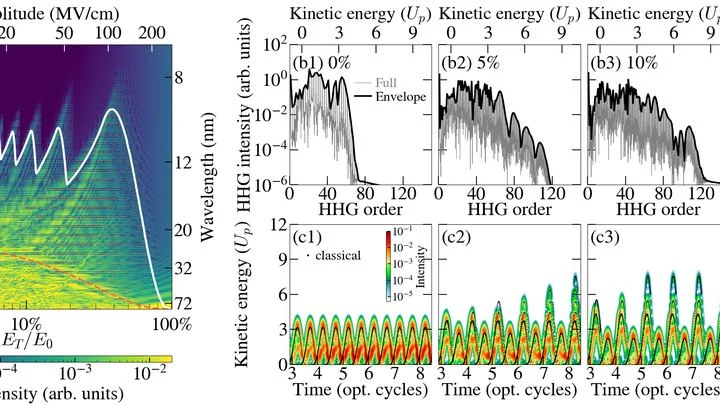
If you hit an atom with a strong laser, the electron flies out like a ball off a racket and then comes back. When it returns, it releases the accumulated energy as a flash of light. Usually, the energy of such a flash is limited: the electron only has time to accelerate a little. Now physicists have added a weak terahertz field to the laser, like a gentle tailwind.
Applied Physics2026-03-072 minarXiv:2603.07243express
How Touch Sparks Electricity
When two different materials are pressed together and then pulled apart, a spark jumps between them. Anyone who has pulled off a wool sweater in the dark or gotten a shock from a doorknob knows the feeling. For a long time, it was thought that charges simply hop from one surface to another due to differences in material properties.
Materials2026-03-291 minarXiv:2603.27731express
How a pinch and a magnet tame charge waves
A rug lies flat, but if you push it from the edge, wrinkles run across it. In a thin film of tantalum sulfide (1T-TaS2), wrinkles made of electrons, charge waves, freeze as if the rug were stuck to the floor. To move them, you need to apply force. Scientists have found a way to control this force using an electric field and a magnet.
HEP Lattice2026-04-141 minarXiv:2604.13269express
Kaon Under the Lens: How a Particle Responds to Light
If you place a kaon in an electric field, it stretches slightly, like a balloon rubbed on wool. This response, the electric polarizability, shows how rigidly the particle is built inside. For the charged kaon, it has been measured for the first time, and the number is about one ten-thousandth of the volume occupied by a proton.
Materials2026-04-181 minarXiv:2604.17071express
Chameleon Magnets: How Altermagnets Control Light and Current
Among magnets, there are quiet masters of disguise. An ordinary magnet attracts paperclips and has two poles — north and south. But there are materials that are internally arranged like a magnetic chessboard: their atoms are aligned in a strict order, yet externally the material behaves neutrally, as if no magnet exists at all. Such substances are called altermagnets.
Materials2026-04-192 minarXiv:2604.17386express
Magnets Without Metal: How Organics Learn from Bees
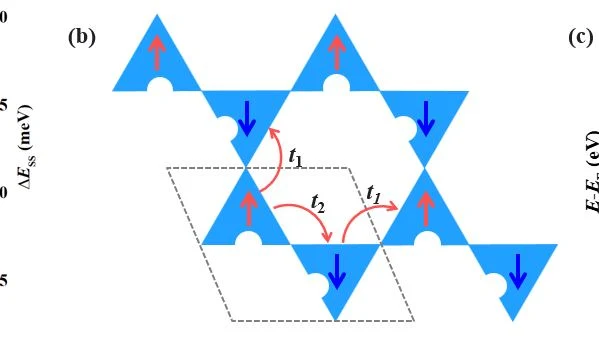
Honeycombs are built from identical cells, but tweak the shape of just one, and the whole structure gains new properties. Researchers did something similar to create a magnet without a single metal atom. They took flat carbon molecules shaped like triangles, triangulenes, and arranged them in a hexagonal lattice, just as bees build honeycombs.
Superconductivity2026-05-112 minarXiv:2605.10700express
How Deformation Turns an Ordinary Metal into a Magnet
The dance floor is full of couples waltzing. Usually, partners move in opposite directions: one steps forward, the other backward, to keep the overall rhythm.
Materials2026-05-232 minarXiv:2605.24320express
Magnetic Dualism in a Crystal
A translator works in two worlds at once: to an outside observer, they are silent and unobtrusive, but inside their mind, a flurry of activity unfolds along clear lines of meaning. Altermagnets, a recently discovered class of magnetic materials, are much the same.
Chemical Physics2026-06-112 minarXiv:2606.13660express
Light Twists Current to Extract Oxygen
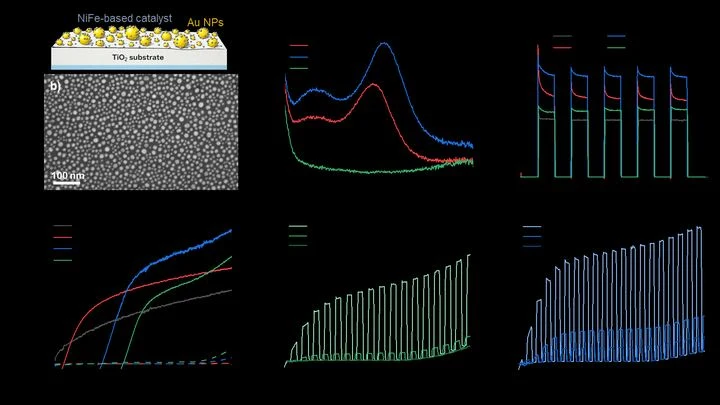
Water in a glass seems simple, but to split it into oxygen and hydrogen with sunlight, it's not enough to just transfer electrons: they also need to 'agree' on the direction of their spin. An oxygen molecule is born with two unpaired electrons spinning in the same direction.
Materials2026-06-263 minarXiv:2606.28458
Magnetic Ballet of Crystals: AI Eavesdrops on Exchange Bond Angles
Inside a crystal, an invisible ballet unfolds: the magnetic moments of atoms, like dancers, sometimes align in unison, sometimes scatter in antiphase. The choreography is dictated by quantum exchange — music sensitive to the geometry of bonds.
HEP Lattice2026-07-031 minarXiv:2607.03370express
Weighing the Void: A New Recipe for the Strength of Electricity
Electric charge is not like a number chiseled in stone. In the vacuum around any charged particle, pairs of particles and antiparticles are constantly born and annihilated, like the foam in a glass of champagne. The bubbles screen the true charge, making it appear smaller or larger depending on how close we get.
Medical Physics2026-07-202 minarXiv:2607.17974express
Oxygen Decides Whether Ultrafast Radiation Saves Tissues
A camera flash that fires in a thousandth of a second doesn't heat the subject — unlike a regular flash that lasts a full second. A similar trick has been found in radiotherapy: when a radiation dose is delivered in milliseconds instead of minutes, healthy tissues suffer less. This is called the FLASH effect.
Strongly Correlated2026-07-232 minarXiv:2607.21430express
How Switching Roles Gives Rise to a New Magnetic Order
In 2022, physicists described a new type of magnetism — alternagnetism. In it, electrons with different spin directions are split in energy depending on their direction of motion, like runners who speed up on one track and slow down on another. But spin is not the only degree of freedom particles have.
Optics2026-08-121 minarXiv:2608.12040express
How Electrons Jostle Each Other
Two electrons that leave a metal needle tip almost simultaneously start to repel each other, like two people trying to squeeze through a narrow door at the same time. The closer they are, the more they get in each other's way.