Silk and sulfur charge your phone express
Rubbing a comb against wool creates a spark. A similar principle works in triboelectric nanogenerators — devices that convert mechanical touches into electricity. The problem is that ordinary materials produce a weak charge.
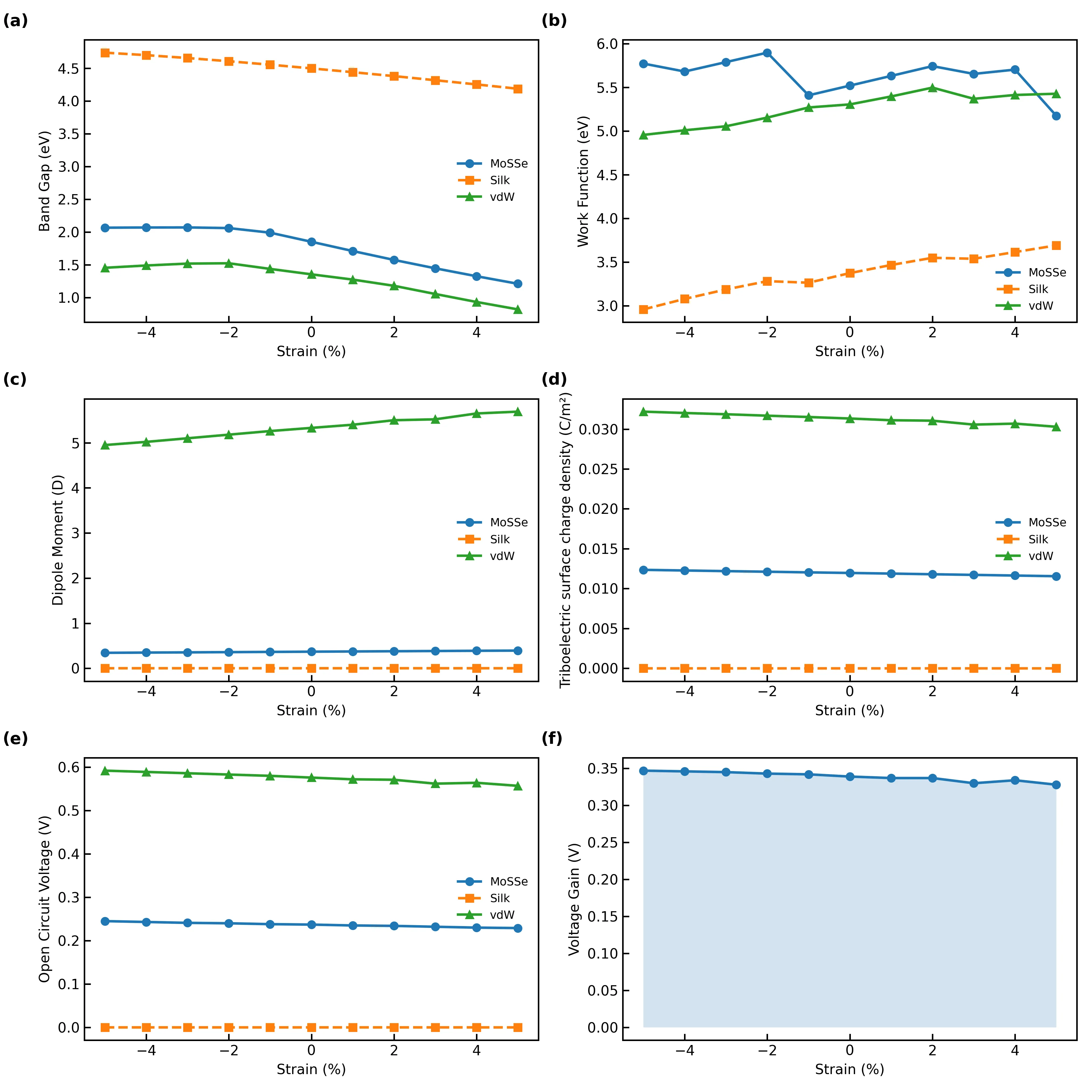
A group of researchers studied the layered material Janus MoSSe: its sheet is covered with sulfur on one side and selenium on the other, like a sandwich with different fillings. They added silk, a protein from silkworm cocoons. Calculations showed that when this composite is stretched, the band gap for electrons narrows more than in each material alone. This means electrons can jump between layers more easily.
As a result, the output voltage increases at all levels of deformation. A thin film of silk and MoSSe could serve as the basis for wearable sensors or for charging gadgets from body movement.
Silk is a natural piezoelectric: when compressed or stretched, it generates a small voltage on its own, which is why it is added to smart clothing.