Wearable sensors are compact electronic devices designed to be worn on the body, continuously monitoring physiological signals such as heart activity, muscle fatigue, or stress markers. Unlike clinical equipment that requires a controlled setting, these sensors operate in everyday environments, capturing data over long periods. This makes them invaluable for preventive healthcare, sports performance analysis, and early warning of medical conditions, as they reveal trends and anomalies that a single doctor's visit might miss.
History
The concept emerged in the 1960s with early heart-rate monitors, but modern wearable sensors gained traction in the 2000s with the advent of miniaturized electronics and wireless communication. The first widely adopted consumer device was the Fitbit in 2009, followed by smartwatches with heart-rate sensors.
How it works
Most wearable sensors rely on transducing a physiological signal into an electrical one. For heart activity, they use electrodes or optical sensors (photoplethysmography) that detect blood volume changes. The raw signal is then amplified, filtered, and processed by a tiny microprocessor, often using algorithms to extract features like heart rate variability or breathing rate. The result is transmitted wirelessly to a smartphone or cloud service for display and analysis.
In practice
Used in fitness trackers, smartwatches, and medical patches for continuous heart monitoring, stress detection, and early diagnosis of arrhythmias.
Fun fact
Some wearable sensors can detect stress by measuring changes in skin conductance, which reflects sweat gland activity controlled by the sympathetic nervous system.
Imagine a book with latches on its pages: you can only flip a page if you know how to click its edge. That is roughly how the mechanical metamaterial we are about to discuss works. Each cell is a small mass inside a larger one, connected by an elastic beam. The beam can sit in two stable positions, like a switch.
A superconducting detector usually works like an honest ruler: absorb a photon, get a pulse whose amplitude is strictly proportional to the energy. This mode is convenient, but it has a ceiling: a weak signal easily gets lost in the amplifier noise.
Now imagine a swing.
For three days straight, a laser blasted a jet of gas, and every second it produced a beam of electrons with the energy of a tiny lightning bolt. Previously, such beams could only be produced in huge halls where the accelerator takes up an entire building. Now the whole setup fits in a room and ran without a glitch for 72 hours.
In a quiet room of a Budapest laboratory, a bracelet lies on the table, and instead of a strap, it has a thin conductive thread stretched in a zigzag. It doesn't heat up or glow, but when pressed against the wrist, it starts to listen. Each heartbeat sends a pressure wave through the radial artery, and the thread, deforming, changes its electrical resistance.
A camera watches a person's face and hands, and from barely perceptible changes in skin temperature it understands: they are struggling right now. Body heat is like invisible ink that shows up under stress. Blood rushes to some areas and drains from others, creating a unique pattern for each person. The challenge is to find the spots and seconds in that thermal signature that betray anxiety.
A doctor places a stethoscope on the chest and listens: lub-dub, lub-dub. The rhythm is there, but how do you measure it when it's noisy around and the patient can't lie still? Conventional devices look for sharp peaks in the heartbeat recording, like catching hammer blows. But if the hammer hits a pillow instead of an anvil, the peaks blur and the device gets lost.
CORAL, the new method, works differently.
A night river is dotted with tiny sparks. This isn't plankton: it's functional pollen-sensors, millimeter-sized devices that swim on their own and measure the water's chemistry.
Each particle is a tiny lab. Inside, two reagents meet: one triggers a glow upon contact with a pollutant, and the second, a colored filter, blocks out interference.
A regular radar works like an amateur photographer: it takes a series of blurry snapshots and tries to stitch them into a panorama. Details are smeared, and in a long corridor or crowd, the robot easily gets lost.
The principle is simple: like a bat, the radar emits a wave and catches the echo.
The heart sometimes loses its rhythm, like an orchestra where the violins suddenly start playing each on their own. Cardiologists in such cases look for the "out-of-tune" areas by reading the heart's electrical signals and precisely ablating them with a thin probe — a catheter.
Diabetes is a constant reminder of needles. To check glycated hemoglobin (HbA1c — a blood protein that reflects average sugar over three months), you need regular blood draws from a vein. It's unpleasant, requires a lab, and takes time. And if you live far from a city, every test becomes a major expedition.
The new iGLU 5.0 device changes the game.
Your arm lifts a cup from the shelf — a familiar motion you don't notice until muscles tire. Then the trajectory changes: the elbow shifts slightly, the hand trembles. A doctor usually catches these changes by hand, feeling the patient's muscles.
An ordinary thread sewn into fabric can listen to the body. It feels the chest rising with each breath, a finger bending, and the pulse beating at the wrist. All this — without stiff patches or wires, just as part of your clothing.
The sensor is made from a flexible thread that changes resistance when stretched or pressed. It is woven into fabric in a triangular pattern, like a fine mesh.
Your finger is a living sensor: beneath the skin, arteries pulse in time with your heart. Traditional blood pressure cuffs squeeze your arm and give a single number, but this ring uses eight electrodes to pass a weak current through the tissue and map blood flow.
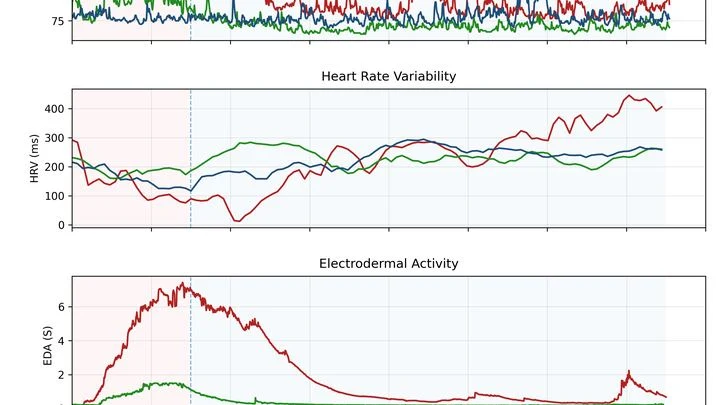
Six adults came to the lab on three consecutive days. On one day they simply rested, on another they pedaled a bike to exhaustion, and on the third they went through an ordeal that makes the heart race without a single movement: they had to give a speech and solve problems in front of a stern committee.
Smartwatches measure your pulse with light: an LED shines through the skin, and a sensor picks up the reflected signal. By analyzing the fluctuations in this signal, you can estimate blood pressure, but accurate calculation requires a powerful neural network — usually running in the cloud, so data leaves the device.
Each breath slightly speeds up the heart, and each exhale slows it down. This rhythm, visible on an ECG, is called respiratory sinus arrhythmia. For a long time, it was dismissed as a mere side effect of the nervous system. But new research shows that this coordination is not a coincidence: it's a way to save energy.
A stroke hits suddenly, but before the strike, the brain sends quiet signals. Blood vessels stop smoothly regulating blood flow, like a thermostat that starts overheating or overcooling a room without reason. This imbalance is invisible on ordinary wearables, but it can be caught by listening to several body rhythms at once.
The gut talks to the doctor, but very quietly. Gurgles and rumbles last fractions of a second and easily get lost among the sounds of the lungs and heart. A stethoscope catches only a fraction, so the diagnosis depends on the experience and hearing of the individual doctor.
An electrocardiogram is like a recording of an engine's hum: an experienced mechanic can hear when something's off. A heart ultrasound shows the engine itself from the inside, but the machine is pricey and specialists are scarce.
A fingernail-sized piece of ceramic is squeezed in a vise, and its internal structure rearranges like clay under your fingers. Inside, orderly rows of tiny domains line up where they were once randomly oriented. After this 'massage,' the crystal lets light through almost like glass and, at the same time, generates a strong electric charge when bent or pressed.
A conventional thermal camera is like a thermometer that slowly heats up and cools down. It shows where heat is well, but it can't keep up with fast motion. The new sensor works differently: it counts individual quanta of heat, like a droplet counter during rain.
A tiny defect in diamond is like a microscopic ear, able to pick up the magnetic 'breath' of the heart. Such sensors work at room temperature and are no bigger than a grain of sand.
In the air of factory floors and laboratories, invisible solvent molecules drift. One of them, acetonitrile, has a faint smell, but at high concentrations it can harm health. Typical sensors for it are bulky and expensive, but here we have a thin crystalline film that responds on its own to the presence of vapor.