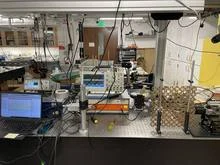
A layered material is a composite made of stacked thin layers, often with different properties, that together create unique physical behaviors. In the context of the axion detector mentioned in the titles, the layered material forms a resonator that amplifiessignals and allows tuning to specific frequencies. This makes it a key component in searching for dark matter candidates.
History
Layered materials have been studied since the 20th century, with artificial superlattices first proposed by Leo Esaki and Ray Tsu in 1970. The specific use in axion detection is a recent development from the 2020s.
How it works
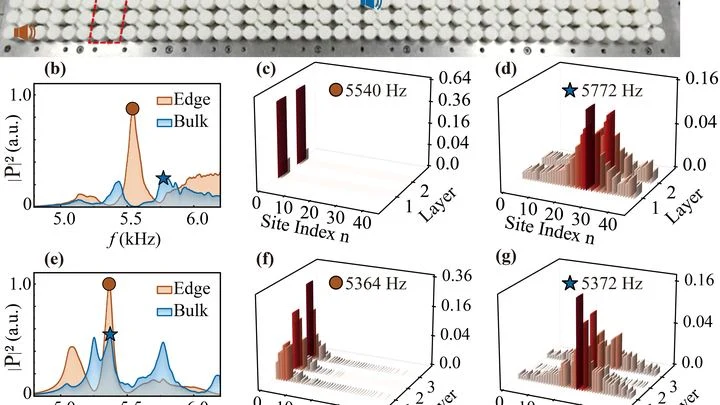
When layers are stacked, their interfaces can reflect or transmit waves in ways that single materials cannot. By carefully choosing layer thickness and material, the structure can be engineered to resonate at specific frequencies, trapping and amplifying signals. This is similar to how a stack of glass plates can create a mirror, but at the quantum scale it can interact with hypothetical particles like axions.
In practice
Layered materials are used in sensors, optical filters, and quantum detectors, including the proposed axion haloscope that searches for dark matter.
Fun fact
Some layered materials, like graphene, are just one atom thick, yet they are stronger than steel by weight.
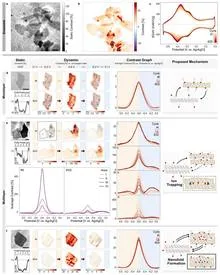
A stack of pages that has been flipped through many times remembers it: some sheets lie flat, others stick up, and creases remain here and there. Layered materials behave much the same way when ions enter them.
Three voices merging into a single chord. In the physics of quantum materials, this image takes on a literal meaning: three layers of graphene, separated by thin spacers, force electrons and holes from different layers to move as a single fluid.
Wireless devices flood the airwaves with signals that blend into chaos — as if everyone in a room started talking at once. Scientists have proposed a solution: smart panels, reminiscent of acoustic tiles. Each cell can either reflect a radio wave on command, like a wall echo, or absorb it, as soundproofing dampens noise.
Gravitational waves from merging black holes sound like bass chords, pulsars tap out a rhythm, and the cosmic microwave background carries echoes of the Big Bang. But there is a silent player — dark matter, whose presence is betrayed only by gravitational effects.
In the pitch darkness of a vacuum chamber, a tiny magnet floats. It touches no walls and loses almost no energy — an ideal sentinel, ready to catch the faintest nudge. Such a sentinel is exactly what you need for axion hunting. These particles are prime suspects in the case of the Universe's hidden mass, which we call dark matter.
An ocean permeates all of space, yet remains invisible to us. This ocean is dark matter, and the waves on its surface are particles called axions. They are so light and elusive that they pass through Earth without noticing it. But if these waves crash against a shore made of a special material, they might leave a trace — a tiny electric current.
In the first moments after the Big Bang, the universe was a boiling cauldron. But then, according to a new hypothesis, it suddenly cooled dramatically — far more than previously thought. In this icy world, dark matter particles, like tiny pendulums, froze and did not begin their oscillations.
Dark matter is invisible, but its gravity governs the motion of galaxies. What it's made of is a mystery. One idea: it consists of ultra-light particles akin to axions.
A stack of magnetic plates, each magnetized opposite to its neighbor, is like a layered sandwich where electrons move as a single organism. The whole material starts mimicking an axion — a ghost particle that physicists suspect might be dark matter.
Imagine a tiny coin hidden inside a perfect safe, but the walls are so thin that the coin sometimes slips right through, leaving a barely audible sound. Axions are like those coins — except instead of metal, they're particles, and instead of a safe, they're ordinary matter. They barely notice obstacles, making them incredibly hard to catch directly.
A gas bubble in water sings loudly — this is Minnaert resonance: the heavy liquid prevents the bubble from compressing quickly, forcing it to vibrate. In air, there's no such effect: air is too light. But if you dress the bubble in a soft silicone shell, like rubber, it plays the role of the water mass. You get an 'elasto-bubble'.
A qubit, the computational unit of a quantum computer, lives for fractions of a millisecond before forgetting its state. One culprit is a tiny contact inside it: two layers of aluminum sandwiching a layer of aluminum oxide just a couple of nanometers thick.
A stack of identical pancakes on a plate is just a stack. But if you arrange them with a certain order, something new suddenly appears: for example, a pattern that was not visible in each pancake individually. Physicists have performed a similar trick with thin layers of materials.
In its infancy, the universe was a hot, plasma-like mixture of particles. Microseconds after the Big Bang, as it cooled, the temperature fluctuated slightly.
A tiny lithium niobate comb vibrates at a frequency of 300 million times per second. Each tooth is carved from a crystal plate as thin as a human hair, with metal electrodes deposited on its sidewalls. The sound wave bounces inside the tooth like an echo in a narrow stone canyon, unable to escape.
In the air of factory floors and laboratories, invisible solvent molecules drift. One of them, acetonitrile, has a faint smell, but at high concentrations it can harm health. Typical sensors for it are bulky and expensive, but here we have a thin crystalline film that responds on its own to the presence of vapor.
A conductor leads an orchestra of billions of musicians while still hearing each one individually. That's roughly the challenge physicists face when trying to make light and electron spins in solids work together.
Deep inside an underground laboratory, a room-sized detector waits for an event that might happen once in a hundred million billion years. That event is neutrinoless double beta decay — a process that would break one of physics' fundamental laws. To catch it, you need perfect silence: not a single stray radioactive atom in the detector's materials.
Dark matter is five times more massive than ordinary matter, yet it emits no light. Its nature remains unknown. One candidate is the ultra-light axion particle. Axions could pierce right through the planet, barely noticing atoms.
Deep inside a cryostat, beneath layers of superconducting coils, lies a stack of hundreds of semiconductor layers. Each layer is just a few nanometers thick: gallium arsenide, then aluminum gallium arsenide. The electrons within these layers are confined to a plane, like ants on a sheet of paper.
A steel plate with an 8×8 grid of cells dampens elastic waves in two frequency corridors at once. This is not a lucky accident but the outcome of a calculation using a new scheme: first a coarse template for the low frequency, then fine-tuning within free pixels for the high frequency.