Molybdenum disulfide (MoS₂) is a layered compound belonging to the family of transition-metal dichalcogenides. It consists of sheets of molybdenum atoms sandwiched between two layers of sulfur atoms, held together by weak van der Waals forces. This structure gives it remarkable lubricating properties: when sliding against graphite or other materials, it exhibits extremely low friction, often approaching superlubricity—a state where friction nearly vanishes. Beyond lubrication, MoS₂ is a semiconductor with a band gap that becomes direct when thinned to a single layer, making it a star material in nanoelectronics and optoelectronics.
History
Molybdenum disulfide has been used as a lubricant since the 1960s, but its potential in electronics was recognized only in the 2010s, when researchers discovered that a single layer of MoS₂ emits light efficiently, sparking intense research into two-dimensional semiconductors.
How it works
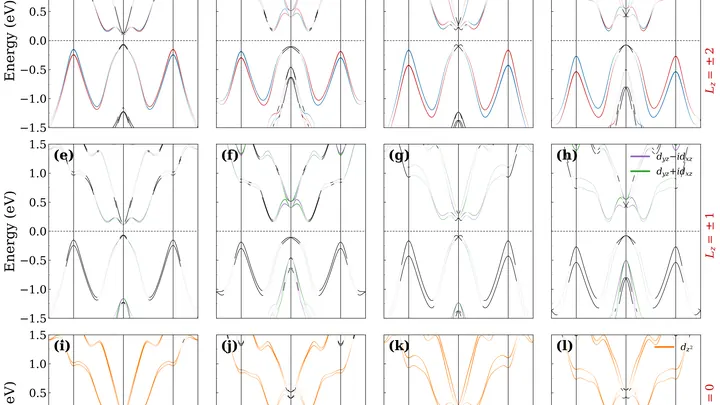
The low friction arises because the layers are held together by weak forces, so they can slide easily over each other. When MoS₂ slides against graphite, the two materials' atomic lattices can align in a way that creates a nearly flat potential energy landscape—the atoms 'ride' over each other without locking into place, a phenomenon called structural superlubricity. This occurs when the contact is incommensurate (the lattice periods don't match), so the net lateral force averages to zero. In electronics, its semiconducting properties emerge from the d-orbitals of molybdenum, which give it a band gap that can be tuned by layer thickness.
In practice
MoS₂ is used as a dry lubricant in aerospace and automotive applications, and as a channel material in flexible transistors, photodetectors, and gas sensors.
Fun fact
When MoS₂ is exfoliated to a single layer, it becomes a direct-band-gap semiconductor, emitting light much more efficiently than its bulk form, which is an indirect-gap material.
A laser pulse hits a thin film of MoS₂, and inside it a cloud of electrons with excess energy starts to boil. These hot carriers are like runners who took off at high speed but, on the way to the finish line, are bound to lose all their momentum through collisions with the crystal lattice.
On the lab bench lies a piece of graphite grown from gas, like a deposit on the wall of a reactor. Usually, such material is not suitable for converting heat into electricity: inside it, electrons and holes run in opposite directions and cancel each other out.
A transparent film of bismuth tungstate sits on a substrate and does not conduct electricity. Three minutes in a cloud of nitrogen plasma, and it turns black, with resistance dropping by a factor of a billion.
A ship in a bottle is assembled from the inside, not the outside: masts and sails are pulled through the narrow neck, and once inside the glass they settle into the right pose on their own. Chemists have done something similar with a single cobaltocene molecule, which they pulled into the gap between layers of a two-dimensional crystal.
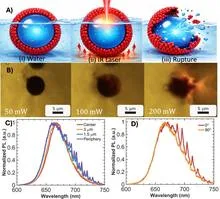
A tiny capsule, like a soap bubble but with a shell of glowing crystals, behaves like a laser. While its wall is intact, light circulates, amplifies, and escapes as a narrow, bright beam. Once the wall bursts, the beam turns into a dim spot. Such a capsule is a colloidosome, and it can change its glow on command.
A superconducting quantum interferometer is a device that senses magnetic fields billions of times weaker than the needle of an ordinary compass. Inside it, there is a narrow bridge where superconductivity briefly breaks.
A light beam usually travels in a straight line, but you can make it spin around its axis, like water swirling into a vortex as it drains. This 'twisted' light carries more information and is needed for ultra-fast communication and quantum computing.
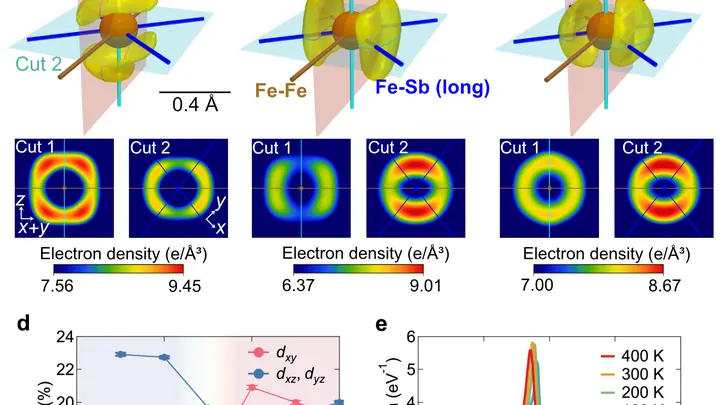
A house with cork walls suddenly gets covered in copper sheets, but only when frost sets in. That's roughly how FeSb₂ behaves when made into a film just a few atomic layers thick. Under normal conditions, it's a narrow-gap insulator: electrons sit tightly in place like spectators in an overcrowded hall.
A weak laser beam falls onto a tiny structure — a hybrid cavity made of metal and glass. Inside is trapped a single light-emitting molecule. Normally, such light only slightly changes color as it scatters off thermal vibrations of atoms.
In a two-dimensional crystal of tungsten diselenide (WSe₂), light creates pairs — an electron and a hole that stick together. Such pairs are called excitons. Among them are "dark" ones: they barely emit, but they set the tone at low temperatures.
The uranium-arsenic crystal UAs2 under pressure behaves like a house with two rooms. In one room, electrons sit still; in the other, they roam freely. Under normal conditions, it's a classic "lattice Kondo" system: heavy, almost immobile electrons on 5f5/2 orbitals are surrounded by a sea of fast conduction electrons.
Usually, light does not turn an insulator into a conductor: that requires powerful laser pulses that break the material's structure. But in twisted bilayer graphene at the magic angle, things are different.
Catching a single molecule in a beam of light and nearly stopping its motion is like trying to hold a dandelion fluff in a gust of wind. A particle that's too hot slips out of the trap, so physicists first tame its thermal jitters with laser cooling.
The authors applied a technique called Sisyphus cooling to strontium hydroxide (SrOH) molecules.
Two sheets of tungsten diselenide (not carbon, but a compound of tungsten and selenium) are rotated relative to each other by a tiny angle, about 5 degrees. This creates a moiré pattern: an enlarged periodic lattice where electrons behave very differently than in a regular crystal.
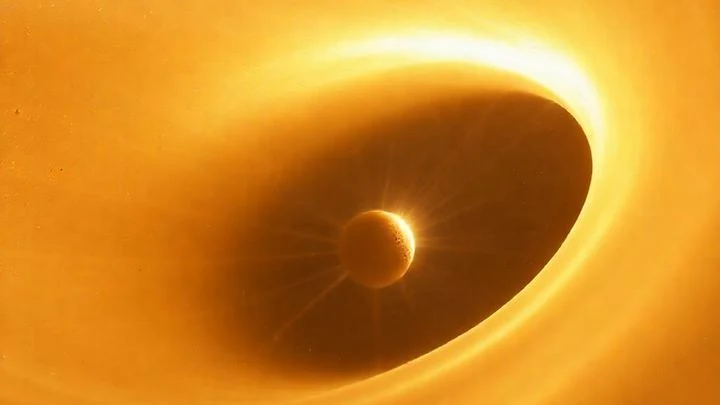
The boundary of a black hole is like the edge of a waterfall: cross it, and there's no way back. But unlike a waterfall, this boundary can be very fragile: a light nudge is enough to make it vanish.
Physicists have found that the horizon's stability is set by an imaginary 'light flow' coming from the past. Invisible streams pierce spacetime.
Graphene, a two-dimensional carbon crystal, has long tantalized physicists with the hope of high-temperature superconductivity. Its electrons obey the relativistic equation of Paul Dirac, racing at tremendous speed, barely noticing each other.
Imagine a multilayered shell where metal and insulator layers alternate like pages in a book. Such a structure can make an object hidden inside invisible to an observer. Light bends around it as water smoothly flows around a smooth stone: no ripple, no splash — no reflection, no shadow.
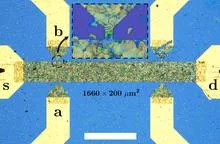
A thin film of molybdenum disulfide, less than a micron thick, acts as a miniature photon-pair factory built right into a fiber-optic connector.
Ordinary optical fiber is not just a glass thread for the internet.
A switch that knows which way to let current flow. That's how a Josephson diode works — a superconducting bridge where current goes willingly in one direction but meets resistance in the other. In the new study, such a bridge was made from graphene — a sheet of carbon just one atom thick.
Electrons in a crystal are like cars on city streets: some race down avenues, others get stuck in traffic jams. In certain lattices, motion freezes entirely — velocity stops depending on energy, and electrons become "flat." This isn't a traffic jam but a special rhythm of the network where waves cancel each other out.
Deep beneath our feet, in the scorching mantle, iron leads a double life. It can be divalent or trivalent, like a coin that lands heads or tails. Which side dominates determines how much oxygen stays in the planet's rocky shell and how much sinks into the core.
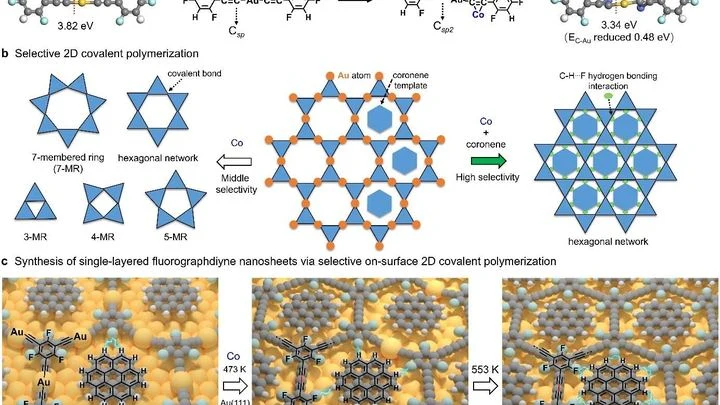
Crocheting, but instead of yarn you have individual molecules, and instead of a hook, a gold surface. Until now, attempts to knit such molecules into a smooth fabric ended in a tangle: the threads hooked where they shouldn't, and the pattern went awry.
A team of scientists has found a way to fix this.
Two ultra-thin sheets, each just one atom thick, are placed on top of each other and slightly rotated. Like two sheets of colored tracing paper: while they lie flat, the picture is one thing, but give them a twist and a moiré pattern appears. Here, though, the pattern isn't visible to the eye, but it completely changes how the material handles light.
Two ultrathin sheets, resembling mica, lie on top of each other. One shifts by a fraction of a nanometer, and a modest semiconductor turns into a magnet. That's roughly how the materials studied by the authors work: layered compounds of niobium and tantalum with sulfur or selenium.
Two paper-thin sheets of a semiconductor are stacked and slightly rotated — by about three to four degrees. The atomic lattices don't match, creating a large-scale pattern — a moiré, like the ripples from two washboards shifted by a small angle. In this pattern, electrons move quite differently than in a regular crystal.
A layered cake of atomic planes of nickel and oxygen: that's how bilayer nickelates are built. Two such planes are separated by a spacer layer. If an oxygen atom sits in that spacer, it acts as a bridge: it links the layers and triggers a state in which electrons move without resistance.
Inside a superconductor, a magnetic field typically twists into tubes, vortices, each carrying one quantum of magnetic flux. That's how the classic Abrikosov lattice works. But in LiFeAs crystals, the picture is different.
Muon spectroscopy showed that the field penetrates not as individual vortices but as stripes. Each stripe contains pairs of 'coreless' vortices.
A graphene sheet is a one-atom-thick grid of carbon atoms. Stacking several such sheets with a specific twist yields a material with unusual properties: it can be a magnet or a superconductor depending on how you poke it. The trouble is that in natural graphite, such 'properly twisted' layers are rare, and growing them artificially is tricky.
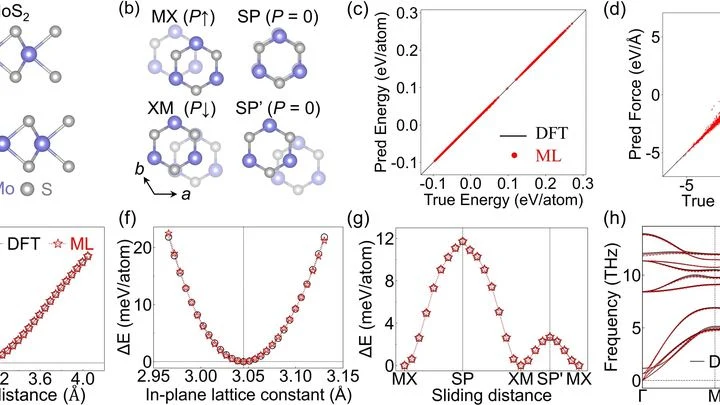
Two sheets of paper stacked together start to creep ever so slightly over each other when heated. That's roughly how layers of molybdenum disulfide, a material one atom thick, behave. At room temperature, they spontaneously slide at a speed of about one meter per second.
A single-atom-thick sheet of tungsten telluride is like thin foil: electrons can't pass through because there's a band gap between their possible states, like a moat you can't jump across. Add two more layers, and the moat disappears; the material becomes a metal, and current flows. Add more layers, and the properties change again, as if someone is flipping modes with a single button.
The glow of an ultrathin sandwich made of two semiconductor layers, molybdenum selenide and tungsten selenide, resembles a tangled musical score: many narrow colored lines that merge into a general background. Figuring out which line comes from where is nearly impossible.
The authors did not try to disentangle the lines one by one.
A sheet of paper weighs almost nothing, but stack a hundred sheets and you get a noticeable pile. That's roughly what scientists did with a material that excels at converting one color of light into another, but only when it's just one atom thick. A single layer is like a single sheet: it works beautifully, but it's too thin to produce much light.
A superconductor is a material that, when strongly cooled, loses its electrical resistance: current flows through it without losses. Scientists took a layered crystal of PdTe2, similar to a stack of sheets of paper, and cooled it to temperatures below 1.8 kelvin (that's about -271°C).
Rubbing a comb against wool creates a spark. A similar principle works in triboelectric nanogenerators — devices that convert mechanical touches into electricity. The problem is that ordinary materials produce a weak charge.
An ordinary transistor in a phone is made in a vacuum chamber, where atoms are deposited layer by layer. Expensive and slow. But indium oxide can be printed like ink — from a drop of liquid metal that, in air, coats itself with a thin oxide film.
The authors took indium, melted it, and rolled it over a substrate at 250 degrees.
A thin film of soap on your hand conforms to the shape of your palm, but clench your fingers and the tension changes unevenly. A monolayer of molybdenum disulfide on a graphite substrate behaves in a similar way.
A sheet of graphene, a carbon lattice just one atom thick, under a powerful laser beam behaves like a road where a toll barrier suddenly appears. Electrons that were freely racing through the material suddenly hit a forbidden zone: an energy gap they cannot leap across. This was predicted theoretically before, but no one had ever seen it directly.
Two sheets of graphene — carbon film one atom thick — without a twist resemble a harbor clogged with shoals: lithium ions either run aground or rush past without stopping. But a 9.43° twist lays out a perfect fairway. The ion ships dock securely to carbon 'piers' and immediately cast off without losing speed.
A superconductor is a material that conducts electricity without loss, but only at very low temperatures. On such a material, researchers placed a film of magnetic material one atom thick.
A sheet of graphene one atom thick is like a flexible metal mesh through which electrons zip almost unimpeded. Stack two such sheets with a slight twist, and the material's properties change dramatically: it can become an insulator that blocks current.