Scientist

Arnold Sommerfeld

1868–1951 · Quantum mechanics, Atomic physics, Solid state physics
German theoretical physicist, teacher and mentor of a whole generation of creators of quantum mechanics. Introduced fine structure and the principal quantum number into the Bohr atom model, developed the theory of metals and relativistic quantum effects. The fine-structure constant—a dimensionless constant that determines the strength of electromagnetic interaction—is named after him.

Biography

Studied at the University of Königsberg, worked at the universities of Göttingen, Munich, and others. His students included Heisenberg, Pauli, Debye, Bethe. Never received the Nobel Prize, although he was nominated more than 80 times. Author of the epochal course 'Lectures on Theoretical Physics'.

Key discoveries

💡 Sommerfeld is often called the 'eternal runner-up'—he mentored a record number of Nobel laureates but did not receive the prize himself. He was also a talented pianist and music lover.
"He described quantum theory as philosophy expressed in the language of mathematics."
Concepts
electromagnetismhydrogenspeed of lightwave-particle duality
Laws
Balmer formula
Scientists
Henri PoincaréRobert HookeJohann Jakob BalmerJames Clerk MaxwellErwin SchrödingerCecilia Payne-GaposchkinLouis de BroglieHendrik Lorentz

Related articles

Materials2026-01-211 minarXiv:2601.14756express
A Lone Rhodium Atom Snaps Up Hydrogen Like a Trap
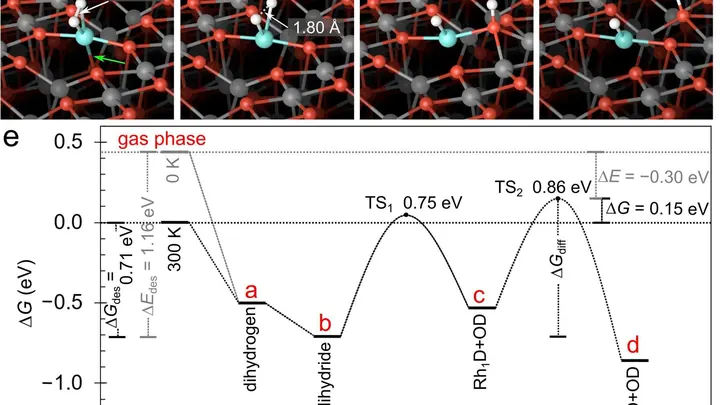
Chemistry has two worlds: in one, the catalyst is a solid particle and the reaction happens on its surface; in the other, it's a dissolved molecule where everything occurs around a single metal center. These worlds rarely meet. But in a new study, they collide. The researchers took iron oxide, a black powder used in magnetic tapes, and scattered single rhodium atoms across its surface.
Geophysics2026-02-031 minarXiv:2602.03509express
Hydrogen Inside Earth: How It Is Distributed
Deep beneath our feet, at the very center of Earth, lies a solid iron core. But it's not pure iron — there are lighter elements too, such as hydrogen. Exactly how hydrogen is distributed within the core has long been a mystery.
Light Faster Than Thought: Catching Particles in 33 Picoseconds
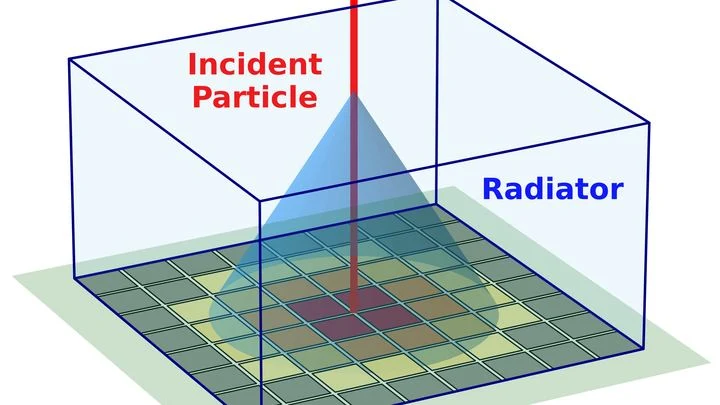
When a particle zips through a transparent material faster than light can travel through it, it leaves behind a faint blue flash, just as a jet breaking the sound barrier creates a shock wave. This Cherenkov radiation fires instantly, with no delay, making it perfect for ultra-precise timing in the world of elementary particles.
Materials2026-02-261 minarXiv:2602.22869express
Gray film, green hydrogen
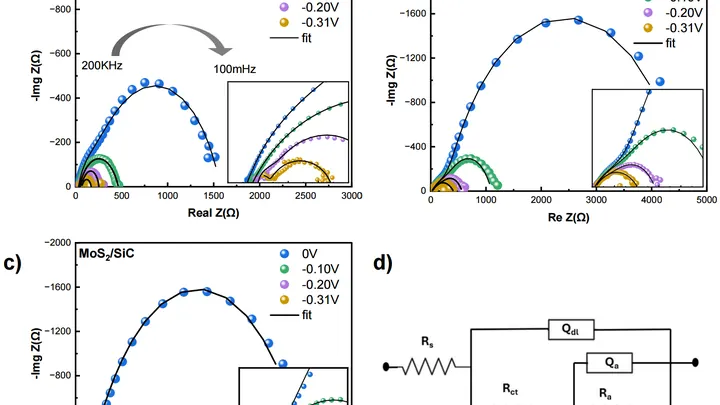
Hydrogen is a clean fuel: when it burns, it produces only water. But to extract it from water, you need to break the strong bond between hydrogen and oxygen. This is usually done with platinum, an expensive metal.
Materials2026-03-142 minarXiv:2603.14139express
Hydrogen Under Control: A Database for New Materials
Hydrogen is a champion in energy per kilogram, but storing it is a hassle. As a gas, it takes up a huge volume, and if you compress it or cool it to a liquid, you need heavy tanks and lots of energy. There's a third way: some solid materials absorb hydrogen like a sponge soaks up water and hold it within. Heat it up, hydrogen comes out; cool it down, it gets absorbed back.
Exoplanets2026-03-191 minarXiv:2603.18769express
Acid for Life: Why Cyanide Is No Obstacle
At the dawn of Earth, about four billion years ago, the planet was a harsh place: a dim sun, frequent asteroid impacts, and air without oxygen. Under such conditions, the first steps of life seem almost impossible.
Chemical Physics2026-03-262 minarXiv:2603.24924express
Hydrogen from Algae: A Green Light for Clean Energy
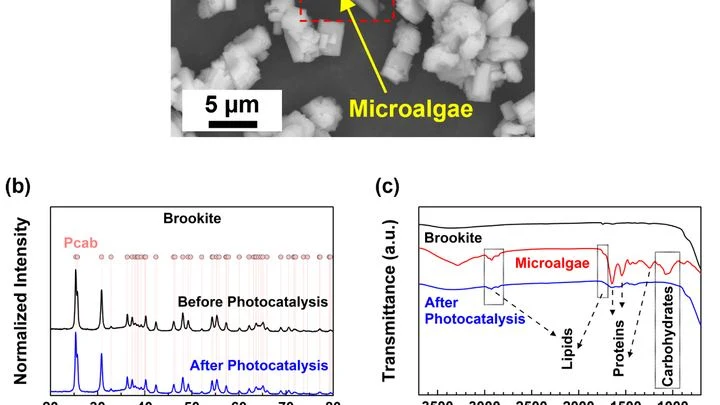
Conventional solar panels convert light into electricity, but here light splits water into hydrogen and oxygen. Hydrogen is a clean fuel, but the process is slow. To speed it up, helper substances that donate electrons are added. Often this is alcohol, but it's a shame to waste it.
Materials2026-03-301 minarXiv:2603.27989express
Sunlight Cleans Water and Produces Fuel
Dirty water laced with antibiotics isn't just waste: it's a hidden energy source. Chemists built a material from two components: titanium oxide nanorods (the white pigment in paints and sunscreens) and carbon nitride nanosheets.
Atomic Physics2026-04-292 minarXiv:2604.26401express
Proton measured with watchmaker precision
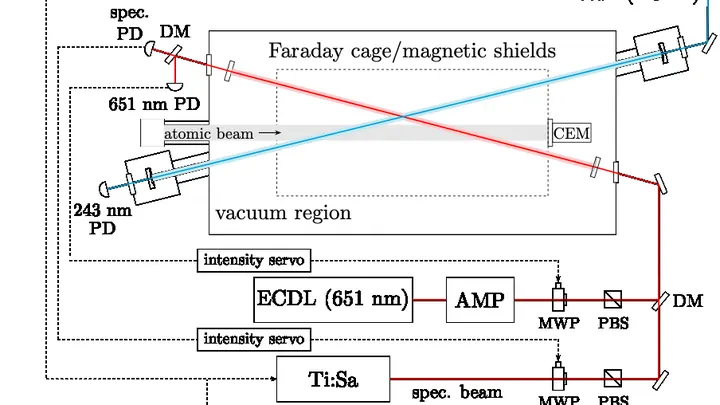
Hydrogen is the simplest atom: one proton and one electron. You'd think there's nothing left to study. But it's precisely on hydrogen that physicists test the most delicate laws of the microcosm. The electron in an atom can occupy different energy levels, like steps on a ladder.
Exoplanets2026-07-212 minarXiv:2607.19579express
Heavy Water on a Hot Jupiter: WASP-39 b Surprises Astronomers
Water comes in different varieties. Not just fresh or salty, but also "heavy"—when one of its hydrogen atoms is replaced by deuterium, its heavier cousin. Such water is called HDO, and it's a true cosmic passport: the amount of deuterium in water reveals where and when that water was born.