Stress Under the Skin: How the Body Betrays Anxiety express
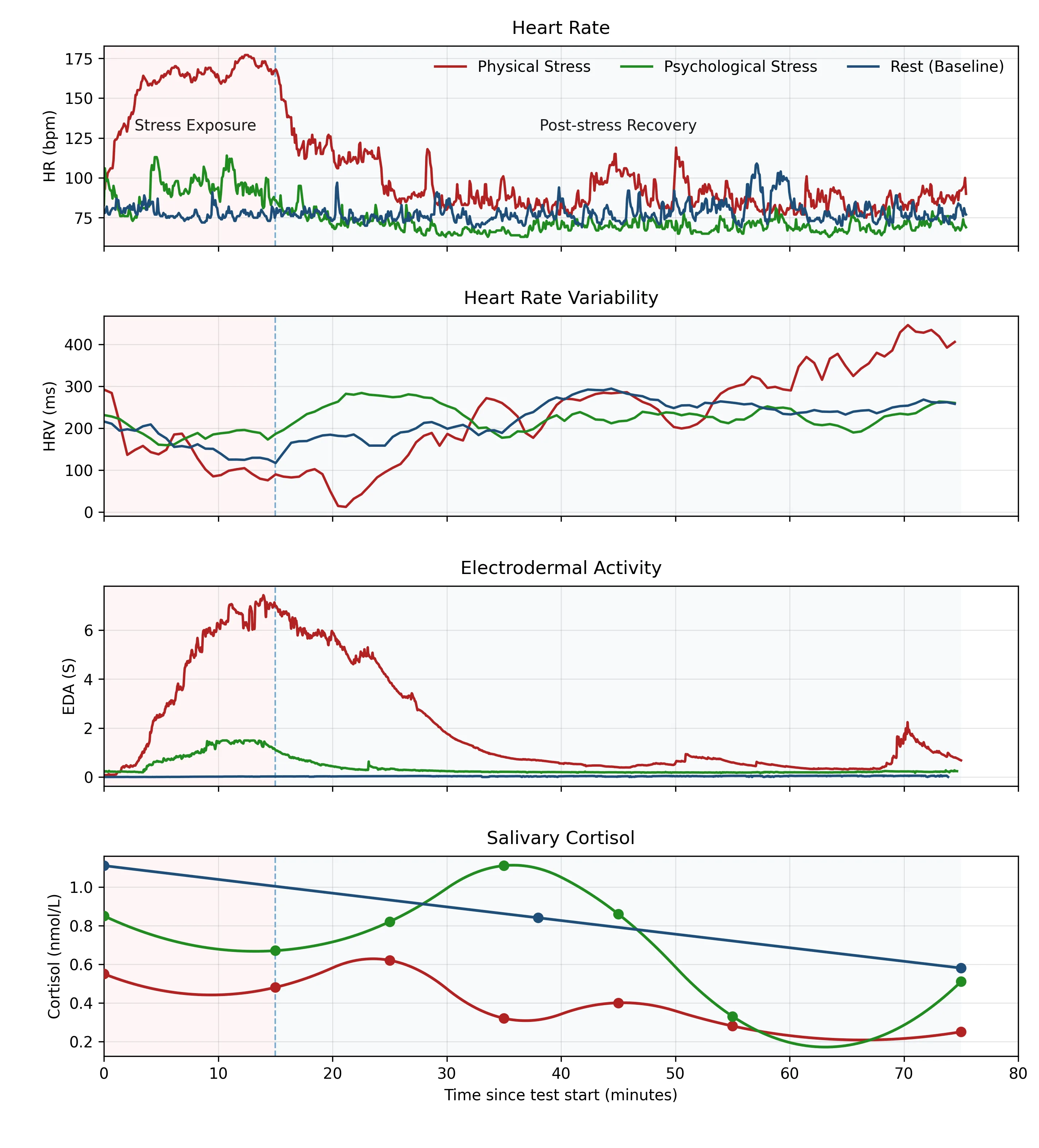
Six adults came to the lab on three consecutive days. On one day they simply rested, on another they pedaled a bike to exhaustion, and on the third they went through an ordeal that makes the heart race without a single movement: they had to give a speech and solve problems in front of a stern committee. Each wore a wristband that recorded heart rate, its variability (the spread of intervals between beats), skin electrical activity, and movement. Saliva was collected five times per session to measure cortisol — the hormone released into the blood during stress.
The recordings were sliced into ten-minute chunks and labeled: rest, physical stress, recovery from physical stress, psychological stress, recovery from psychological stress. Then a computer program was trained to guess the person's state using only the wristband data. On average, it got it right 78% of the time. It recognized physical exertion and recovery well, but it confused psychological stress and its recovery with rest: out of ten such states, it correctly identified only five or six.
When five numbers describing cortisol levels in saliva over the same time window were added to the wristband data, accuracy jumped to 94%. Recognition of psychological stress improved especially: the program correctly identified it in 83% of cases, and recovery from it in 88%. Cortisol helped separate states that previously blurred together: psychological stress no longer hid behind rest.
So wrist sensors alone are not enough to tell anxiety from calm. But add saliva analysis, even occasionally, and the picture becomes clear. This paves the way for more honest stress monitoring systems that won't mistake pre-exam jitters for lounging on the couch.
Original abstract
as written by the authors arXiv:2604.12671
Objective: This study aimed to assess how wearable physiological signals, alone and combined with salivary cortisol, distinguish physical and psychological stress and their recovery states. Methods: Six healthy adults completed three laboratory sessions on separate days: rest, physical stress (high-intensity cycling), or psychological stress (modified Trier Social Stress Test). Heart rate, heart rate variability, electrodermal activity, and wrist accelerometry were recorded continuously, and salivary cortisol was sampled at five time points. Features were extracted in non-overlapping 10-minute windows and labelled as rest, physical stress, physical recovery, psychological stress, or psychological recovery. A gradient boosting classifier was trained using wearable features alone and with five additional cortisol features per window. Performance was evaluated using leave-one-participant-out cross-validation. Results: Wearable-only classification achieved 77.8% overall accuracy, with high accuracy for physical stress and recovery but frequent misclassification of psychological stress and recovery (recall 50.0% and 54.2%). Including cortisol improved overall accuracy (94.4%), particularly for psychological states, increasing recall to 83.3% and 87.5%. Cortisol also reduced misclassification between psychological stress and rest. Conclusion: Wearable signals alone were insufficient to reliably distinguish psychological stress from rest and recovery. Integrating salivary cortisol improved classification of psychological stress and recovery and reduced confusion with rest, highlighting the value of endocrine context alongside wearable physiology. Significance: These findings support multimodal stress monitoring and motivate larger, ecologically valid studies and scalable alternatives to repeated cortisol sampling.
Saliva isn't just fluid in your mouth. It offers a window into your adrenal glands: cortisol enters saliva from blood in just a couple of minutes, so a saliva test is almost as accurate as a blood test, but without the needle.