Accuracy is the degree to which a measurement or calculation matches the true or intended value. It is distinct from precision, which describes how reproducible a measurement is. A measurement can be precise but inaccurate if a systematic error shifts all results away from the truth. In physics, accuracy is essential for validating theories and for engineering applications where exactness matters.
History
The concept of accuracy has been implicit in measurement since antiquity, but it was formalized in the 19th century with the development of error analysis by mathematicians like Carl Friedrich Gauss. The distinction between accuracy and precision became standard in the 20th century with the rise of experimental physics.
How it works
Accuracy is assessed by comparing a measured value to a known standard or reference. For example, a ruler might be accurate to within 0.5 millimeters, meaning any measurement could deviate from the true length by at most that amount. Systematic errors — such as a miscalibrated instrument or a biased experimental setup — reduce accuracy, while random errors affect precision. Improving accuracy often involves calibration against standards, correcting for known biases, and using more refined measurement techniques.
In practice
Accuracy is critical in GPS navigation, where meter-level errors can cause significant positional mistakes, and in metrology, where national standards laboratories maintain ultra-accurate references for units like the meter and the second.
Fun fact
The most accurate measurement ever made is the speed of light in a vacuum, which is defined as exactly 299,792,458 meters per second — so accurate that it now defines the meter itself.
When chemists calculate the behavior of molecules on a computer, they use approximate methods because exact calculations are too complex. For light atoms, there are well-established benchmarks, but for heavy atoms, where relativistic effects matter, such benchmarks did not exist. It's like checking a ruler against another ruler rather than against a standard meter.
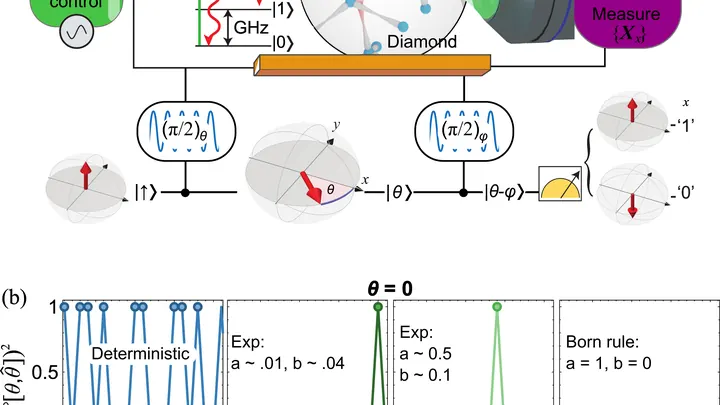
In quantum theory, a particle can run along two paths at once. When measured, we catch it on just one. According to Niels Bohr, all other possibilities vanish instantly — like a branch snapped off a trunk. Yet Hugh Everett insisted: the tree of reality grows all its branches at once, and we only see the one we’re on.
A coin toss seems random, but in reality, physics decides everything: the force of the throw, air resistance, the surface's elasticity. If you knew all the details, you could predict the outcome. True randomness lives deeper — in the quantum world.
Two twins look identical, but one is left-handed and the other right-handed. In the world of elementary particles, there are similar pairs: Ξ- and its antiparticle Ξ+. They are born together in the decay of the J/ψ particle and, like entangled twins, maintain a connection even at a distance.
A team assembling a jigsaw puzzle from random pieces: how many simultaneous moves does it take to complete the picture? If the pieces are independent, they all go down at once. If each piece depends on the previous one, you have to work one at a time. So it is with systems: some states assemble instantly, others require a long sequential effort.
Fog thickens over the line "def max(a: Int, b: Int): Int". What does it do? It returns the larger of two numbers, but how can you verify that? You could write a dozen tests with specific pairs: max(2,3)=3, max(5,5)=5, max(-1,0)=0. Still, a nagging doubt remains: what if it breaks for, say, a million and minus a million?