Hormones are biologically active substances produced by endocrine glands and carried via the bloodstream. They act in extremely low concentrations (nanograms per milliliter) and regulate metabolism, growth, reproduction, and mood. They are classified into peptide, steroid, and amino acid derivative hormones, which bind to receptors on the surface or inside target cells.
History
Claude Bernard's experiments (1855) showed that the liver releases glucose into the blood, laying the foundations of endocrinology. In 1901, J. Takamine and J. Abel independently crystallized adrenaline. Frederick Banting and Charles Best isolated insulin in 1921, saving millions of lives. Roger Guillemin and Andrew Schally in the 1970s revealed the structure of hypothalamic releasing hormones.
How it works
Steroid hormones penetrate the plasma membrane and bind to nuclear receptors, regulating gene transcription. Peptide hormones and catecholamines bind to membrane receptors, activating G-proteins or enzymatic cascades, leading to the formation of second messengers (cAMP, IP3, Ca²⁺). This achieves signal amplification: one hormone molecule can trigger the synthesis of thousands of target enzyme molecules. Negative feedback maintains homeostasis: for example, thyroid hormones inhibit thyrotropin production.
In practice
Hormones are used to make insulin for diabetics, birth control pills, and adrenaline to stop anaphylactic shock.
Fun fact
Oxytocin, the 'cuddle hormone', is released in mothers during breastfeeding and in lovers during touch, enhancing feelings of trust.
Picture every blood test as a dot on a large map. Plot thousands of those dots and they won't scatter at random: they line up along two main roads. One road separates men from women, the other stretches from youth to old age. Follow these roads and you can see how a person grows up, lives and grows old.
The liver is an orchestra in which every cell plays its part from a shared score. Males and females have different scores: in males, the genes responsible for detoxifying foreign substances and steroid hormones sound louder, while in females, the genes for fat metabolism and bile acids do.
In the orchestra of the worm Caenorhabditis elegans, which has 302 neurons, the protein NHR-49 was long cast as a conductor who runs nothing but the fat warehouse. But a new experiment shows that this conductor can walk onstage without a fat score in hand.
A protein is like a tiny machine that switches on and off on command. The command arrives when another molecule sticks to it, like a key in a lock. The protein then changes shape and passes the signal along. But exactly how the signal travels inside the protein has long been a mystery.
Inside every cell, logistics is in full swing: tiny protein motors, like couriers, haul cargo along a network of microtubules. One of the main workhorses is kinesin, which steps using the energy of ATP (the cell's main energy currency). For a long time, researchers tried to evaluate it like a car: how much fuel it burns, how fast it gets there.
The cells of an organism are like twin chefs sharing a kitchen. They have the same cookbook (DNA), but when copying the recipe to a cheat sheet and assembling the dish, random errors occur. This unpredictability, entropy, means that in identical cells, protein levels are sometimes high, sometimes low.
Inside each of us, invisible clocks are ticking. They control the release of cortisol — the hormone that helps us wake up in the morning, cope with anxiety, and keep our immune system on its toes. In adrenal insufficiency, these clocks break down: the body can't produce the right amount of cortisol on its own.
In embryonic development, a cell resembles a musician in a vast orchestra: it must play its part, following a conductor — the gradient of signaling molecules. But the conductor is unreliable: morphogen concentrations constantly fluctuate. How then does a cellist not veer into a violin melody?
You buy a new kitchen scale, but instead of exact weight, it only shows deviations from some "norm." To find out how much an apple weighs, you first have to weigh dozens of other apples and calculate the average.
An orchestra plays without a conductor. Each musician has a score: that's the genes. But the volume and tempo depend on the acoustics of the hall, the mood, and the neighbors on stage. That's roughly how heredity and daily life together shape a teenager's behavior.
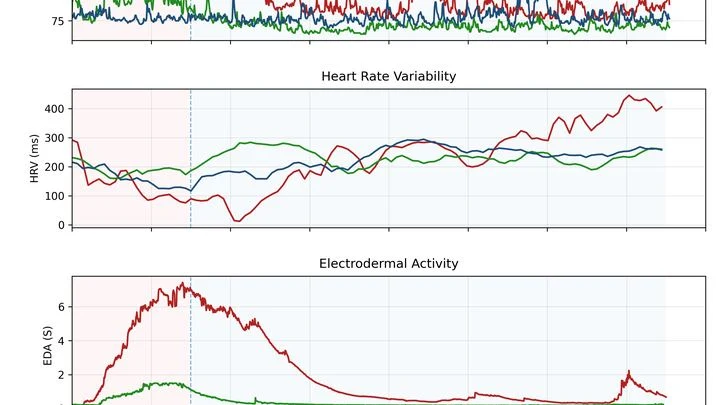
Six adults came to the lab on three consecutive days. On one day they simply rested, on another they pedaled a bike to exhaustion, and on the third they went through an ordeal that makes the heart race without a single movement: they had to give a speech and solve problems in front of a stern committee.
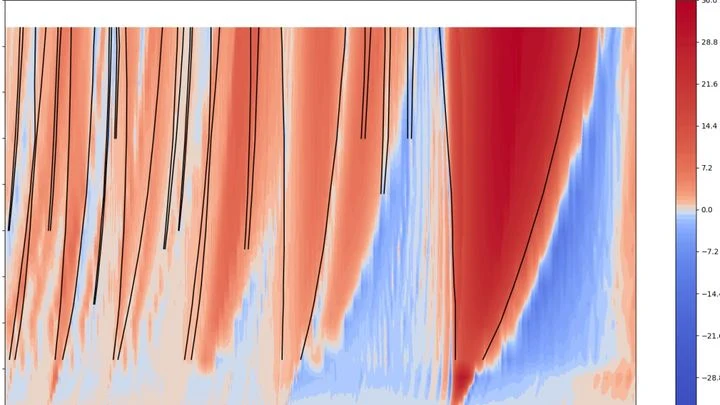
Each breath slightly speeds up the heart, and each exhale slows it down. This rhythm, visible on an ECG, is called respiratory sinus arrhythmia. For a long time, it was dismissed as a mere side effect of the nervous system. But new research shows that this coordination is not a coincidence: it's a way to save energy.
A child's heart, even before birth, already listens to chemical signals from the mother. When mothers are given the hormonal drug betamethasone to help the fetus's lungs mature early, this signal can leave a lasting mark on the heart rhythm for years to come.
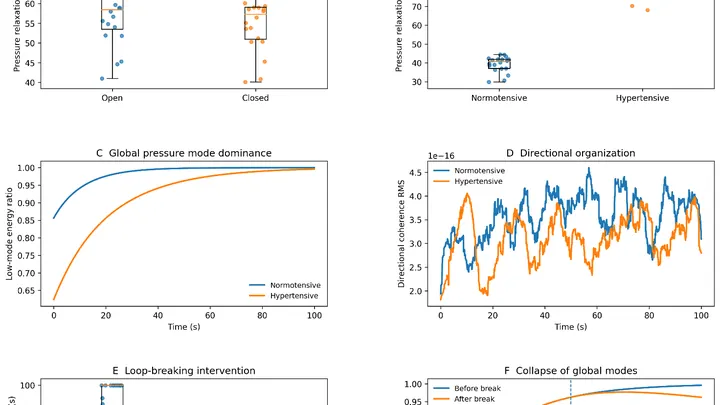
Water in a circular hose, pumped around by a pump, won't stop even if you pinch one section: the flow finds a detour and keeps going around. That's roughly how some parts of our circulatory system are arranged — not as single pipes but as closed loops.
Scientists built a computer model of blood flow and compared two scenarios: an open vessel and a closed loop.