Variability in astronomy refers to the observed change in brightness or flux of a celestial object over time. This can range from periodic pulsations of stars, like Cepheid variables, to erratic flares from active galactic nuclei, and even to the subtle flickering caused by exoplanets transiting their host star. The study of variability is fundamental because it provides a dynamic view of the universe, revealing processes that are otherwise hidden in static snapshots.
History
The first recordedvariable star, Mira, was identified in the 16th century by David Fabricius. The systematic study of variable stars began in earnest in the 19th century with the advent of photography, allowing for the detection and classification of thousands of such objects.
How it works
The mechanisms behind variability are diverse. Intrinsic variability arises from changes within the source itself, such as stellar pulsations, eruptions, or the accretion of matter onto a compact object. Extrinsic variability is caused by external factors, like the eclipse of a star by a companion or the gravitational lensing of light by an intervening mass. By measuring the amplitude, period, and wavelength dependence of the variability, astronomers can infer physical properties like the size, mass, and energy output of the source.
In practice
Variable stars, particularly Cepheids and RR Lyrae stars, serve as standard candles for measuring cosmic distances, which is essential for determining the scale and expansion rate of the universe.
Fun fact
The brightness of the Sun varies by only about 0.1% over its 11-year solar cycle, making it an exceptionally stable star compared to many of its variable counterparts.
In active galactic nuclei, supermassive black holes are surrounded by a dense ring of dust that acts like a curtain: it hides everything happening at the center. If a star ventures too close to the black hole, tidal forces tear it apart, and the resulting flare is usually visible in optical and X-ray light.
In a binary star system, one star pulls matter from its companion. Over centuries, this material settles onto the surface of a neutron star — the ultra-dense remnant of a dead star. This process, called accretion, usually proceeds smoothly. Gravity behaves as general relativity predicts, without surprises.
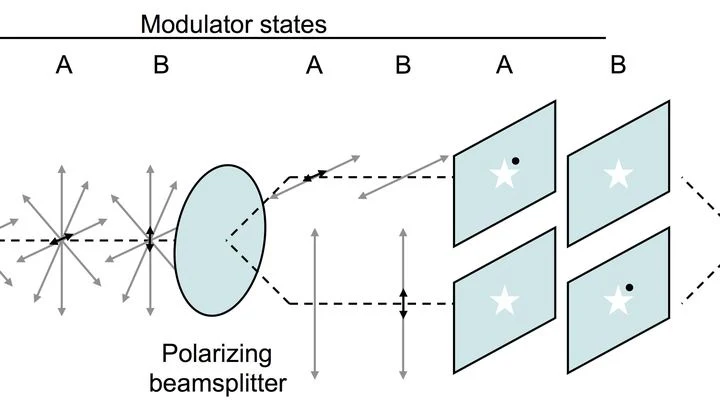
Night on La Palma. The 4.2-meter William Herschel Telescope is aimed at Venus. At the focus is the experimental polarimeter ExPo, designed to catch the ghostly light of exoplanets.
It is commonly believed that a black hole is a merciless cosmic vacuum cleaner, sucking in everything indiscriminately. But new research flips the picture: right at the horizon, curvature transforms from a trap into a trampoline.
A string sounds perfectly pure until a draft touches it. That's roughly how a superradiant laser works: a beam of atoms, pre-charged with energy, flies through a room made of two mirrors — an optical resonator (a trap where light bounces back and forth).
The early universe underwent a rapid expansion — inflation. In a tiny fraction of a second, minuscule quantum jitters were stretched to galactic scales and became the seeds of all large-scale structure.
A candle flame in a draft dances: now it flares up, now it almost goes out. Quasars behave much the same way — supermassive black holes in the centers of distant galaxies, surrounded by a scorching disk of infalling matter. Only they flicker not over seconds, but over months and years.
A lighthouse blinks every few seconds, but then begins to slowly brighten and dim over the course of a year. That is exactly what about a third of red giants do — huge stars in the late stages of life. Their normal pulsations take days or weeks, but on top of that, long secondary periods are visible: months and years.
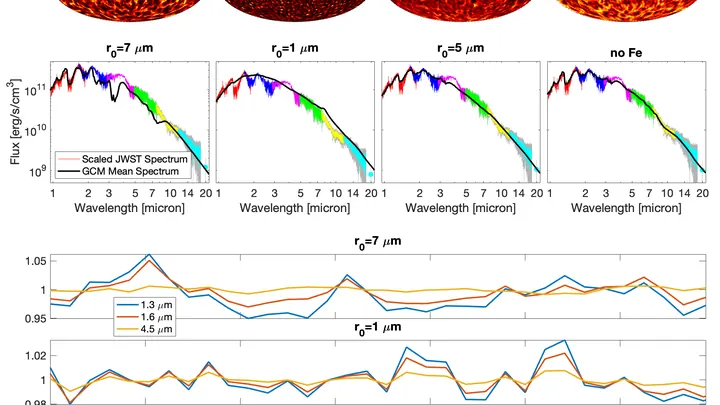
Far beyond the Solar System, a world called VHS 1256B wanders — a giant planet without a star. For a long time, astronomers couldn’t figure out why its brightness jumped by nearly 40% in just a few days. The answer came with the James Webb telescope: it turns out, colossal storms of silicate dust engulf the entire planet.
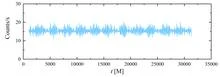
In 2019, the Event Horizon Telescope gave humanity the first image of a black hole's shadow. Since then, astrophysicists have dreamed of more: seeing how matter moves in the very funnel of spacetime. One of the mysteries is chaos.